Economics of Battery Energy Storage Systems (BESS)
Stationary large-scale storage (Battery Energy Storage Systems, BESS) is economically viable when it uses several revenue streams simultaneously — so-called multi-use strategies. This article summarises the most important economic metrics: investment costs, revenue sources, market environment and a return classification. All figures are guide values based on public sources, not investment advice.
Investment costs (capex)
The system costs for LFP large-scale storage (lithium iron phosphate) including inverter, transformer, climate control and assembly are around 180–260 €/kWh in 2025 (investinzukunft.de 2025).
For context: in 2015 the system costs were still above 1,200 €/kWh. The cost reduction of around 80% in ten years is primarily attributable to falling cell prices, economies of scale in manufacturing and standardised container designs. In 2025 the total system costs are around 400 €/kWh including all ancillary costs (grid connection, permitting, project development) (investinzukunft.de 2025).
Revenue models: multi-use as standard
Standalone storage systems today market in parallel across several markets. The gross revenue structure of a multi-use storage system is around 163 €/kW per year (ohana-invest.de 2025). The distribution across individual revenue sources is shown in the following table.
Revenue sources at a glance
| Revenue source | Share | Description |
|---|---|---|
| aFRR (secondary balancing reserve) | 34% | Automatic frequency restoration reserve — dominant revenue driver for large-scale storage |
| Arbitrage (day-ahead) | 32% | Buying at low-price periods, selling at high-price periods on the spot market |
| FCR (primary balancing reserve) | 14% | Frequency containment — market increasingly saturated, prices declining |
| Intraday trading | 13% | Short-term trading on the intraday market (15-minute contracts) |
| mFRR (minute reserve) | 4% | Manually activated frequency restoration reserve |
| Negative-price strategies | 3% | Targeted charging at negative electricity prices |
Source: ohana-invest.de. Shares rounded. The dominant single driver aFRR accounts, according to regelleistung-online.de, for about 63% of the revenue of large storage systems (with purely balancing-energy-focused marketing).
Market environment 2025/2026
The price environment for battery storage has normalised compared with the record years 2022/2023. Key trends:
- Negative electricity prices are increasing: in 2025 more than 12% of the hours were in the negative price range — in principle an arbitrage opportunity for storage.
- Revenue potential declining: despite more negative-price hours, the overall revenue potential declined in 2025 compared with 2024, among other things due to lower day-ahead spreads (pv magazine 01/2026).
- FCR market saturated: due to the strong addition of storage, FCR prices have fallen significantly (regelleistung-online.de).
- aFRR remains the driver: the automatic secondary balancing reserve remains the highest-revenue single market, but requires technically demanding prequalification.
Return classification (IRR)
As a guide value for standalone BESS with multi-use marketing, 8–11% IRR before tax is cited (ohana-invest.de 2026). This figure is based on a single source and should be understood as orientation — not a guarantee.
Key factors influencing the actual return:
- Grid connection costs and capacity (often the largest single item after the cells)
- Degradation and warranty conditions of the cells (LFP: typically 70–80% SoH after 15 years)
- Marketing strategy and optimisation software
- Regulatory development (grid fees, balancing-energy market design)
- Financing costs and debt share
Co-location as the economically most attractive entry point
According to market analysis, co-location — that is, building a storage system at the existing grid connection point of a wind or solar park — is in 2026 the economically most attractive entry point for new BESS projects (ohana-invest.de 2026).
Advantages of co-location:
- Shared use of the existing grid connection point — saves connection costs (often six-figure)
- Planning privilege under Section 35(1) No. 8b BauGB with a spatial-functional connection
- Curtailment losses can be absorbed by the storage system
- Synergies in maintenance, access roads and infrastructure
Detailed information on co-location can be found on the page Co-Location with Wind & PV.
Frequently asked questions
What return does a standalone battery storage system achieve?
As a guide value, 8–11% IRR before tax applies for multi-use marketing (arbitrage + balancing energy). The actual return depends strongly on location, grid connection costs, contract terms and market development.
What does a large-scale storage system cost per kWh?
The system costs for LFP large-scale storage including peripherals are 180–260 €/kWh in 2025. In 2015 they were still above 1,200 €/kWh — a decline of about 80% in ten years.
Which revenue source is most important in 2025/2026?
The automatic frequency restoration reserve (aFRR) is the dominant driver with about 63% revenue share. FCR prices, by contrast, have fallen significantly due to market saturation.
Is co-location with PV or wind economically advantageous?
Yes. Co-location enables shared use of the existing grid connection point, saves connection costs and is, according to 2026 market analysis, the economically most attractive entry point for new BESS projects.
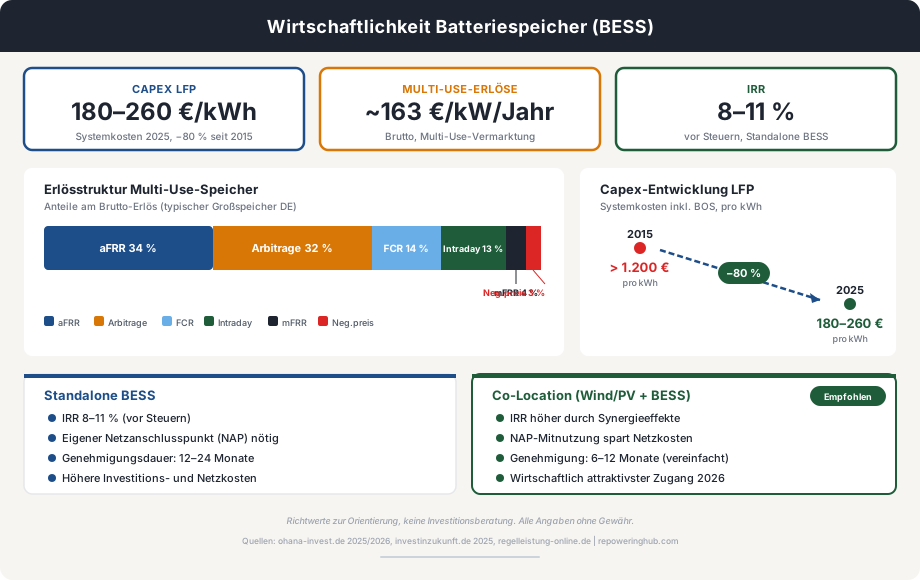
Economics of BESS — capex, revenue structure and return 2025/2026
Economic calculation for your storage project
Are you planning a large-scale storage system and need a project-specific revenue and return calculation? We connect you with specialised engineering firms and marketers.
Submit an enquiry