Permitting Battery Energy Storage Systems (BESS) in Germany
In brief: Stationary large-scale storage systems in Germany generally require no BImSchG permit, but a building permit under the relevant state building code. Since December 2025, BESS are privileged in unzoned areas under certain conditions per Section 35 BauGB — though more narrowly than initially planned. The legal situation changed twice within a few weeks at the end of 2025; developers must plan with caution and up-to-date legal advice.
Building permit instead of BImSchG
Battery storage systems (including lithium-ion large-scale storage in the three-digit MWh range) do not fall under the 4th BImSchV (Ordinance on Installations Requiring a Permit). The permitting requirement therefore arises not from the Federal Immission Control Act, but from the building regulations of the federal states.
In practice this means:
- Responsible authority: the lower building supervisory authority (district / independent city), not the immission control authority.
- Procedure: building permit procedure (sometimes simplified, sometimes regular — depending on size and state building code).
- Concentration effect: unlike a BImSchG procedure, the concentration effect is absent — parallel water-law or nature-conservation permits may be required separately.
Source: Becker Büttner Held, 2025.
Section 35 BauGB: privilege in unzoned areas
The majority of stationary BESS are built in the unzoned outer area (Außenbereich) — where, in principle, only privileged projects are permissible. The question of whether and under what conditions battery storage is privileged was open until the end of 2025 and was settled in a rapid legislative sequence:
Legislative timeline
| Date | Event | Content |
|---|---|---|
| 13.11.2025 | First draft, Bundestag | All storage from 1 MWh privileged in unzoned areas |
| 04.12.2025 | Legislative resolution (final) | Privilege restricted to co-location AND standalone from 4 MW within a 200 m radius |
Sources: energie-experten.org (13.11.2025), CMS (12/2025), Taylor Wessing (12/2025).
Co-location vs. standalone: the two privilege paths
| Criterion | Co-location (Section 35 I No. 11 BauGB) | Standalone (Section 35 I No. 12 BauGB) |
|---|---|---|
| Requirement | Spatial-functional connection to a renewable energy facility (wind, PV) | Capacity of at least 4 MW |
| Location | At the site of the renewable energy facility | Within 200 m of a substation or a facility of 50 MW or more |
| Evidence | Functional connection (shared grid connection, curtailment management) | Proof of proximity to grid infrastructure |
| Typical size | Any size (as long as a functional connection exists) | From 4 MW — smaller standalone projects not privileged |
Further obligations alongside building law
Regardless of whether the building permit is granted via the Section 35 privilege or a development plan, additional permitting obligations exist that — in the absence of the BImSchG concentration effect — must be fulfilled separately:
- Nature conservation: species protection review (saP), possibly EIA screening under the UVPG, intervention/compensation rules. Especially in FFH areas or bird sanctuaries, an FFH compatibility assessment may be required.
- Water law: in flood areas (Section 78 WHG) or water protection areas, additional water-law permits are required. Relevance increases with containers containing coolants.
- Fire safety: fire safety concept, coordination with the local fire brigade, compliance with VdS guidelines and the BVES safety guideline. Details under Battery Storage Fire Safety.
- Immission control (noise): although not a BImSchG procedure, noise emissions (HVAC, inverters) must comply with TA Lärm — the building authority requires a noise immission forecast.
Source: Gleiss Lutz, 2025.
Special cases: when does BImSchG apply after all?
In exceptional cases a battery storage system may fall under the BImSchG:
- Seveso relevance: if the stored energy quantity reaches the thresholds of the Major Accidents Ordinance (12th BImSchV) — for lithium-ion this is currently under technical discussion.
- Thermal post-treatment: facilities with integrated combustion processes (e.g. thermal recovery) may be subject to BImSchG.
In practice this currently affects only very few projects. The vast majority of BESS permits run exclusively via building law.
Frequently asked questions (FAQ)
Do battery storage systems need a BImSchG permit?
Generally no. BESS do not fall under the 4th BImSchV and typically only require a building permit under the state building code. Exception: Seveso-relevant quantities or integrated combustion processes (rare).
Does the privilege apply to all storage sizes?
No. For co-location (Section 35 I No. 11) there is no minimum size, provided a spatial-functional connection to a renewable energy facility exists. Standalone storage (Section 35 I No. 12) must have at least 4 MW capacity and lie within a 200 m radius of a substation or a facility of 50 MW or more.
What happens if my project is not privileged?
Without the privilege, the classic route via a municipal development plan remains. This requires a council resolution, an environmental report and public participation — typical duration: 12–24 months additional.
Since when does the new rule apply?
The legislative resolution was passed on 04.12.2025. An earlier draft of 13.11.2025 had provided for a broader privilege (all storage from 1 MWh), but this was narrowed in the mediation process.
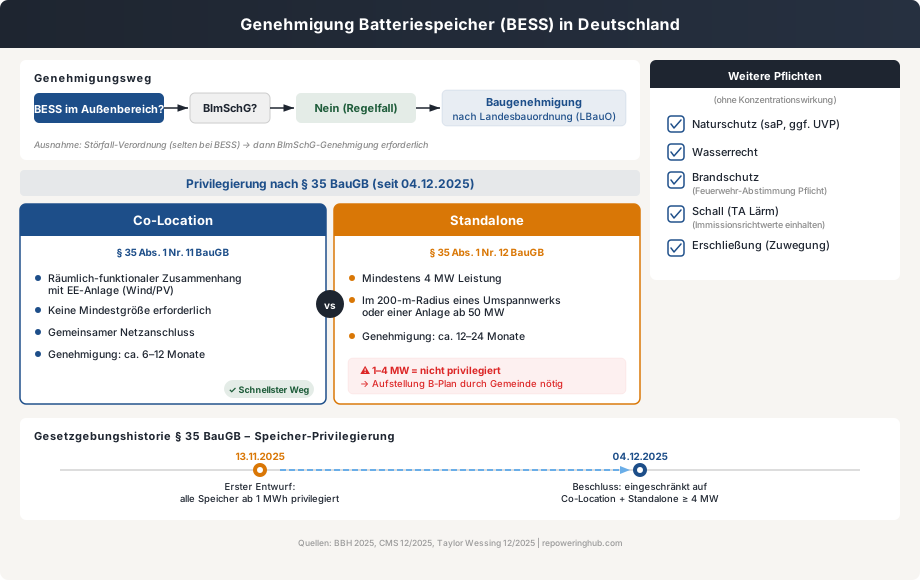
Permitting BESS — decision tree, privilege and obligations
Planning a BESS permit?
Are you planning a battery storage system and need support with the building application, privilege review, fire safety concept or nature conservation report? We connect you with specialised engineering firms and law firms with BESS experience.
Submit a non-binding enquiry