Fire Safety Concept for Wind Turbines
The fire safety concept demonstrates how the fire risk of the turbine is minimised and how personal injury, property damage, and environmental damage are prevented in the event of fire. The key challenge for wind turbines: fire brigades cannot reach a burning nacelle — fire protection must therefore be primarily preventive and designed for self-extinguishing.
Main fire sources in a wind turbine
| Source | Risk | Protective measure |
|---|---|---|
| Generator | Overheating, bearing failure | Temperature monitoring, automatic shutdown |
| Transformer (nacelle or tower base) | Insulation failure, arc flash | Dry-type transformer (instead of oil), fire barrier |
| Hydraulic units | Leakage, spark + oil | Fire barrier, drip trays, leakage sensor |
| Switchgear cabinet | Short circuit, overload | Circuit breakers, residual current protection |
| Brakes (rotor brake) | Frictional heat, sparking | Wear monitoring, protective enclosure |
| Lightning strike | Direct strike damage, rotor blade fire | Lightning conductor system in rotor blade (mandatory), down-conductor rails |
What does the concept contain?
- Risk analysis of all fire sources + probability of occurrence
- Prevention measures: dry-type transformer, fire barriers, temperature monitoring
- Self-extinguishing system in the nacelle (aerosol suppression system such as Stat-X or similar)
- Fire detection system with smoke detectors + transmission to control centre
- Lightning protection concept per IEC 61400-24 (rotor blade conductor, nacelle earthing)
- Emergency shutdown: what happens on fire alarm (rotor standstill, power disconnection)
- Fire brigade plan: access route, parking area, safety distances, communication
- Evacuation of the turbine + safety corridor in case of fire
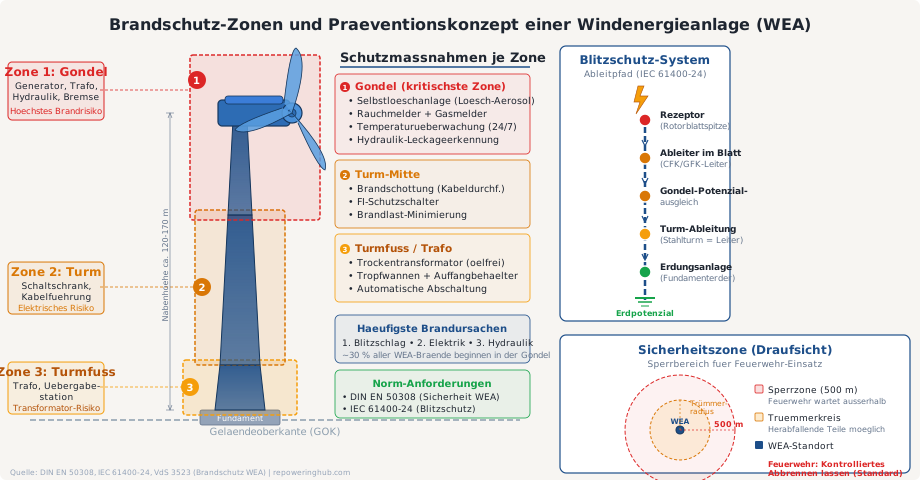
Fire protection zones and protective measures of a wind turbine — from nacelle to tower base
Mandatory self-extinguishing in the nacelle
Required in most federal states (state building code requirements) for turbines whose nacelle fire could trigger fire spread into forest/vegetation. Common systems on the market:
- Aerosol suppression systems (Stat-X, FirePro): chemical aerosol, very compact, no pressure vessel
- Argonite/Inergen systems: inert gas suppression, requires larger tanks
- Water mist systems: rare, due to frost risk
Cost of suppression system: approx. EUR 15,000–30,000 per turbine (capital investment, not the report).
What does the concept cost?
Indicative range: EUR 4,000 – 12,000 for the fire safety concept per wind farm. Factors:
- Number of turbines (degressive pricing)
- Site sensitivity (forest, nature reserve, proximity to urban areas)
- Complexity of the turbine type + suppression system
- On-site fire brigade coordination
In addition: self-extinguishing system investment (EUR 15,000–30,000 per turbine) and possible structural modifications to the tower-base transformer.
Legal basis and regulations
The fire safety concept is not a uniform federal requirement but follows the respective state building code (Landesbauordnung, LBO) and the requirements of the permitting authority in the BImSchG procedure. Whether a standalone concept is required depends on the site — proximity to forest, nature reserves, or dry vegetation raise the requirements. Technically, lightning protection is based on IEC 61400-24, which defines the rotor blade conductor system and earthing concept; for the nacelle self-extinguishing system there is no uniform standard, but manufacturers provide established test certifications. The safety distance to forest is handled at state level and in many places lies around 100 m — there is no fixed nationwide figure; it must be clarified case by case with the local forestry and fire safety authority.
Process of preparing the concept
- Turbine and site analysis: turbine type, transformer position (nacelle or tower base), vegetation and development in the surroundings.
- Risk assessment: classification of fire sources by probability of occurrence and potential extent of damage.
- Measure definition: prevention (dry-type transformer, fire barriers), detection (smoke detectors, connection to control centre), and self-extinguishing.
- Fire brigade coordination: access routes, parking areas, safety corridor and communication channel are agreed with the local fire brigade.
- Documentation: the fire brigade plan and concept become part of the application documents.
Distinction from related reports
The fire safety concept concerns the operationally safe design of the turbine and is therefore related to the structural stability report, which demonstrates the structural integrity of tower and foundation — both belong to the construction and safety-technical part of the application. It should be distinguished from the environmental and nature conservation reports (noise, shadow flicker, species protection), which concern different protected interests. At forest sites, fire safety also touches on matters reviewed by the forestry authority within the BImSchG procedure.
Who prepares this?
Fire protection planners specialising in wind turbines — e.g. the larger TÜV organisations or specialised engineering firms. The fire brigade coordination on-site is part of the concept: access routes, parking areas, emergency communication.
Commission a fire safety concept
We connect you with a fire protection planning firm experienced with wind turbines — including fire brigade coordination and suppression system recommendation.
Request a quoteFrequently asked questions
How often does a wind turbine catch fire?
Rarely — the German Wind Energy Association (BWE) reports approximately 5–10 documented turbine fires per year nationally among approximately 30,000 turbines. Causes are usually generator failure, hydraulic leakage + spark, or lightning strike.
Do older turbines burn more frequently?
Yes — fire incidents correlate with turbine age. Wearing bearings, ageing hydraulics, deteriorating insulation systems. A fire safety upgrade for existing turbines during repowering is often worthwhile.
Is water suppression possible?
Not from nacelle height technically — the largest turntable ladders reach approximately 30 m; a modern turbine has a hub height of 100+ m. Water can only stop fire spread on the ground from outside; it cannot extinguish the nacelle itself.
What happens to the turbine after a nacelle fire?
Typically a total loss — the nacelle + often the upper tower section are replaced. Repair costs are typically EUR 1.5–3 million, making comprehensive machinery breakdown insurance mandatory.
Does the fire safety concept have to be redone for repowering?
Yes, without exception. New turbines have different transformer positions, different suppression technology, and often a different vegetation and development situation in the surroundings than the old turbine — an existing concept from the previous installation can at most serve as a starting point for fire brigade coordination, but it does not replace the renewed turbine-specific risk assessment in the current permitting procedure, since suppression technology and manufacturer requirements have developed considerably between turbine generations. Modern turbines often come with factory-integrated self-extinguishing systems and improved early fire detection, which can simplify the concept in practice — but the site-specific fire brigade coordination always has to be clarified anew.