Structural Stability Report for Wind Turbines
The structural stability report demonstrates through calculation that the turbine can withstand all load effects over its service life — from dead loads through wind and seismic loads to special loads such as icing or malfunction. It is a mandatory component of the BImSchG application and must be confirmed by an independent inspection engineer.
What is verified?
- Load assumptions: Dead load, wind per DIN EN 1991-1-4 + site-specific wind zone, seismic per DIN EN 1998, ice load, snow, temperature
- Turbine structures: Tower (steel, concrete, hybrid), rotor blades, nacelle, bearings, connections
- Foundation: Shallow foundation, pile foundation, or hybrid — design against soil pressure, overturning, ground failure
- Soil mechanics: Geotechnical survey, bearing capacity, settlement, groundwater
- Service-life strength: Fatigue analysis for 20–25 years of operation
- Special loads: Lightning strike, ice imbalance, emergency shutdown
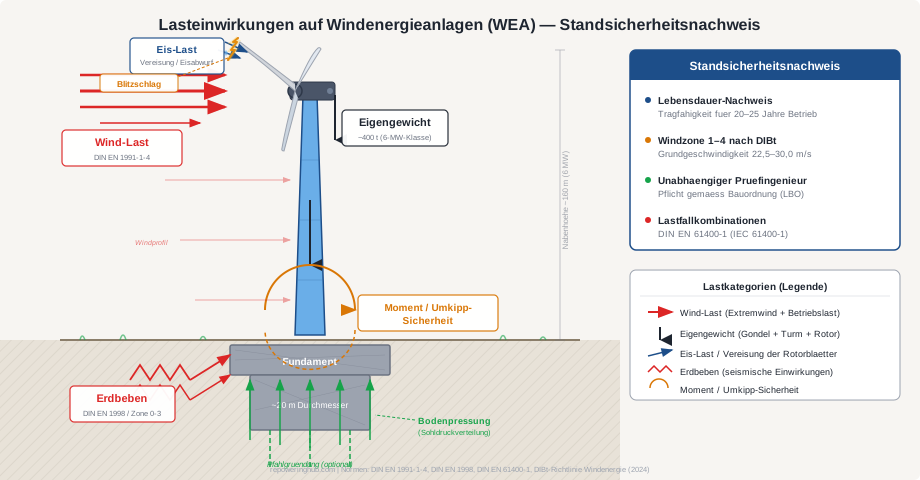
Load effects on a wind turbine — all forces to be verified in the structural stability report
DIBt Guideline as the central basis
The "Guideline for Wind Turbines" issued by the German Institute for Construction Technology (DIBt) consolidates the structural requirements for onshore wind turbines. It references the DIN Eurocodes and adds turbine-specific requirements:
- Load combinations from wind + operation + special cases
- Site wind zones (1–4 per wind map, with topography correction)
- Requirements for the manufacturer's type certification ("type certificate")
- Specifications for anchorage and foundation
Type certificate as simplification
| Component | Verified by | When provided |
|---|---|---|
| Turbine structure (tower, rotor) | Manufacturer, certified by DEWI-OCC, TÜV, DNV | Once per turbine type |
| Foundation + anchorage | Applicant, site-specific | Per project |
| Subsoil | Geotechnical survey, site-specific | Per project |
| Component failure scenarios | Turbine manufacturer | With type certificate |
The manufacturer's type certificate covers the turbine structure — you "only" need to commission the foundation and site-specific report.
What does the report cost?
Indicative range: EUR 10,000 – 35,000 for the site-specific analysis per turbine (foundation + subsoil + site adaptation). Degressive pricing per turbine for wind farm commissions. Factors:
- Number of turbines + subsoil variation at the site
- Foundation type (shallow vs. piled)
- Subsoil complexity (karst, buoyancy, slope)
- Inspection engineer fee (additional, regulated by HOAI/HBVI)
Procedure and duration
The structural stability report is produced in a fixed sequence, because each step builds on the previous one:
- Geotechnical investigation: boreholes, probings, and laboratory tests deliver bearing capacity, soil stratigraphy, and groundwater level (geotechnical survey per DIN EN 1997 / Eurocode 7).
- Adopting load assumptions: the turbine-side tower base loads come from the manufacturer's type certificate and are combined with the site-specific wind, seismic, and special loads.
- Foundation design: verification against soil pressure, overturning, sliding, buoyancy, and ground failure, plus the reinforcement design of the reinforced concrete foundation.
- Review: the independent inspection engineer checks the structural analysis and issues the inspection report — a precondition for approval by the building supervisory authority.
Realistically, the site-specific analysis takes several weeks; the critical path is almost always the upstream geotechnical investigation, not the calculation itself.
Who prepares this?
Structural engineering firms with wind turbine experience — e.g. Nordex Engineering, Wölfel, Ingenieurbüro Burger, or the manufacturers' in-house structural departments. The inspection engineer is commissioned separately — they confirm the report and are approved by the building supervisory authority.
Commission a structural stability report
We connect you with a structural engineering firm experienced in wind turbine statics — including inspection engineer referral if desired.
Request a quoteFrequently asked questions
Is the manufacturer's type certificate sufficient?
No — the type certificate covers only the turbine structure (tower, rotor, nacelle). The foundation + site-specific adaptation must be calculated on a site-specific basis, because every site has different subsoil conditions.
What does the building supervision cost?
In addition to the structural stability report, construction supervision inspection fees apply — typically 0.5–1.5% of the construction cost. For a 5 MW turbine with EUR 5 million investment, that means EUR 25,000–75,000 per turbine.
What about the old foundation during repowering?
For repowering, a new foundation is usually built, because the load assumptions for modern turbines far exceed those of the old turbines. Some manufacturers offer adapter foundations for existing turbines — rarely practical.
Who is liable in the event of turbine damage?
The operator (with their insurers). Correct structural analysis + inspection protects against insurance disputes. Archiving all inspection reports for the entire turbine service life is mandatory.
Can the structural stability report be updated for continued operation?
Yes — that is exactly what a separate continued-operation assessment does, when a turbine is to run beyond its originally certified design life. It recalculates the remaining service life based on the actually measured site conditions and operating loads, and adds an on-site inspection of the load-bearing components. The original structural stability report remains the calculation basis but is not replaced — it is extended by the continued-operation review.
What role does turbulence intensity play for the analysis?
Increased turbulence at the site — from forest edges, complex terrain, or wake effects from neighbouring turbines in the wind farm — raises fatigue loads on the tower, rotor blades, and drivetrain beyond the pure wind-speed loads. If turbulence turns out higher than the standard type class assumes, the structural stability report must factor in this additional load separately; where in doubt, the upstream site assessment supplies the decisive input data for this — which is why, in practice, the two reports are commissioned in close coordination. If the site assessment is only completed after the first foundation design, the structural stability report must be revised afterwards where results diverge — an avoidable loss of time that a coordinated commission sidesteps from the outset and that quickly shows up in the project schedule.