Ice Throw Report for Wind Turbines
The ice throw report (Eisfallgutachten) assesses whether ice accretion on rotor blades during winter could endanger persons or traffic routes in the vicinity of the turbine. It is required whenever sensitive objects (residential buildings, roads, hiking/cycling paths) lie within the throw range.
What does it contain?
- Site risk analysis: icing frequency based on climate data (DWD), elevation, terrain class
- Throw range calculation per BWE rule-of-thumb formulas (Seifert): standstill 1.5 × (D + H), rotation additionally + Vtip
- Cartographic representation of the throw range with all sensitive objects in the vicinity
- Hazard assessment for traffic routes, residential buildings, and areas where people may be present
- Mitigation concept: ice detection with automatic shutdown, warning signs, path closures
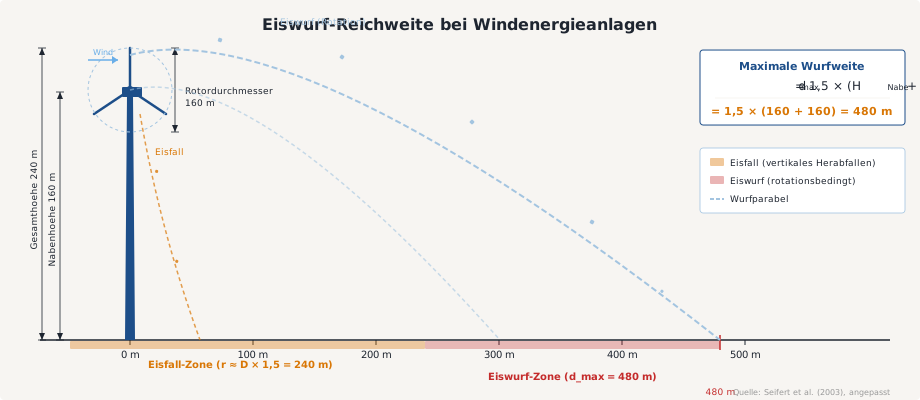
Ice throw range of a WTG — safety distance per Seifert formula (guideline values)
When is the report required?
- Always when traffic routes lie within the throw range (motorway, federal road, railway line)
- Always when residential buildings lie within the standstill throw range
- In most federal states when hiking/cycling paths or main agricultural roads are affected
- At icing-exposed sites (elevation above 600 m a.s.l., mountain ridge locations)
Ice detection — the standard solution
If the rule-of-thumb throw range extends over sensitive objects, a certified ice detection system with automatic shutdown is prescribed. This reduces the decisive safety distance to the standstill value (1.5 × (D + H)).
| Provider | Method | Advantages |
|---|---|---|
| Bofin | Rotor blade vibration analysis | No sensor on the blade required |
| Eologix | Sensor directly on the blade | Direct ice measurement |
| Wölfel iSpin | Combined weather + blade dynamics | Early detection |
What does the report cost?
Guideline value EUR 3,000 – 10,000. For complex path networks and many sensitive objects up to EUR 15,000. Retrofitting an ice detection system costs an additional approx. EUR 8,000–15,000 per turbine (procurement + installation).
Who prepares the report?
Specialised engineering firms for WTG reports (often the same ones that also handle noise and shadow flicker). Certification bodies for ice detection: TÜV Sued, DEWI-OCC, DNV.
The Seifert rule-of-thumb formula in detail
The formula commonly used in Germany goes back to studies by the German Wind Energy Association (BWE) and distinguishes two cases. At standstill, ice that has formed on the rotor blade can simply fall off as it thaws — the safety radius is then 1.5 × (rotor diameter + hub height). During rotating operation, the piece of ice is additionally flung outward by the blade tip speed, which considerably increases the throw range and requires a larger safety distance. This distinction is why ice detection is such an effective protective measure: if the system detects ice accretion, it stops the turbine before it even enters the more critical rotating case — the relevant safety distance then shrinks to the significantly smaller standstill radius.
The formula is deliberately calibrated conservatively and does not account for wind direction or wind speed during the ice fall — it delivers the worst-case radius within which a piece of ice could theoretically land, not a probability distribution. This explains why real-world incidents within the calculated radius occur far less often than the sheer area size would suggest.
Regional risk classification
Not every site carries the same icing risk. The site risk analysis is based on long-term climate data from the German Weather Service (DWD) — frost days, humidity, and fog frequency during the winter half-year determine how often ice accretion on the rotor blades is to be expected in the first place. Inland mountain locations above roughly 600 m a.s.l. are considered particularly exposed due to more frequent fog and hoarfrost formation; northern German lowland sites are typically affected considerably less often. This classification feeds directly into the question of whether a pure rule-of-thumb assessment is sufficient or whether the authority additionally requires ice detection as a condition.
Request an ice throw report
We connect you with an engineering firm specialised in icing-exposed sites — including assessment of ice detection as a mitigation measure.
Request a quoteFrequently asked questions
How often do ice fall incidents occur in Germany?
Statistically very rarely — fewer than a dozen documented incidents with personal injury or property damage in the last 15 years. The rule-of-thumb formulas are intentionally designed to be conservative.
Can I retrofit ice detection?
Yes — all major manufacturers offer retrofit modules. Cost approx. EUR 8,000–15,000 per turbine. This often allows a planned standstill condition (e.g. December–February) to be replaced — the yield savings can pay back the investment in 1–2 years.
Do I need the report for repowering?
Yes — repowering also requires a new assessment because the new turbines are usually larger and therefore have different throw ranges. For 1:1 repowering (same turbine types, same locations), a simplified process is sometimes possible.
Can the online calculator do this?
The calculator provides the rule-of-thumb throw range for a single turbine. An official report must additionally assess site climate, topography, and the specific locations of all sensitive objects — which the online calculator cannot do.
Is winter operation fully shut down when there is icing risk?
Only if no other mitigation measure is possible — that is the exception, not the rule. Much more common are time- and weather-dependent standstill conditions that only kick in when ice accretion is actually detected, or an automatic ice detection system that stops the turbine only for the duration of the icing and then restarts it automatically. A complete winter shutdown lasting several months would considerably impair the turbine's economics and is therefore only considered at particularly exposed individual sites.
Does the ice throw report have to be redone for repowering?
Yes. Larger rotor blades and higher hub heights considerably increase both the standstill and the rotational throw range compared with the old turbine, so the affected sensitive objects in the surroundings can shift. Carrying over the old calculation is not technically defensible; only the site's climate data and already existing mapping of paths and development can be reused as a starting point, which usually shortens the processing time noticeably compared with a first-time commission. At the same time, repowering often makes it worthwhile to reassess an existing ice detection system: if a working system is already installed at the site, it can be checked whether it can be technically transferred to the new, larger turbine configuration, or at least used as a reference for designing the new system.