BImSchG Procedure for Wind Turbines
Every wind turbine with a total height exceeding 50 m requires an immission control permit under the 4th BImSchV (Annex 1 Nr. 1.6). Which procedure applies depends on the number of turbines at the site.
§ 19 — Simplified Procedure (Column V)
For 1–19 WTGs with total height > 50 m at the same site.
- Permit deadline: 3 months from complete application
- Public participation: none
- Hearing: none
- EIA: site-specific screening (S) for 3–5 WTGs, general screening (A) for 6–19
- Required documents: noise prognosis, shadow flicker, structural safety, species protection screening, LBP, ice throw (if applicable), visualization (if applicable)
- Real timeline: 4–8 months (including expert reports and authority communication)
§ 10 — Formal Procedure (Column G)
For 20 or more WTGs at the site — or voluntarily when a full EIA is required.
- Permit deadline: 7 months from complete application (real timeline often 12–24 months)
- Public participation: yes, with public display and objection period
- Hearing: usually yes
- EIA: full EIA per UVPG with environmental impact study (UVS)
- Required documents: all reports from the simplified procedure + UVS + FFH assessment + extended LBP + specialist reports where applicable
- Real timeline: 18–36 months
Comparison at a Glance
| Aspect | § 19 simplified | § 10 formal |
|---|---|---|
| Number of WTGs | 1–19 | 20+ |
| Permit deadline | 3 months | 7 months |
| Real timeline | 4–8 months | 18–36 months |
| Public participation | no | yes |
| Hearing | no | yes |
| EIA | S or A screening | full EIA |
| FFH assessment | only near protected areas | regularly required |
| Litigation risk | low | higher (BUND/NABU/residents) |
Required Application Documents
- Turbine master data (type, height, capacity, manufacturer certificates)
- Site plan + layout plan + land registry extracts
- Acoustic emission prognosis + noise protection report
- Shadow flicker report
- Species protection assessment with avifaunal and bat surveys
- Landscape management plan (LBP)
- Visual impact assessment (photo-montages from 6–12 representative viewpoints)
- Ice throw report where traffic routes/residential buildings lie within throw range
- Structural stability report
- Fire safety concept
- Formal procedure only: environmental impact study (UVS)
- Near protected areas: FFH compatibility assessment
Who Decides?
The competent authority varies by federal state:
- Bavaria: Landratsamt (district office) / independent city
- NRW: Bezirksregierung (district government — Düsseldorf, Münster, Cologne, Detmold, Arnsberg)
- Lower Saxony: Landkreis (county) — Staatliches Gewerbeaufsichtsamt (state trade supervisory office) co-reviews
- Baden-Württemberg: Landratsamt
- Schleswig-Holstein: LLUR (State Agency for Agriculture, Environment and Rural Areas)
- Brandenburg: LfU (State Environment Agency)
- ...varies by federal state
Stakeholders in the Procedure
Besides the permitting authority leading the procedure, nearly every BImSchG process involves other agencies whose opinions shape the conditions that end up in the final permit:
- Lower nature conservation authority: reviews species protection and the compensation regulation, often the most critical office in the whole procedure.
- Immission control authority / trade supervisory office: assesses the noise and shadow flicker reports on technical merit.
- Aviation authority: checks height restrictions and marking obligations near airfields and low-flying routes.
- Heritage protection authority: where sightlines to listed buildings or archaeological monuments are affected.
- Road authority: where access crosses, or setbacks apply to, classified roads.
- Water authority: where watercourses or water protection zones are affected.
Each of these specialist authorities has its own, often statutorily defined, deadline to respond. If a single opinion is delayed, the whole procedure usually slips — one reason the real processing times regularly exceed the statutory target deadlines.
After the Permit: Ancillary Provisions
The permit decision almost always comes with ancillary provisions — conditions under which the permit is granted. Typical examples are operating-time restrictions (night curtailment for noise or bat protection), a bird-collision monitoring program during the first year of operation, the obligation to post a decommissioning bond, and requirements for ecological site supervision during construction. These conditions are legally binding; failing to comply can lead to revocation of the permit and should therefore already be factored into the project's financial model.
Critical Path
In most projects the bottleneck is not the authority but the species protection assessment — breeding bird surveys run March–August, bat surveys April–October, often spanning two full seasons. Plan this early.
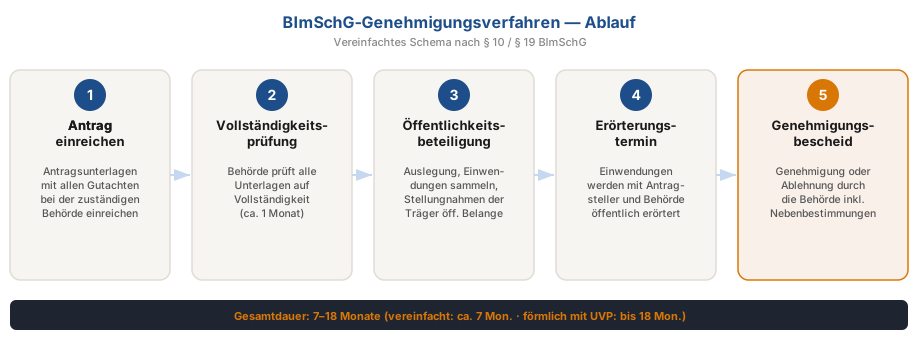
BImSchG procedure for wind turbines — Simplified (§ 19) vs. Formal (§ 10) overview
Application planning for your wind farm?
We connect you with a specialist firm experienced in BImSchG permitting in your federal state — site selection, commissioning of expert reports, application documents, authority communication, hearings.
Get in touchFrequently Asked Questions
What if the authority misses the deadline?
The deadline per § 10 Abs. 6a / § 19 BImSchG is a "should" deadline (Soll-Frist). If it is exceeded, the applicant can file an inaction lawsuit (Untätigkeitsklage, § 75 VwGO) — after 3 months without justification. In practice, delays are common and lawsuits are rare.
Can a simplified procedure be upgraded to formal?
Yes — if an EIA obligation is established during the procedure, or if the applicant voluntarily opts for public participation (e.g. to increase legal certainty). Also, if 20 WTGs are applied for in a "staggered" fashion, the authority may treat all applications as a single formal procedure.
How high is the fee?
Varies significantly between federal states: in the range of 0.5–2 % of the investment sum, typically EUR 10,000–50,000 per turbine in the formal procedure, significantly less in the simplified procedure. Plus expert report costs (separate).
Repowering — simplified or formal procedure?
The same logic as a new build applies: the number of new WTGs plus protected area status determine the track. For 1:1 repowering (same location, same number of turbines), the WaLG (2022) provides procedural simplifications — some expert reports can be carried over from the existing permit, public participation may be shortened.
Does decommissioning the old turbine run within the same procedure?
Usually not. Decommissioning the old turbine is already part of its original permit (decommissioning obligation under § 35 para. 5 BauGB) and is handled separately — typically staggered against the new build so the site keeps generating power for as much of the transition as possible.
What does the full set of expert reports typically cost?
For a simplified procedure with a small number of turbines, the combined cost of noise, shadow, species protection, structural stability, and visual impact reports typically falls in the mid five-figure to low six-figure range; for a formal procedure with a full EIA, the considerably more expensive environmental impact study and extended specialist reports come on top. A reliable figure only comes from an actual quote from the commissioned firms — flat total sums without site knowledge are not credible.