Agri-PV — Power & Farming on the Same Land
In brief: Agri-PV (agrivoltaics) describes solar installations under which the land continues to be used for agriculture — as arable farming, specialty crops (berries, hops) or grassland. Under the EEG 2024 (Renewable Energy Sources Act), agri-PV installations are classified as "special solar installations" and receive 9.36 ct/kWh (6.86 base + 2.50 bonus). Installations under 1 MWp are eligible for support without going through the auction.
The EEG Tariff in Detail
| Category | Tariff / Mechanism |
|---|---|
| Agri-PV < 1 MWp | 9.36 ct/kWh (6.86 base + 2.50 bonus), fixed for 20 years, no auction |
| Agri-PV > 1 MWp | Sub-segment "special solar installations" in the PV auction, ceiling price 9.50 ct/kWh |
| Innovation auction | Ceiling price 9.00 ct/kWh (special segment) |
Sources: agripv-solutions.com, top agrar / BNetzA (Federal Network Agency). The preferential treatment is expressly welcomed by the German Farmers' Association (DBV) and by Fraunhofer ISE (DBV position paper).
Construction Types
- Elevated mounting ("Category I"): modules ≥ 2.10 m above the ground — keeps the land accessible to farm machinery, suited to specialty crops.
- Ground-level rows with wide spacing ("Category II"): conventional mounting, but with rows spaced widely enough that agricultural use remains permanently possible (arable farming, grassland).
- Vertical bifacial rows: modules mounted vertically (east-west orientation), with the full usable area between the rows — popular on arable land.
- Tracker installations over specialty crops: tracking modules on high mounting structures.
What Agri-PV Offers Over Standard Ground-Mounted PV
- Land potential: dual use unlocks agricultural land that would be socially or politically hard to win over for conventional ground-mounted PV.
- Crop protection: the modules act as protection against hail, sun and evaporation — relevant for fruit, wine and sensitive specialty crops.
- Double revenue from the land: electricity + the agricultural product.
- EU agricultural subsidies remain possible with the right design — the land still counts as agricultural utilized area.
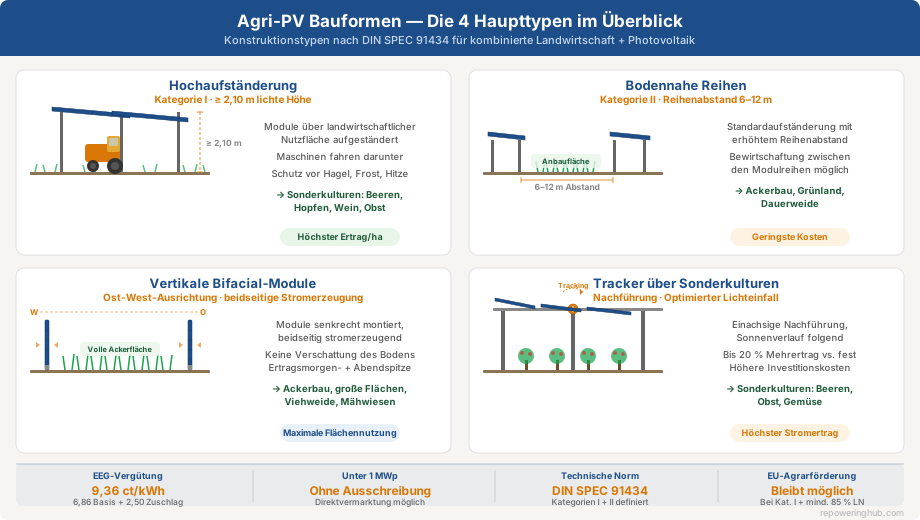
4 agri-PV construction types — from elevated mounting to trackers, all to DIN SPEC 91434
DIN SPEC 91434 — What the Standard Actually Requires
DIN SPEC 91434 ("Agrivoltaic systems — Requirements for the primary agricultural use") is the technical reference standard the EEG 2024 points to when defining "special solar installations". It distinguishes the two construction categories above (I: elevated mounting, II: ground-level with row spacing) and sets minimum requirements for both:
- Agricultural use must remain the primary use. The standard requires that at least 66% of the area stays workable for farming (near 100% for Category I in most cases; for Category II it depends on row spacing).
- Proof of harvest yield. The operator must document that farming is actually taking place on the land — grazing with a token number of animals is not enough.
- Access for machinery. Under Category I, standard farm equipment (a tractor with an attachment) must be able to pass beneath the module rows — this is where the roughly 2.10 m clearance height comes from.
- Certification by an accredited body. Without a DIN SPEC 91434 certificate from an accredited assessor, the Federal Network Agency (Bundesnetzagentur) will not recognize the installation as a "special solar installation" — it then falls back to the standard ground-mounted PV tariff.
The certificate is a support precondition, not a bonus extra: without DIN SPEC 91434 proof, there is no 2.50 ct/kWh bonus (source: top agrar / BNetzA).
Agricultural Use Under the Modules
Which use fits depends on the construction type:
- Arable farming (grain, potatoes, maize): needs continuous access for harvesting machinery — works mainly with Category I (elevated mounting) or vertical bifacial rows with enough row spacing for combine-harvester cutting widths.
- Specialty crops (berries, wine, hops): historically the first agri-PV application in Germany, because the modules simultaneously act as hail and sun protection — the added benefit offsets part of the extra cost compared with separate hail nets.
- Grassland and grazing (sheep, sometimes cattle): works under ground-level mounting (Category II), as long as fencing and water troughs don't damage the module rows. Sheep grazing is also often used as vegetation management for the installation itself, partly replacing mechanical mowing under the modules.
- Vegetable growing: possible, but more demanding for cable routing because of frequent soil cultivation (ploughing, tilling) — underground cables need to be laid deeper than under permanent crops or grassland.
Land Efficiency: Land Equivalent Ratio
The internationally used metric for dual use is the Land Equivalent Ratio (LER): the sum of (crop yield under agri-PV ÷ crop yield without PV) and (electricity yield of the area ÷ reference electricity yield of a comparable ground-mounted PV installation without agricultural constraints). An LER above 1.0 means dual use generates more total benefit per hectare than separate areas for farming and PV. In field trials (the APV-Resola project in Hettingen), Fraunhofer ISE measured LER values well above 1.0 for potatoes, celery and wheat under agri-PV, alongside a 15–20% lower crop yield for the arable crop itself compared with the undisturbed reference area (source: Fraunhofer ISE). The yield reduction varies strongly by crop, module arrangement and shading level — there are no blanket percentage figures that apply across all crops.
Technical Challenges
- Shading and light distribution: depending on row spacing and orientation, a shading pattern emerges that shifts over the course of the day. Light-hungry crops (grain, maize) react more sensitively to shading than shade-tolerant crops (certain berry varieties, lettuce).
- Ground pressure from foundations: the supports for elevated mounting must be placed and founded so they don't obstruct farm machinery and don't cause lasting soil compaction along the tramlines — this limits the permissible foundation grid.
- Maintenance access: cleaning and repairing the modules must be scheduled so it doesn't clash with the agricultural work windows (sowing, harvest) — in practice a planning issue between the installation operator and the farmer, especially when the two roles are held by different parties.
- Cable routing in the ground: buried cables need to sit below the usual tillage depth — for deep ploughing or drainage work, this is extra planning effort compared with standard ground-mounted PV on grassland.
- Statics for elevated mounting: greater structure height means higher wind loads on the support frame — the structural stability assessment is correspondingly more involved than for low-mounted standard ground-mounted PV.
Economics in Comparison
The higher tariff (9.36 ct/kWh) partly offsets the added cost of the mounting structure and statics. Pure economics versus standard ground-mounted PV (4–6 ct/kWh from the auction) depend on the installation type, the crop and the specific cost situation. As a rough rule: Category I (elevated mounting) has the highest investment cost per installed MWp but also the smallest loss of agricultural yield; Category II (ground-level) is cheaper to build but restricts crop choice more. For a rough orientation: LCOE calculator.
Permitting and Site Acquisition for Agri-PV
The permitting procedure for agri-PV runs through the same channels as standard ground-mounted solar — see Permitting for Ground-Mounted Solar for details. One difference concerns the zoning framework under § 35 of the Federal Building Code (BauGB): because the land remains primarily agricultural, agri-PV projects can sometimes be integrated into the land-use plan more easily than pure ground-mounted PV on arable land in some federal states, since the intervention in land use is assessed as smaller. This does not replace the regular BImSchG/BauGB procedure, however. In land lease arrangements, a clear contractual separation between the lessor (farmer) and the installation operator is advisable when the two roles aren't held by the same party — particularly to settle maintenance access and liability for crop damage caused by the installation.
Frequently Asked Questions
Do I lose EU direct payments if I install agri-PV?
With the correct design as "agricultural utilized area under agri-PV", direct payments are retained — the precondition is continued agricultural use with demonstrable yield. The details are a matter of agricultural policy and vary by federal state — this is a topic for a tax or agricultural advisor.
Who builds and operates agri-PV in Germany?
Specialized developers with an agricultural background, alongside a few large ground-mounted PV developers with their own agri-PV division. We can broker contacts on request.
What does agri-PV cost compared to standard ground-mounted PV?
Investment costs per MWp are typically above standard ground-mounted PV due to the higher mounting structure and statics. The exact extra-cost ratio varies widely — a reliable figure can only be given on a project-specific basis.
Which crop is the easiest starting point?
Grassland with sheep grazing is generally seen as the simplest entry from a planning perspective, because Category II (ground-level mounting) is sufficient and no harvesting-machine access needs to be guaranteed. Arable farming under elevated mounting is technically more demanding but offers more long-term flexibility in crop choice.
Does agri-PV make economic sense without EEG support?
For specialty crops with high hail risk (wine, berries), agri-PV can pay off through the avoided cost of hail nets and protective measures plus self-consumption, independent of the EEG tariff. For arable farming without a specialty-crop protection benefit, the EEG tariff is in practice the deciding economic factor.
Planning an agri-PV project?
We connect operators and project developers with specialized agri-PV planners. Tell us about your site and we will broker the right contact.