What Is Ground-Mounted Photovoltaics?
In short: Ground-mounted photovoltaics (GMPV) refers to large-scale solar plants built on level land in the outlying area (Außenbereich, the undeveloped open countryside) — typically as a solar park with capacities ranging from a few hundred kWp well into the high MWp range. It is the fastest-growing segment of German PV — under the EEG (Renewable Energy Sources Act) deployment path, roughly half of the 215 GW of PV targeted by 2030 is to be built on open land.
Definition & classification
| Plant type | What |
|---|---|
| Rooftop PV | Modules on existing buildings (homes, commercial premises, logistics halls) |
| Ground-mounted PV (GMPV) | Modules on purpose-built mounting structures on land in the outlying area (meadow, arable field, conversion site) |
| Agri-PV | Special form of GMPV — modules above land that remains in agricultural use (elevated mounting or vertical rows) |
| Floating PV | GMPV on water bodies (gravel-pit lakes, reservoirs) — a niche in Germany |
Typical plant sizes
- Small parks: 0.5–5 MWp, a few hectares, often with municipal or citizen participation.
- Mid-sized parks: 5–50 MWp, 5–50 hectares — the standard size in the EEG auction range.
- Large parks: > 50 MWp, several hundred hectares — usually outside EEG support as a PPA project (see PPA).
The EEG auctions for ground-mounted solar cover plants from 1 MWp up to 50 MWp. Maximum bid per bidder: 100 MWp per auction round (see EEG auction).
Components of a solar park
- Modules — today predominantly crystalline silicon (mono-Si), efficiencies around 21–23 %, in glass-glass construction for long service life.
- Mounting structure — fixed-tilt or single-axis tracking (trackers), driven-pile or screw foundations.
- Inverters — string or central inverters, distributed across the park.
- Medium-voltage grid connection — transfer station, transformer station, cable routes.
- Optional: battery storage — increasingly used for smoothing and for grid services.
Module technology in detail
Almost all ground-mounted plants built today use monocrystalline silicon (mono-Si, mostly PERC or TOPCon cells). Polycrystalline modules (poly-Si) played a larger role in the ground-mounted market until a few years ago, but are now the exception because of their lower efficiency (roughly 16–18 % versus 21–23 % for mono-Si) — new projects are planned almost exclusively with bifacial mono-Si modules, which also capture diffuse light on the rear side. Depending on mounting angle and ground albedo, bifacial modules increase annual yield by an estimated 3–8 % compared with monofacial modules of the same cell type.
For the mounting structure, a distinction is made between fixed-tilt racking (usually 20–30° tilt, south- or east-west-facing) and single-axis trackers that follow the sun's path through the day. Trackers cost more to buy and maintain (moving parts, greater land demand from larger row spacing to avoid self-shading), but deliver a flatter, longer generation profile over the day — relevant for PPA projects, where a smoother feed-in profile can improve the achievable price.
For inverters, two concepts compete: string inverters (smaller units distributed across the field, one per module-string group) and central inverters (a few large units per transformer station). String inverters are considered more redundant — if one fails, only a small section of the field is affected — and make string-level monitoring easier; central inverters can be more economical to buy and maintain in very large parks. The choice depends on park size, layout and operator preference and is settled in detailed engineering, not prescribed across the board.
How long does a ground-mounted plant run?
The technical design is based on 25–30 years of operation — the same period for which module manufacturers usually issue a performance warranty (often at least 80 % of nominal output after 25 years). In practice, a well-maintained module often lasts longer, with an annual power degradation of roughly 0.3–0.5 % (an estimate, depending on cell type and manufacturer). Inverters have a shorter technical lifespan and, depending on the design, are usually replaced once during the plant's operating life. Once the 20-year EEG support period (plus commissioning year) ends, a plant continues either under a PPA model or as a so-called post-EEG plant — repowering with new, higher-output modules is technically possible for ground-mounted PV, but so far a less common topic than for wind turbines, because PV modules stay usable longer than wind-turbine components.
Role in the power mix and the energy transition
Alongside onshore wind, ground-mounted solar is the main pillar of German solar build-out, because compared with rooftop PV it can be realised much faster and in larger capacity units per site — a single project can deliver as much output as thousands of rooftop systems combined. The solar deployment path in the EEG provides for continuous annual build-out, with ground-mounted and rooftop PV jointly contributing to the overall PV target (for details and sources on the EEG 2024 target path, see EEG 2024). Without speculating on a specific current figure: ground-mounted solar delivers plannable solar power concentrated in daytime hours and is increasingly combined with battery storage to shift generation peaks in time — a trend visible in the results of recent EEG auction rounds (see EEG auction and Market 2026).
Special forms: agri-PV and floating PV
Two variants depart from the classic solar park on open meadow, but technically and legally still belong to the ground-mounted solar family. Agri-PV keeps agricultural use of the land intact — either through elevated mounting (modules several metres above the ground, with crop farming or grazing underneath) or through vertically mounted, bifacial modules in row spacings that remain farmed in between. It is listed as its own, usually better-remunerated category in the EEG auction (see Agri-PV). Floating PV — modules on floating pontoons on gravel-pit lakes or reservoirs — remains a niche in Germany, partly because of nature-conservation restrictions on many water bodies and a limited supply of suitable water surfaces; internationally, for example in the Netherlands and parts of Asia, the technology is more widespread.
From first conversation to grid connection — the rough sequence
A solar-park project typically goes through several phases spread over several years: identifying and securing the site through a lease agreement (see Land lease), inclusion in the municipal land-use plan or proof of statutory privilege, environmental and species-protection assessments, the actual permitting procedure (see Permitting), securing the grid-connection point with the distribution system operator (see Grid connection), financing and construction, and finally commissioning with an EEG award or a PPA contract. Each phase carries its own risks and lead times — the individual detail pages in this cluster describe them step by step. For a rough yield or land-fit calculation for a specific site, the German-language solar-park yield calculator and solar-park land planner are useful starting points.
Land demand — the rule of thumb
Per installed megawatt-peak, a modern park needs about 0.8–1.2 hectares — depending on the module, row spacing and mounting type. A 20-MWp plant therefore occupies roughly 16–24 hectares. Tracker plants require larger row spacing but gain yield.
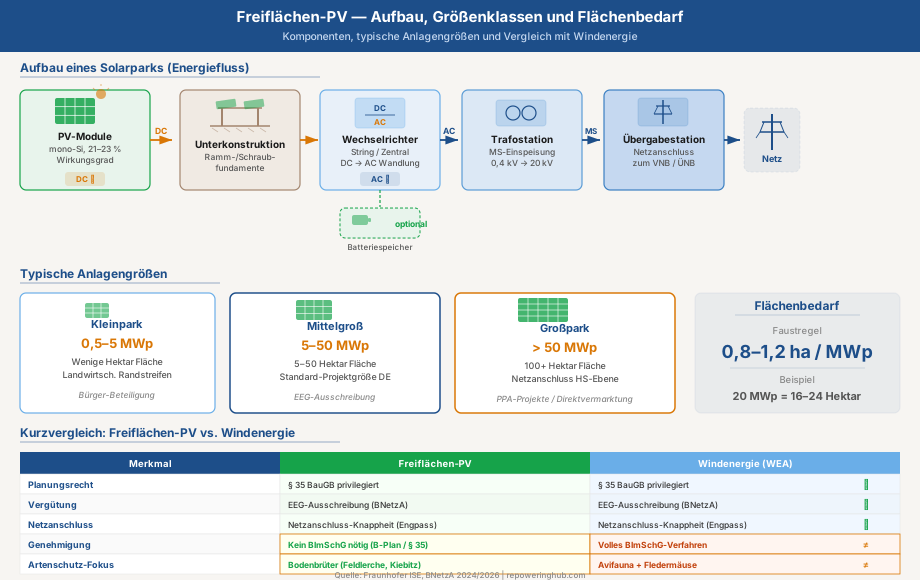
Solar-park setup — components, size classes and land demand
Where ground-mounted solar is built
- Privileged areas under § 35 BauGB (Federal Building Code): alongside motorways and double-track railway lines (200-m corridor) — see Permitting.
- Conversion sites: former military, mining or industrial land — privileged in EEG auctions.
- Disadvantaged agricultural land: opened up for the EEG auction through state-level ordinances.
- Arable and grassland via the B-Plan procedure (Bebauungsplan, local development plan): with the consent of the municipality.
- Agri-PV sites: with dual use (agricultural + solar) — see Agri-PV.
Comparison with onshore wind — what the two worlds share
GMPV and wind share the same regulatory and planning space:
- Outlying area (Außenbereich), land-use planning, privilege (§ 35 BauGB).
- EEG auctions with maximum prices.
- Land lease as a revenue source for landowners.
- Grid-connection scarcity (medium- and high-voltage bottlenecks).
- Long lead time for project development.
The differences lie above all in the permitting burden (no BImSchG (Federal Immission Control Act) procedure for GMPV below the thresholds) and in the expert reports (no full avifaunal survey as for wind, but species-protection aspects for insects and ground-nesting birds).