Solar Ground-Mounted EEG Auction — Volume, Prices, Competition
In short: EEG remuneration (feed-in support under the German Renewable Energy Sources Act) for ground-mounted solar plants is allocated by auction through the Bundesnetzagentur (BNetzA, Federal Network Agency). Volume in 2025: 9,900 MW total, evenly distributed across three bidding rounds. The round on 01.07.2025 was awarded with 258 bids / 2,271 MW — prices between 4.00 and 6.26 ct/kWh (sources: BNetzA, round of 01.07.2025).
Key figures 2025
| Metric | Value |
|---|---|
| Total ground-mounted solar auction volume 2025 | 9,900 MW |
| Distribution | 3 bidding rounds per calendar year |
| Awarded bids, round of 01.07.2025 | 258 |
| Awarded volume, round of 01.07.2025 | 2,271 MW |
| Lowest awarded bid value | 4.00 ct/kWh |
| Highest awarded bid value | 6.26 ct/kWh |
| December 2025 round | heavily oversubscribed (source: Solarserver) |
How the procedure works
- Plant size: ground-mounted solar plants of 1 MWp output and above are covered; plants below 1 MWp are supported outside the auction.
- Pay-as-bid: Each award is remunerated at its own bid, not at the highest awarded price (unlike a uniform-price model).
- Maximum value (Höchstwert): The BNetzA sets a ceiling value before each round, above which no awards are granted.
- Security deposit (Sicherheitsleistung): Bidders must lodge a security before participating, which can be forfeited if the project is not realised.
- Realisation obligation: Awarded projects must go into operation within a deadline, otherwise penalties (Pönalen) become due.
The three bidding rounds in detail
The BNetzA puts ground-mounted solar out to tender three times a year — deadlines typically fall around 01.02., 01.06. and 01.10. (the exact dates for each calendar year are published by the BNetzA in its official gazette). Each round has its own bid volume and its own ceiling value; the annual volume is not necessarily split into equal thirds, since the legislator can adjust the figures within the EEG from round to round. Bidders submit electronically through the BNetzA's procedure, which is tied to the German market master data register (Marktstammdatenregister), stating location, output and bid value in ct/kWh. If the sum of submitted bids exceeds the tendered volume, the BNetzA ranks bids by price — the cheapest bids are awarded first until the volume is used up (BNetzA procedure description).
In case of undersubscription — fewer bids than the tendered volume — all formally admissible bids up to the ceiling value are generally awarded; this does not additionally depress the average award value, because no price competition takes place below the ceiling. The December 2025 round, by contrast, was heavily oversubscribed according to Solarserver, which increases competition and therefore the pressure on bid values (Solarserver).
Ceiling value and award value — the pricing mechanism
The ceiling value (Höchstwert) is the price cap that the BNetzA sets before each bidding round (legal basis: § 37b EEG 2023 or the corresponding successor provision in the version of the EEG then in force, together with the annual ceiling-value ordinance). Bids above the ceiling are formally excluded and receive no award, regardless of remaining volume. The award value, by contrast, is the individual price at which a single bid is awarded — the German procedure applies pay-as-bid, meaning every bidder is remunerated exactly at their own bid value, not at the highest still-awarded value (as would be the case under a uniform clearing price). That creates a structural incentive to calculate one's own bid as close as possible to one's own viability threshold, because too high a markup simply costs margin, while too low a bid raises the risk of missing out on an award.
The 4.00 to 6.26 ct/kWh range in the 01.07.2025 round shows how differently projects calculate — site quality (irradiation, grid-connection costs), land costs and lease terms (see Land lease) drive the spread. A solid upfront calculation via the LCOE calculator helps set a bid value that is realistic rather than speculative.
Penalties for non-realisation
Anyone who receives an award must realise the project within the deadline. If a bidder misses that deadline or returns the award early, the security deposit lodged before bidding is forfeited, in part or in full, to the BNetzA (legal basis: the penalty provisions of the EEG in conjunction with the auction ordinance for ground-mounted plants). The penalty is therefore not a fine in the classic sense but a deposit lodged in advance, meant to limit the risk of unrealistic or purely speculative bids — without it, bidders could collect awards "on spec" en masse without ever building, blocking market volume for other, realisation-ready projects.
For project planning this means: a bid should only be submitted once land acquisition (see Land lease), a grid-connection commitment, and the fundamental permitting path (see Permitting) are far enough along that the realisation deadline can be met with a sufficient buffer. Delays in municipal land-use planning under § 35 BauGB or in grid connection are the most common reasons why awarded projects miss the deadline.
Realisation deadlines
Once an award is granted, a deadline runs within which the plant must be brought into operation. The exact deadline depends on the plant category and the EEG vintage in force at the time, and is communicated by the BNetzA in the award notice. If the deadline is exceeded, the penalties described above apply — for particularly long delays the award can be withdrawn entirely, freeing the corresponding volume in the market master data register for future rounds. Developers running several sites in parallel therefore plan bid participation so that land, grid connection and permitting are already well advanced by the time of the award — speculative bids on undeveloped land carry a high penalty risk.
Special solar plants: the Agri-PV bonus
The EEG 2024 introduces a dedicated auction access route for special solar plants — which includes Agri-PV alongside floating PV and car-park PV — with generally higher permissible bid values. The reasoning: Agri-PV plants have higher specific investment costs than conventional ground-mounted plants because of the elevated or vertical mounting structure, the clearance to the agricultural working area, and additional technical requirements (e.g. light transmission, mounting height under DIN SPEC 91434). The bonus is meant to offset this extra cost without making the dual use of land for farming and energy generation economically unattractive. Details on the technical classification and support logic of Agri-PV, including the relevant DIN SPEC categories, are summarised on the Agri-PV page.
Important for bidding strategy: special solar plants do not compete in the same bidding pool as conventional ground-mounted plants but have their own auction segments with their own volume and their own ceiling value — an Agri-PV project therefore does not compete directly against a conventional ground-mounted plant on arable land.
Eligible land under § 37 EEG
Not every plot of land may take part in the auction at all. § 37 EEG (in the version currently in force) conclusively defines the eligible land categories for ground-mounted solar plants. These include, among others:
- Side strips along motorways and railway lines — a corridor of a defined width (the exact metric varies by EEG version) that is considered privileged under planning law because it is already pre-burdened by transport infrastructure.
- Conversion sites — former military, industrial or mining land no longer put to agricultural use and therefore available without competing for land with farming.
- Disadvantaged areas under the relevant state (Land) ordinance — agricultural land with limited productivity that the federal states release by ordinance for the solar auction. Which land actually counts as "disadvantaged" is set separately by each federal state, so the eligible-land picture differs by location.
- Other land permissible under planning law, for which a municipality adopts a development plan under § 35 BauGB as part of its planning authority.
The federal states can broaden or narrow the eligible-land picture regionally through their own ordinances — a project that qualifies as a "disadvantaged area" in one state may fall outside the eligible categories in another. Before submitting a bid it is therefore worth checking the current state ordinance for the site's federal state. More on the planning-law classification and the permitting steps on the Permitting page.
The southern-quota rule
To avoid a regional concentration of ground-mounted solar plants in a few, particularly irradiation-rich federal states, the EEG provides for a southern quota (Südquote): a minimum share of the auction volume is specifically reserved for sites in the southern federal states, or conversely steered so that awards are not distributed one-sidedly across only a few regions. The mechanism is meant to counteract the grid-expansion need that arises when solar capacity clusters heavily in regions that already have high feed-in density. For developers this means award chances can differ by federal state and by the current utilisation of the southern quota — a factor that should feed into site selection alongside irradiation and grid-connection costs.
Ground-mounted vs. rooftop auction
Solar rooftop plants above a certain output threshold take part in a separate auction of their own — with its own volume, its own ceiling value and its own pool of bidders. The two segments are not in direct price competition with each other, because their cost structure and land availability differ fundamentally: rooftop plants use already-sealed, often otherwise unused surfaces without additional land consumption, but often carry higher specific costs due to structural requirements, access, and smaller plant sizes. Ground-mounted plants generally achieve lower costs per kWp through economies of scale, but require agricultural or other land and go through a more demanding permitting path under § 35 BauGB. Anyone weighing the two routes will find the key differences in planning-law logic summarised on the § 35 BauGB page; an overview of the current EEG 2024 system as a whole is provided on the EEG 2024 page.
Citizen-energy exceptions
For citizen-energy companies (Bürgerenergiegesellschaften) — associations with a minimum number of voting natural-person members, mostly from the host region, and a cap defined in the EEG on the stake of individual members — the law provides for eased participation conditions in the auction. These typically include a simplified application procedure with reduced proof requirements before bidding, and a later point in time by which the BImSchG/planning permit must actually be in place, compared with non-citizen-energy bidders. The legislator's intent is not to disadvantage smaller, regionally rooted project sponsors against well-capitalised, professional developers who can often present a complete permit much earlier and with lower cash-flow risk. The exact thresholds for member numbers and the participation cap are set out in the EEG itself and reviewed at every amendment — a legally binding case-by-case check should be carried out before bidding; this overview does not replace it.
Who wins awards
- Conversion sites (Konversionsflächen) (former military / mining / industrial land) — historically often with good award chances.
- Privileged corridor sites (motorway/rail, see Permitting) — a new large category since Solar Package I (Solarpaket I).
- Disadvantaged agricultural land (benachteiligte landwirtschaftliche Flächen) under state-level ordinance.
- Special categories such as floating PV and car-park canopies via the innovation auction (Innovationsausschreibung).
For an outlook on how auction volume and competitive intensity for ground-mounted solar are likely to develop in 2026, see the 2026 market outlook.
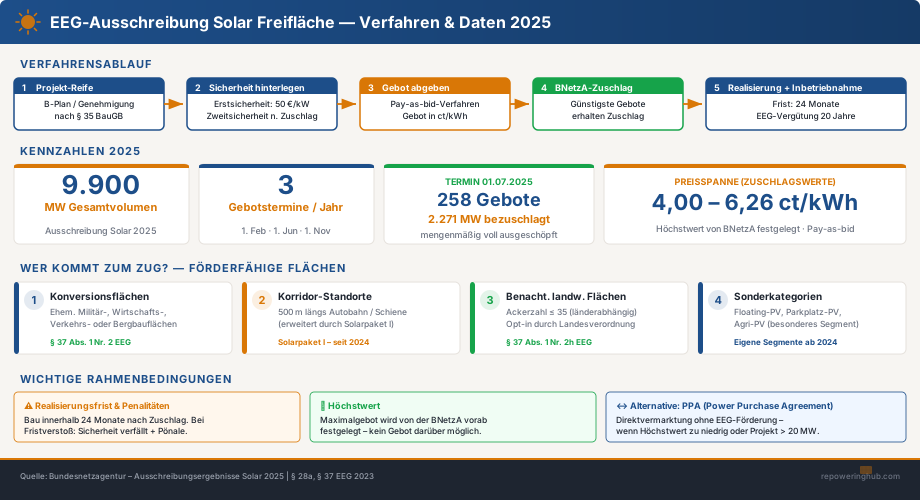
Solar EEG auction procedure — 5 steps from project to remuneration, 2025 data
PPA as an alternative
For plants that are economically viable without an EEG award (or where the EEG ceiling values are too low), a PPA (Power Purchase Agreement) is the standard route — a direct electricity supply contract with an off-taker, often fixed over 10–15 years. Large parks (> 50 MWp) are today almost exclusively built on a PPA-financed basis.
Frequently asked questions
How does the EEG remuneration compare to the market price?
The awarded prices (4–6 ct/kWh) are usually below the average market prices — the EEG market premium makes up the difference. The market premium page provides concrete quarter-by-quarter comparisons.
What happens after 20 years of EEG support?
The plant switches to direct marketing at the market price. For solar this is often more attractive economically than for wind, because solar OPEX is low.
Who advises on bidding strategy?
Experienced developers and energy consultancies — we refer on request. Individual advice on auction strategy goes beyond the scope of this portal.