Solar Park Land Lease — What Landowners Receive in 2025
In brief: Lease rates for solar parks in 2025 range from EUR 2,500 to 5,000 per hectare per year. In the outlying area (Außenbereich, undesignated rural land) without privileged status the typical range is EUR 3,000–4,000/ha, while on privileged sites (the § 35 BauGB corridor) it is EUR 3,500–4,500/ha. Standard terms run 20–30 years, often with a renewal option. As a result, the solar lease yield is frequently far above the conventional agricultural lease rate for the same land.
2025 Lease Rates by Land Type
| Land type | Lease range (EUR/ha/year) |
|---|---|
| General range | 2,500–5,000 |
| Outlying area (not privileged) | 3,000–4,000 |
| Privileged open space (§ 35 BauGB) | 3,500–4,500 |
| Prime sites with grid connection + southern Germany | up to 5,000 |
| Saxony / structurally weaker regions | often at the lower end |
Sources: SonnenProjekte 2025, landverpachten.de 2025.
Terms & Contract Structure
- Standard: 20–30 year lease duration with one or more renewal options.
- Current practice: increasingly also 30–40 years, since module service life and possible repowering of the solar modules support this.
- Minimum lease + revenue share: an alternative to a pure fixed lease; combines security with participation in the electricity-price upside.
- Indexation: inflation adjustment is common (e.g. consumer price index), protecting against loss of purchasing power.
- Pool model: all landowners in the park share the total lease in proportion to their land share — fairer in mixed layouts with access roads, cabling and the grid handover point.
Lease Rate Models in Detail: Fixed Lease vs. Revenue-Based Lease
In practice, landowners usually negotiate between two basic models — or a hybrid of the two:
- Fixed lease: a set EUR/ha amount per year, independent of the installation's electricity output. This gives the landowner planning certainty, but no share of especially strong years (plenty of sun, high power prices). The lessee carries the full yield risk.
- Revenue-based (or yield-based) lease: payment is tied to the actual electricity generated or the installation's revenue (e.g. cents/kWh or a percentage of power revenue). Attractive at very good sites, but it carries fluctuation risk for the landowner — weak solar years or plant outages feed straight through.
- Minimum lease + revenue share (hybrid model): in practice, by now the most common model. A base amount secures a minimum income regardless of yield, plus a variable component above a threshold. This caps the landowner's downside without handing the entire upside to the operator.
From a landowner's perspective, the minimum-lease-plus-revenue-share variant is regularly the lower-risk choice, since it combines a floor with participation in the upside — though the concrete design (threshold, reference metric for the variable component, the operator's reporting obligations) remains a matter for case-by-case negotiation.
Value Protection, Ancillary Costs and Property Tax
Over a term of 20–30 years, a value-protection clause (indexation to the German Federal Statistical Office's consumer price index) is practically standard — without it, a nominally fixed lease loses substantial real purchasing power. Key ancillary points that should be explicitly settled in the contract:
- Property tax: the lessee (plant operator) usually bears the property tax attributable to the leased land for the contract term — this should be explicitly fixed in the contract, not silently assumed.
- Recoverable ancillary costs: access-road upkeep, fence maintenance and insurance for the installation itself normally sit with the operator.
- Duty of traffic safety: must be clearly assigned to the operator once the installation is standing — the landowner should not be liable for plant damage or accidents within the plant area.
- Payment rhythm: annual or semi-annual payment in advance is common; default provisions and a bank guarantee for the first payment period increase security for the landowner.
Decommissioning Obligation and Decommissioning Bond
At the end of the lease term, the land must be fully restored — modules, mounting structures, cabling, transformer stations, fencing, foundations. This obligation already follows from the emissions-control or building-law permit (see Permitting for Ground-Mounted Solar), but it should additionally be set out independently in the lease contract so the landowner has a direct civil-law claim against the lessee.
The central safeguard is the decommissioning bond: a bank guarantee or comparable security that the operator deposits in the landowner's favour, covering decommissioning costs if the operator becomes insolvent. Without this bond, in the worst case the landowner bears the risk of being left with an un-restored site full of foundations and electrical installations. Points to check:
- Bond amount — should cover realistic decommissioning costs, not just a token sum.
- Timing of the deposit — ideally before or at commissioning, not only at the end of the contract.
- Guarantor — the creditworthiness of the guaranteeing bank or insurer should be checked, not just the existence of a guarantee document.
Land Handback: Condition at Contract End
The contract should precisely define the condition in which the land is returned — not just "restored", but concretely: reinstatement of agricultural usability (soil loosening, recultivation where needed), removal of foreign materials, deadlines for decommissioning after contract end (typically several months up to a year), and who bears the cost of any soil analysis that may be required. Where repowering options exist (renewing the installation instead of decommissioning), it should also be settled whether and on what terms the lease extends.
Tax Classification — What Needs Clarifying
A solar lease is taxable. Depending on the agricultural history and the contract structure, it may be classified as letting/leasing (§ 21 EStG, German Income Tax Act) or as commercial income (§ 15 EStG) — with different consequences for trade tax (Gewerbesteuer), farm succession and EU direct payments. Also relevant: if a farmer leases land previously used for agriculture for a solar installation, this can under certain circumstances affect the tax treatment of the remaining farm business (e.g. business assets vs. private assets, impact on farm succession). This is a matter for a tax adviser in the individual case; this article does not replace individual tax or legal advice, it only outlines the questions in general terms.
Negotiating Points for Landowners in Detail
Beyond the lease amount itself, the following contract points often weigh more heavily on the landowner's actual risk:
- Liability: a clear allocation that the operator is liable for all damage arising from construction, operation and decommissioning of the installation — including operational liability insurance with adequate cover.
- Rights of way: where the solar site is accessed via other owners' driveways, rights of way must be cleanly secured in the land register — verbal assurances are not enough for a 20–30 year commitment.
- Construction schedule: start, expected duration and compensation for construction-related restrictions on use (e.g. noise, site traffic) should be fixed in the contract.
- Cable and line rights: laying cable routes for grid feed-in (see Grid Connection) often affects neighbouring plots — this requires its own easements.
- Exclusivity and reservation phase: developers frequently secure the site in advance via an option or reservation agreement, before the actual permit is granted (see Site Acquisition) — the terms for the transition from option phase to lease phase should be clear from the outset.
- Decommissioning & renaturation bond from the lessee (no risk at the end of the lease)
- Inflation indexation instead of a fixed lease
- Revenue share in addition to the minimum lease
- Pool distribution where there are several owners
- Clear arrangements for repowering the installation after 20+ years
- Exit/adjustment clause in the event of a permit refusal
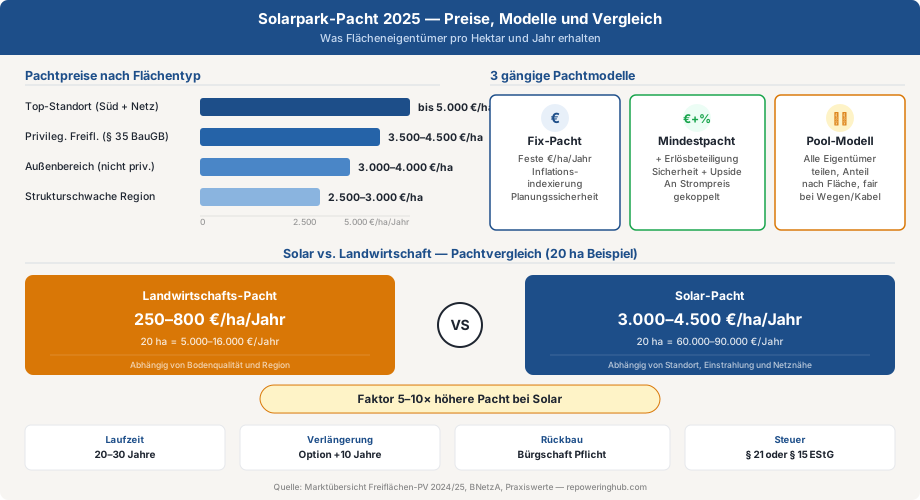
Solar park land lease — prices, models and comparison with agriculture
Solar Lease vs. Agricultural Lease
The agricultural lease for arable land is regionally well below the solar lease — in part EUR 250–800/ha/year. A 20-hectare plot that brings in, say, EUR 8,000–12,000/year in agricultural use quickly reaches EUR 60,000–90,000/year as a solar site. Over 25 years the difference funds a seven-figure sum.
Frequently Asked Questions
How much is the lease per hectare?
The lease per hectare in 2025 falls in the range of EUR 2,500–5,000/year: EUR 3,000–4,000/ha in the non-privileged outlying area, EUR 3,500–4,500/ha on privileged sites (§ 35 BauGB), and up to EUR 5,000/ha at prime sites with grid connection (see the table above, sources SonnenProjekte 2025 and landverpachten.de 2025).
Which land is even suitable for solar?
The most important criteria: flat or gently south-facing terrain, good grid-connection availability, no exclusion zones (water protection, nature conservation, soil protection), and enough size (from around 5 hectares a park becomes plannable). Details in the cluster article Site Acquisition.
Can I have both — a lease + agricultural use?
Yes, with agri-PV — see Agri-PV. There the land beneath the modules continues to be farmed, and the EEG remuneration includes a special bonus.
Am I tied to the installation — what if the developer pulls out?
As long as no valid permit decision and building application are in place, many contracts provide for a withdrawal/adjustment clause. The binding commitment to the lease typically begins with realisation — before that a reservation and option phase applies.