Permitting ground-mounted solar — what changed with Solar Package I
In short: Since Solar Package I (in force on 16/05/2024), ground-mounted solar installations along motorways and double-track railway lines within a distance of up to 200 metres are privileged under § 35 (1) BauGB (German Federal Building Code). Within the corridor this replaces the previously customary Bebauungsplan (local development plan) procedure with a simple building permit — and the municipality can no longer block the project by refusing to adopt a local development plan.
The legal change at a glance
| Before Solar Package I | With Solar Package I (since 16/05/2024) |
|---|---|
| Open land in the outlying area (Außenbereich) not privileged | Privileged within the 200-m corridor along a motorway / double-track railway (§ 2b AEG) |
| Local development plan procedure with municipal council resolution | Simple building permit from the building authority |
| Municipality can block | Entitlement to a permit once the requirements are met |
| Typical duration 18–36 months | Simplified, duration depends on the authority and the state of the expert reports |
Sources: landverpachten.de, GÖRG.
Who benefits — and who does not
The privilege applies only to land within the 200-m corridor along qualifying transport routes. Outside this corridor, the previous route remains:
- Local development plan procedure via the municipality, the classic land-use planning procedure with public participation.
- Conversion sites (Konversionsflächen): often in the advantaged auction segment of the EEG auction.
- Disadvantaged agricultural land (benachteiligte Flächen): opened up by state-level ordinance.
Requirements for the privilege
- Site within the 200-m line alongside a federal motorway (Bundesautobahn) or a double-track railway of the higher-level network (§ 2b AEG).
- No conflicting public interests — in particular nature/landscape conservation, water management, monument protection, traffic safety.
- Assessment of spatial significance (Raumbedeutsamkeit) and compatibility with the objectives of spatial planning.
- Development under building planning law secured (access road, grid connection).
The municipality no longer has to give its consent, but it retains participation rights in safeguarding public interests.
Which expert reports are typically required
- Species protection technical report (Artenschutz-Fachbeitrag): ground-nesting birds, insects, reptiles — methodology under species protection report.
- Landscape impact plan (LBP): where there are interventions in nature and the landscape.
- Soil report / subsoil: for the foundations.
- Water-management interests: in water-sensitive areas.
- Glare report: where transport routes or residential development lie within reflection range.
- EIA screening (UVP-Vorprüfung): from certain size thresholds or in sensitive locations — see EIA screening.
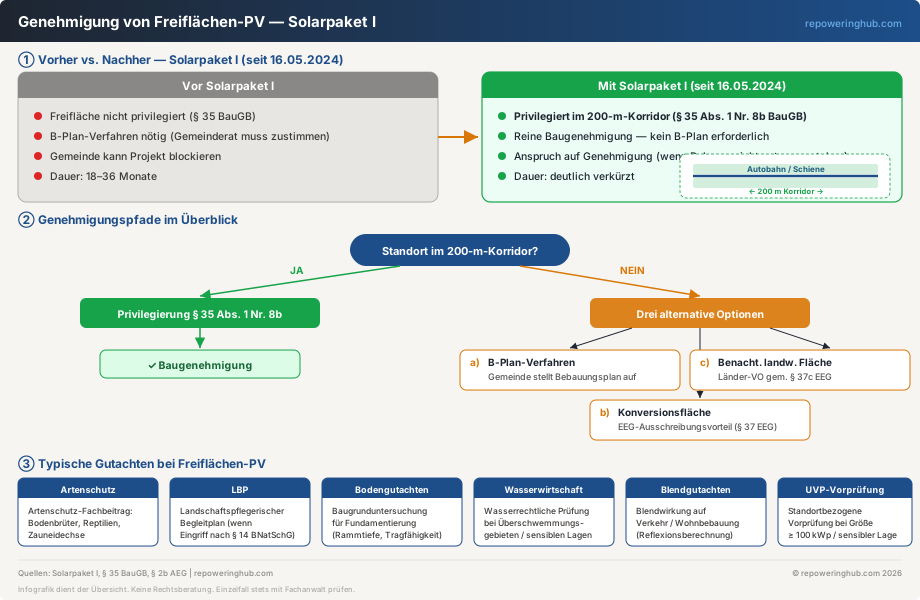
Ground-mounted solar permitting — Solar Package I, permitting routes and overview of expert reports
Why ground-mounted solar needs a local development plan at all
The difference from wind energy is the starting point of any permitting strategy for ground-mounted solar: wind turbines in the outlying area are privileged in principle under § 35 (1) No. 5 BauGB and run through the BImSchG procedure — an installation-licensing process with statutory deadlines. Ground-mounted solar, by contrast, counts under building law as an "other project" under § 35 (2) BauGB and is precisely not privileged outside the 200-metre corridor. Without the privilege, a project needs its own planning-law basis — and the municipality creates that through a local development plan (Bebauungsplan, or "B-Plan") under § 30 BauGB in conjunction with § 1 (3) BauGB. Only the B-Plan designates the site as a special-purpose "photovoltaic" area; only then can the building permit be issued. That is the key difference from the BImSchG permit for wind: there, a specialist authority approves a privileged installation in one procedure; here, the municipal council first has to open the site for development at all.
How the local development plan procedure runs (§§ 2–10 BauGB)
The regular B-Plan procedure outside the privileged corridor follows a legally prescribed sequence. In practice each step takes a different amount of time, depending on the planning authority's capacity and how contentious the site is:
- Resolution to prepare the plan (§ 2 (1) BauGB): the municipal council resolves to prepare a B-Plan for the site at all. Without this resolution nothing happens — it is the political starting signal and, at the same time, the single biggest project risk, because the council decides freely whether to open the procedure.
- Early public participation (§ 3 (1) BauGB): the public and authorities are informed early about the aims and purposes of the planning; comments are collected. This is usually where nature and species-protection conflicts surface for the first time.
- Draft and agency participation (§ 4 (1) BauGB): public bodies (the lower nature conservation authority, water authority, grid operator, road authority) submit specialist comments on the draft plan.
- Public display / exhibition (§ 3 (2) BauGB): the draft plan is displayed publicly for one month; anyone can raise objections. On contested projects this is the phase with the highest volume of objections.
- Weighing of interests (§ 1 (7) BauGB): the municipality must weigh all public and private interests fairly against one another — a key point of attack in later judicial review actions if the weighing was flawed.
- Formal adoption (§ 10 (1) BauGB): the municipal council adopts the B-Plan as a statute (Satzung). Only publication makes it legally binding.
- Building permit: only on the basis of the legally effective B-Plan does the building authority issue the actual building permit for the solar modules, transformer stations, and access roads.
In parallel with the B-Plan, the municipality's land-use plan (Flächennutzungsplan, FNP) usually also has to be amended, or adjusted in a parallel procedure under § 8 (3) BauGB, if the site is still shown in the FNP as agricultural land rather than as a special-purpose building area. Without this FNP adjustment, the B-Plan is not "developed from" the land-use plan (§ 8 (2) BauGB) and is therefore open to legal challenge.
Environmental assessment and the EIA screening
From a certain size threshold, ground-mounted solar installations require a general case-by-case screening under the EIA Act (Annex 1 UVPG) to determine whether a full environmental impact assessment (EIA) is required. Details on the methodology and thresholds are covered under EIA screening and EIA in general. In addition, the B-Plan procedure itself requires an environmental assessment under § 2 (4) BauGB, whose result feeds into the environmental report as a separate part of the statement of reasons (§ 2a BauGB). This dual structure — EIA screening under the EIA Act plus environmental assessment under building law — often causes confusion in practice, because the two assessments rest on different legal bases but cover overlapping ground (interventions in nature and the landscape, effects on protected assets).
Municipal consent (§ 36 BauGB)
Even where the municipality itself prepares the B-Plan, § 36 BauGB comes into play additionally for projects in the outlying area: the building permit authority decides on projects under §§ 31, 33, 34, 35 BauGB in agreement with the municipality. In practice this means: for ground-mounted solar projects outside the 200-metre corridor, the municipality has influence through two levers — first, the decision on whether and how it prepares the B-Plan; second, its consent to the building permit itself. If the municipality withholds consent without objective grounds, the higher administrative authority can substitute it under state law — but this route is politically demanding and rarely used in practice, because developers usually depend on a cooperative relationship with the municipality (for example, over land negotiations and local acceptance).
Authorities and bodies involved
- Building authority / lower building-law authority: responsible for the building permit and formal review of the building application.
- Municipal council: resolution to prepare the plan, weighing of interests, formal adoption of the B-Plan.
- Lower nature conservation authority: species-protection review, impact-mitigation assessment, and any compensation measures.
- Lower water authority: for water-sensitive sites (flood zones, groundwater protection).
- Grid operator: grid-connection assessment and commitment, without which a site is not economically viable — see also site acquisition for the order of lease, grid connection, and permit.
- Public bodies (Träger öffentlicher Belange): depending on the site, further bodies such as monument protection, road authorities, agricultural authorities.
Procedure duration — a realistic assessment
To our knowledge there is no publicly available, robust nationwide statistic on the average duration of municipal B-Plan procedures for ground-mounted solar. In our assessment (not an official source, but an experience value from project practice), a regular B-Plan procedure often falls in the range of 12 to 24 months from the resolution to prepare the plan to formal adoption, but can extend considerably in the event of litigation, complex species-protection assessments, or political resistance. The subsequent building permit itself is usually markedly faster where the documentation is complete, typically a few months. Unlike the BImSchG procedure for wind turbines, which has statutory processing deadlines, the local development plan procedure has no binding deadlines — a structural difference that should be factored into project planning.
Ground-mounted solar permitting — Solar Package I, permitting routes and overview of expert reports
Frequently asked questions
What counts as a "double-track railway line of the higher-level network"?
Lines covered by § 2b AEG (German General Railways Act), i.e. supraregional main lines of DB Netz AG. Branch lines are not covered, and freight-only lines generally are not either. When in doubt: ask the authority.
What about § 35 (1) No. 5 BauGB (general privilege for renewables)?
The general renewables privilege applies to wind, not to ground-mounted PV. For ground-mounted PV it is precisely the above-mentioned No. 8 lit. b BauGB that is the relevant new privilege.
Can a municipality "override" the privilege?
It can bring public interests into play or steer sites through land-use planning via the local development plan. However, a complete blockade within the corridor is legally difficult, because the applicant has a legal entitlement to a permit.
Why doesn't ground-mounted solar go through the BImSchG procedure like wind?
The BImSchG procedure applies to installations requiring a permit under § 4 BImSchG in conjunction with the 4th BImSchV — this covers wind turbines, but not ground-mounted solar installations. Ground-mounted PV installations are permitted under building law, not under emissions-control law. That is why the route for PV runs via the local development plan plus building permit, while wind is permitted through the separate, deadline-bound BImSchG procedure.
Does every ground-mounted solar installation need a new B-Plan?
No — within the 200-metre corridor along a motorway/railway, the privilege under § 35 (1) No. 8 lit. b BauGB has, since Solar Package I, replaced the need for a B-Plan, as described above. On conversion sites already designated as a special-purpose photovoltaic area, an existing B-Plan can also form the basis, provided the project is covered by it.