Grid connection for solar parks — the most common bottleneck
In short: The grid connection determines the maximum plant size and, in many regions, whether a park can be realised at all. Before any serious project development comes a grid connection pre-application (Netzanschluss-Voranfrage) with the responsible distribution system operator. In regions with grid bottlenecks, waiting lists of 12 months and more are realistic.
Voltage level by plant size
| Plant size | Typical connection level |
|---|---|
| < 100 kWp | Low voltage (Niederspannung, NS) |
| 0.1–10 MWp | Medium voltage (Mittelspannung, MS, usually 20 kV) |
| 10–100 MWp | Medium voltage with a dedicated transfer station, possibly high voltage (Hochspannung, HS, 110 kV) |
| > 100 MWp | High voltage / extra-high voltage via a transformer substation |
The exact threshold and availability depend on the specific grid area — clarifying this in advance is mandatory.
How the grid connection procedure unfolds
The procedure broadly follows the distribution grid connection model set out in the EnWG (Energy Industry Act) and the NAV (Low Voltage Connection Ordinance), together with the technical connection conditions (TAB) of the relevant distribution system operator. Medium-voltage connections follow the VDE-AR-N 4110 technical rules; high-voltage connections follow VDE-AR-N 4120. In practice, the process breaks down into four steps:
- Grid connection pre-application: an informal or DSO-specific request about available capacity at the nearest grid connection point — non-binding, usually free of charge.
- Grid compatibility assessment: the DSO simulates the grid impact of the planned feed-in capacity (voltage band, short-circuit power, back-effects). Where several competing requests target the same point, a first-come-first-served principle typically applies — whoever submits a complete, binding request first.
- Formal grid connection request: a binding application with complete project documents (site plan, plant schematic, planned output, target commissioning date). The DSO then issues an offer covering costs and a deadline.
- Grid connection contract and construction: once the contract is signed, physical works begin — cable route, transfer station, and any grid reinforcement carried out by the DSO.
Important for project planning: the grid connection commitment is usually a prerequisite for taking part in EEG auctions — without a secured connection point, a bid to the Bundesnetzagentur can rarely be calculated seriously. Details on the auction procedure itself are covered in our article on the EEG auction.
The pre-application — what it delivers
On request, the distribution system operator (Verteilnetzbetreiber, VNB) examines:
- Available connection capacity at the nearest transfer point.
- Necessary grid expansion measures (transformer upgrade, line reinforcement).
- The connecting party's cost share under the NAV / NAV-StromGS (low-voltage connection ordinance).
- Reservation terms (deadline, possibly a fee).
The pre-application is often free of charge or carries moderate fees — the binding reservation (the "grid connection point commitment", Netzverknüpfungspunkt-Zusage), by contrast, often costs several thousand to tens of thousands of euros depending on the VNB.
Typical cost blocks
- Cable route from the park to the transfer station: 100–250 €/m, depending on soil type and cross-section.
- Transfer station: 80,000–250,000 €, depending on power class and switchgear configuration.
- Transformer station(s) in the park: 30,000–80,000 € per station.
- Possible medium-voltage reinforcement (VNB share): can run into six or seven figures if the grid is locally insufficient.
- Connection fees according to the VNB's tariff.
Rule of thumb: 5–10% of the total investment goes to the grid connection; in grid-constrained regions considerably more.
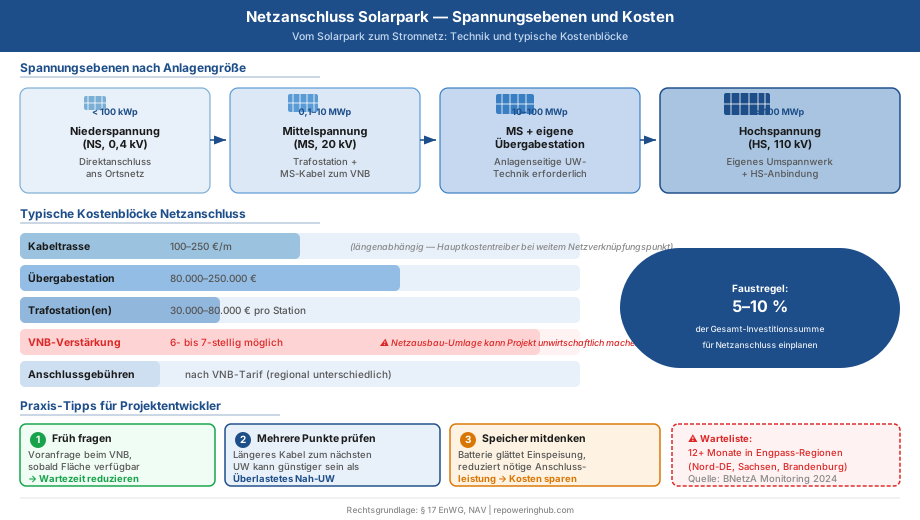
Solar park grid connection — voltage levels, cost blocks and bottleneck warning
Feed-in management and redispatch 2.0
Even after a grid connection is completed, feed-in isn't always unrestricted. In case of grid bottlenecks, the DSO can temporarily curtail a solar park's active power output under feed-in management pursuant to § 14 EEG 2024 — the lost remuneration is generally reimbursed to the operator under the EEG's compensation rules. Since the introduction of redispatch 2.0 (a nationwide, standardised system for managing grid bottlenecks, coordinated by transmission and distribution system operators), renewable plants above certain output thresholds are also included in redispatch processes and must be remotely controllable — a requirement that should already be factored into transfer station planning (ripple control receiver or remote control technology).
For project calculations, this means curtailment hours are a yield risk that should feed into the economic model — the extent varies considerably by region, and is noticeably more frequent in grid-constrained areas than the national average (a regional assessment best confirmed with the responsible DSO in each case).
Battery storage to relieve the grid connection
A growing number of solar park projects combine the PV plant with a battery storage system at the same grid connection point (co-location). The storage system smooths feed-in peaks, shifts energy into grid-friendly time windows, and can thereby reduce the connection capacity required compared with unstored full feed-in — an argument that DSOs increasingly credit favourably during the grid compatibility assessment. Conversely, an undersized connection can partly be compensated for by storage if the solar park's peak output is fed in over a longer time window via the battery. Our article on co-location of battery storage and solar park covers the combined grid connection and permitting planning for PV and storage at the same site in detail.
Direct marketing vs. market premium and the feed-in model
The choice of feed-in model indirectly affects the requirements placed on the grid connection. Solar parks above the EEG's de-minimis threshold are obliged to use direct marketing (§ 21b EEG 2024) and receive the market premium as the difference between the solar market value and the value to be applied. Direct marketers typically require remote controllability of the plant (actual feed-in data, curtailment on remote signal) — technically this overlaps with the redispatch 2.0 requirements and should be planned in one step with the transfer station rather than retrofitted later. A detailed comparison of the market premium model, other forms of direct marketing, and the contractual pitfalls involved is available in our article on direct marketing for solar and wind parks.
What project developers can do
- Ask early: submit the pre-application as soon as the site is realistically available.
- Check several transfer points — sometimes a longer cable to the next substation pays off.
- Plan for scalability: size the transfer station for possible repowering / expansion.
- Factor in storage: a battery storage system can smooth grid feed-in and reduce the required connection capacity.
- Coordinate with other developers — bundled connections reduce the cost per connecting party.
Frequently asked questions
Who bears the cost of grid expansion?
Under the NAV rules, the costs are shared — the connecting party pays the customer-specific share (cable route, transfer station), the VNB pays the share attributable to general grid expansion. In the event of a dispute, the Bundesnetzagentur (Federal Network Agency) is the point of contact.
What if the nearest connection is too far away?
Long cable routes (e.g. 5 km) are fundamentally feasible but tip the economics — a rule of thumb: from a distance of 2–3 km onwards, a critical economic review using the LCOE calculator is worthwhile.
Can I press the VNB?
The right to a grid connection is statutory (§ 17 EnWG, NAV), but the processing deadline is not hard. In case of inaction, file a complaint with the Bundesnetzagentur — it works, but it takes time.