Species Protection in a Solar Park — what is assessed and what practice shows
In short: During the permitting procedure, a species-protection technical report (Artenschutzfachbeitrag) is prepared — the main focus is on ground-nesting birds, reptiles and endangered insects. A solar park built on previously intensively used arable land can, with appropriate management, even become a more biodiversity-friendly area — provided the park is designed correctly from a species-protection perspective.
What is assessed in the species-protection report
- Breeding birds: in particular ground-nesting species (skylark, lapwing, grey partridge) — recorded through field surveys during the breeding season.
- Resting and migratory birds: relevant for large-scale parks located in resting areas.
- Reptiles: sand lizard, smooth snake (central/southern Germany), recorded using reptile cover boards.
- Butterflies, wild bees, grasshoppers: indicator groups for habitat quality.
- Mammals: European hamster (regional), game crossings — fence configuration relevant.
- Bats: for sites near roosts / foraging grounds.
For the procedural side, see species-protection report and avifaunistic survey.
The biodiversity-friendly solar park — the standards
- Light penetration between the rows: sufficient spacing for plant growth under and beside the modules.
- Extensive management: one to two mowing operations per year, no pesticide use, often sheep grazing as maintenance.
- Structures for animals: stone/deadwood piles for reptiles, flowering strips, avoiding fine-mesh fences (passages for small mammals).
- Site-appropriate seed mixtures: regional wildflowers instead of standard turf.
- Water management: retention of depressions, small-scale features where appropriate.
A "colourful" solar park is not a marketing term but measurable in insect and bird populations — several scientific monitoring studies show positive effects compared with intensive arable use.
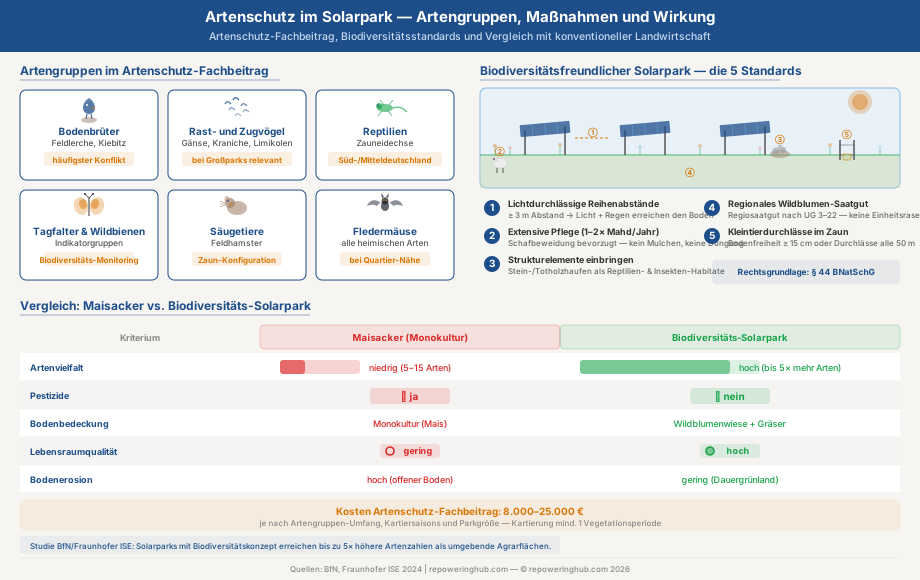
Species protection in a solar park — species groups, biodiversity standards and comparison with arable use
Common points of conflict
- Skylark: a frequent point of conflict because it needs open areas — solution: compensation areas outside the park.
- Dry grassland / calcareous grassland: often off-limits, because habitat quality would be directly altered by shading from the modules.
- Game crossings: generous passages in the fencing are standard today.
- Proximity to Natura 2000 (FFH) sites: may require an FFH appropriate assessment (FFH-Verträglichkeitsprüfung).
Legal basis: access prohibitions under Section 44 BNatSchG
The core provision is Section 44(1) of the Federal Nature Conservation Act (BNatSchG). For specially and strictly protected species it prohibits four categories of action: killing or injuring (no. 1), significant disturbance during breeding, rearing, moulting, overwintering and migration periods (no. 2), removal or damage of breeding and resting sites (no. 3), and removal of wild specimens of specially protected plant species (no. 4). For a solar park this means in concrete terms: clearing the construction area, laying cable trenches and driving in mounting posts must not destroy clutches, injure a sand lizard population, or damage bat roosts in adjacent woody vegetation. If any of these four prohibitions would occur without mitigation, the project needs a derogation under Section 45(7) BNatSchG — with correspondingly more review time and effort for the permitting authority.
Important in practice: the prohibition applies at the level of the individual animal, not the population — in principle, harm to a single specimen is enough to trigger it. The special species-protection assessment (saP, see below) must therefore demonstrate convincingly that the avoidance measures are sufficient to prevent the prohibition from being triggered in the first place. That is the difference between a cleanly prepared procedure and months of back-and-forth requests for further information from the lower nature conservation authority.
How the special species-protection assessment (saP) proceeds
The saP is the technical core of the species-protection report and generally follows four steps:
- Relevance screening: matching species known to occur in the natural region (distribution atlases, state-level species data) against the project's zone of impact — which species are realistically in scope at all.
- Field surveys: site visits during the species-specific prescribed time windows — breeding-bird mapping typically requires 6 to 8 visits between March and July, reptile surveys use plastic or bitumen cover boards left in place over several weeks in spring/early summer.
- Impact forecast: comparing the recorded occurrences against the four prohibitions in Section 44 BNatSchG, taking into account the planned construction period, land take and operating phase.
- Mitigation concept: defining avoidance, minimisation and, where needed, CEF measures (see below), which are then written into the permit as binding conditions.
The field survey is the time-critical step: anyone who misses the breeding-bird mapping season (generally March to July) loses a full year on the schedule.
Avoidance measures, CEF measures and construction-timing rules
Three instruments prevent an access prohibition from being triggered at all:
- Avoidance measures: for example, construction windows outside the breeding and rearing season, buffer distances to clutches, fencing with ground clearance for small mammals, and removing woody vegetation only outside the bird breeding season.
- CEF measures (continuous ecological functionality measures, sometimes called advance compensation measures): if a breeding or resting site is unavoidably affected, a functionally equivalent replacement site must be created and demonstrably accepted by the species before construction starts — for example, relocating a sand lizard population to a prepared replacement habitat.
- Construction timing / clearing windows: under Section 39(5) BNatSchG, cutting back or clearing woody vegetation is generally only permitted between 1 October and 28/29 February — outside the breeding and vegetation period. For clearing the construction area as a whole, many permits additionally set a construction window aligned with the locally confirmed breeding period of the species found on site.
These measures are usually written into the building permit or the development-plan (Bebauungsplan) procedure as binding conditions, not as voluntary commitments.
Monitoring obligations after the permit is granted
Unlike the construction phase, species-protection responsibility does not end once the plant is commissioned. Typical obligations for the operating phase include:
- Success monitoring of CEF measures: proof over several years that the replacement habitats were actually accepted by the species — for example, confirming sand lizards in the replacement area in years 1, 3 and 5.
- Management monitoring: documenting the agreed mowing and grazing intervals, often with an annual report to the lower nature conservation authority.
- Vegetation development: sample surveys of the wildflower mixtures and open-land vegetation to detect scrub encroachment or grass dominance early.
These obligations need to be factored into operating-cost planning — they run for the entire operating life, not just until commissioning.
Interface with the Landscape Impact Plan
The species-protection report/saP and the Landscape Impact Plan (LBP) are two separate but closely linked technical reports. The saP examines admissibility under species-protection law (Section 44 BNatSchG); the LBP addresses the general impact-mitigation regime under nature conservation law (Section 15 BNatSchG) — avoidance, minimisation and compensation for the intervention in nature and landscape as a whole, not just for individual species. In practice, CEF measures from the saP are often also captured in the LBP as part of the compensation concept and documented in the measures sheet, so that the building application and the permitting authority receive a consistent overall picture. Where this coordination is missing, authorities typically require revisions — a common cause of delay in the procedure.
Conflict potential: ground-mounted PV vs. wind energy
Species protection for ground-mounted PV and for wind turbines concerns structurally different risk groups, something planning teams with a wind background often underestimate:
- Wind turbines: collision risk in the airspace is the main concern — birds of prey (red kite, white-tailed eagle), bats in the rotor-swept area. Depending on the species, review radii extend up to 6,000 m around the turbine location (see LAI guidelines).
- Ground-mounted PV: land loss and habitat change at ground level are the main concern — ground-nesting birds, reptiles, small mammals. Collision risk plays practically no role, since there are no moving rotor blades.
- Practical consequence: the review radius for PV is smaller, the survey methodology differs (reptile cover boards instead of nest-site mapping), and the permitting time for the species-protection part is generally shorter for PV than for wind — provided there is no proximity to a Natura 2000 (FFH) site, in which case the FFH appropriate assessment also applies.
For developers moving from wind into ground-mounted PV, this is the key expectation to reset: the species-protection review is generally leaner, but site selection (open farmland vs. dry grassland vs. proximity to Natura 2000 sites) has a bigger influence on procedural effort than it does for wind turbines.
Frequently asked questions
Do I need an avifaunistic survey at full wind-turbine depth?
No. Unlike wind, the avifaunistic survey for ground-mounted PV is generally focused on ground-nesting species and, where relevant, resting birds — effort and cost are considerably lower than in the wind procedure.
What does the species-protection technical report cost?
On the order of EUR 8,000–25,000 depending on site and size. With particular conflicts (sensitive location, many species) it can be more.
Are there incentives for biodiversity-friendly solar parks?
Regionally yes — some federal states promote or give preference to biodiversity-friendly parks in the development-plan (Bebauungsplan) procedure. On the market and EEG side there is so far no direct premium; the topic is under discussion.