§ 35 BauGB for Wind Turbines
§ 35 BauGB is the central building planning law norm for wind energy. Since 1996, wind turbines have been privileged projects in outdoor areas. The WaLG reform 2023 fundamentally changed municipal control via concentration zone planning.
What does "privileged" mean?
In outdoor areas (= outside development plans and connected built-up areas), projects are generally impermissible. Privileged projects under § 35 para. 1 are an exception — they may be erected if no public interests oppose.
For wind turbines this means: permit entitlement in the outdoor area, provided the public interests (noise, shadow, species protection, landscape) can be managed through conditions.
Concentration zone concept (pre-WaLG)
Municipalities could designate concentration zones for wind energy in their land-use plan. Effect:
- Inside the concentration zone: wind turbines privileged
- Outside the concentration zone: exclusion effect — wind turbines regularly impermissible
- Prerequisite: substantial space for wind energy in the plan, otherwise null and void
The WaLG reform — what changed in 2023
The Wind on Land Act (WaLG) obligates the federal states to designate 2.2 % of their land area for wind energy by 2032 (interim target 1.4 % by 2027). If the target is not met:
- Exclusion effect of concentration zones lapses — wind turbines may also be built outside zones where privileged
- Sanctions mechanism motivates states toward timely designation
- Acceleration effect for project planners: sites outside concentration zones become permittable again
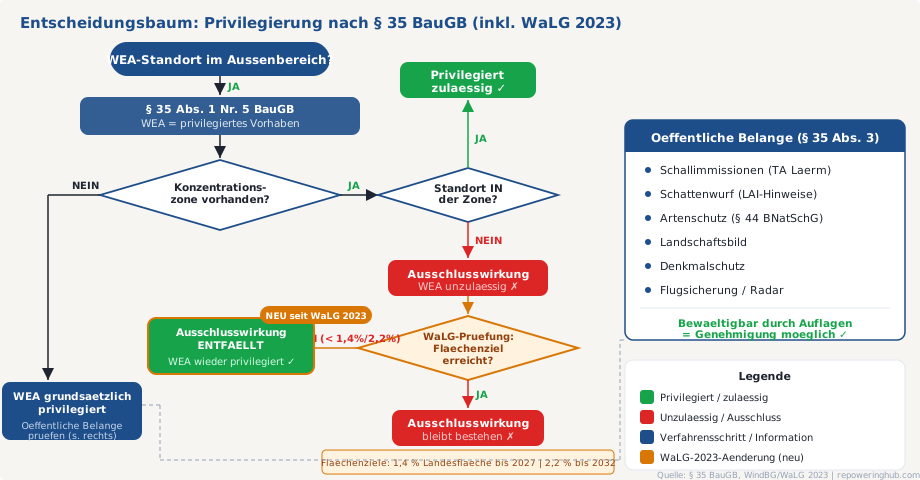
Decision tree § 35 BauGB — privileged status, concentration zones and WaLG reform 2023
Requirements under § 35 para. 1 Nr. 5 BauGB
- Privileged status: given for "wind energy" as an explicitly named installation type
- Outdoor area location: outside the inner/connected built-up area
- No opposing public interests (noise, shadow, species protection, landscape, traffic — all subject to expert reports)
- Adequate infrastructure: road access + grid connection possible
- Permanent structural safety + decommissioning obligation at end of life
- Location within concentration zone (if zoning plan is effective)
Decommissioning obligation
§ 35 para. 5 BauGB obligates the operator to completely decommission the installation after end of use. Specifically:
- Turbine fully dismantled
- Foundation removed (possibly to 1.5 m below ground level)
- Crane pad and access road re-naturalized
- Decommissioning bond: usually EUR 100,000–200,000 per turbine as security
Public Interests in Detail
§ 35 para. 3 BauGB lists the public interests that can oppose a privileged project, non-exhaustively — in practice, the following are most relevant for wind turbines:
- Land-use plan designations — for example an effective concentration zone designation outside the site.
- Nature conservation interests — species protection under § 44 BNatSchG, habitat protection under FFH law, the compensation regulation.
- Harmful environmental effects — noise under TA Lärm, shadow flicker under the LAI guidelines.
- Disfigurement of the landscape — an undefined legal term construed narrowly in case law: wind turbines visibly shape the outdoor area, but that alone does not amount to "disfigurement".
- Insufficient infrastructure — where access roads or grid connection cannot be secured.
Each of these interests is examined through its own expert report; only once all reports are in can the authority weigh whether anything genuinely stands in the way of the privileged project.
Why § 35 BauGB Plays Out Differently in Repowering
At an existing site, building-planning permissibility has already been demonstrated once — that lowers legal risk but does not replace the review entirely. Because the new turbines are typically taller and fewer in number, their effect on the landscape and on noise and shadow immissions changes compared with the old installation, so the authority reassesses every time, even at an established site. Working in the developer's favor, however, is "site commitment": land already developed with wind turbines counts as pre-affected from a landscape-aesthetics standpoint, which can tilt the balancing decision in the project's favor.
Relationship to BImSchG procedure
For turbines above 50 m total height, BImSchG is the superior procedure — the building planning review under § 35 BauGB is handled as part of the BImSchG permit. A separate building permit is not needed.
Building planning site assessment?
We connect you with a specialized law firm for building planning law and an experienced engineering consultancy for site evaluation against § 35 BauGB criteria.
Contact usCommon Questions
What about pre-WaLG concentration zones?
They remain fundamentally effective — until the federal state misses its land area target. Then the exclusion effect of those zones lapses, and wind turbines are privileged outside as well.
What does a permit cost purely for § 35 BauGB?
Since the review runs within the BImSchG procedure, no separate fees apply. The total BImSchG costs include the § 35 review.
How does this affect repowering?
Repowering at existing sites is facilitated: the existing development demonstrates that the site choice is planning-law feasible. Even with tightened concentration zones, existing sites usually remain possible ("site commitment").
What about nature conservation / bird protection areas?
Protected areas are an independent public interest under § 35 para. 3 BauGB. Location in or near protected areas can make even privileged projects impermissible — see FFH assessment and species protection expert reports.
Can a municipality block a project solely through its consent?
No. Municipal consent under § 36 BauGB may only be refused on the grounds named in § 35 — a plain "we don't want wind turbines" stance is not legally sufficient. If the municipality withholds consent without a valid justification, the permitting authority can substitute it.
What does "exclusion effect" mean in practice for a site?
If a parcel lies outside an effective concentration zone, a project there is generally impermissible — regardless of how favorable the wind resource or otherwise suitable the site is. The exclusion effect is not merely a planning goal but a genuine permissibility barrier. Developers therefore check the current land-use plan of the site municipality and the WaLG implementation status of the relevant federal state before selecting any site — together, these two factors decide whether a parcel can become permittable at all, before expert reports and planning services are commissioned.