FFH Assessment for Wind Turbines
The FFH assessment (FFH-VP) examines whether a project is compatible with the conservation objectives of a Natura 2000 site. It is an independent procedure under § 34 BNatSchG, carried out parallel to or following the BImSchG permit.
FFH and Bird Protection Areas in German Nature Conservation Law
Natura 2000 is the European protected area network with two pillars:
- FFH areas (Habitats Directive 92/43/EEC) — protection of habitat types and species of Annexes I + II
- Bird protection areas (Birds Directive 79/409/EEC resp. 2009/147/EC) — protection of wild bird species
Both have their own conservation objectives (species-specific and site-specific), which are specified by national ordinances.
FFH Screening vs. Full Assessment
| Stage | When? | Scope |
|---|---|---|
| FFH Screening | WTG in or near FFH area, but conservation objectives possibly unaffected | Compact assessment per conservation objective; possible negative certificate |
| FFH Full Assessment | Significant impact on conservation objectives cannot be excluded | Comprehensive compatibility study, often spanning multiple seasons |
| Derogation procedure per § 34 para. 3 | Full assessment concludes "not compatible", but compelling reasons + no alternatives + coherence measures | Approval still possible, but very rarely successful |
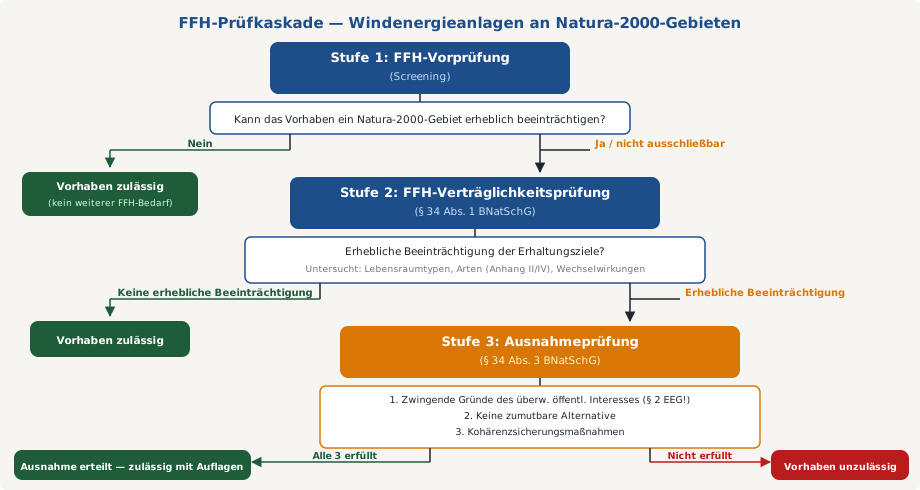
FFH assessment cascade — from screening to derogation under § 34 BNatSchG
Trigger Distances — When Is an FFH Assessment Required?
- Within the FFH area: FFH assessment always required (screening at minimum)
- Directly at the FFH area boundary: FFH assessment due to direct impact
- Within the functional range of conservation objectives: e.g. bird species with large territories (red kite, black stork, white-tailed eagle) — up to 6 km distance
- Coherence areas: where conservation objectives have interactions with neighbouring sites
Contents of the Full Assessment
- Site characterisation: catalogue all conservation objectives of the FFH area
- Impact prognosis of WTG construction and operation on each conservation objective individually
- Significance assessment: for each objective — is conservation endangered?
- Cumulative effects with other plans/projects in the area
- Mitigation measures: shutdown periods, seasonal restrictions, turbine positioning
- Final assessment: compatible / not compatible
Costs
Guide value EUR 8,000–40,000. Key factors:
- FFH screening (compact): EUR 4,000–10,000
- Full assessment with cartographic surveys: EUR 15,000–30,000
- Full assessment with own breeding/resting bird survey (1–2 seasons): EUR 25,000–60,000
- Derogation procedure with coherence measures: additionally EUR 30,000–80,000
Authorities Involved and Procedural Flow
The FFH assessment is legally part of the BImSchG permit procedure, but it is assessed on the merits by the nature conservation authority. Typically the lower nature conservation authority (county or independent city) is involved as part of the consultation of public-interest bodies (§ 10 BImSchG); in complex cases it brings in the upper nature conservation authority (district government / state agency). The permitting authority (for wind turbines usually the state environment agency or district government) ultimately makes the legally binding decision on whether the project is compatible with the conservation objectives. The applicant submits the FFH assessment as a standalone document; the authority either adopts the result in its own review or requests revisions.
In terms of timing, the FFH assessment runs parallel to the application preparation: first the nature-conservation field survey (potentially over one or two breeding seasons), then the impact prognosis, then the authority consultation. If the screening alone already shows that significant impairment can be reliably excluded, the procedure ends with a negative certificate — the most common and fastest outcome.
Significance Threshold and Standard of Review
The core of the FFH assessment is the concept of significant impairment. Under case law of the European Court of Justice and the Federal Administrative Court, the standard is whether the components of the site relevant to the conservation objectives are impaired in their function — not every measurable effect is automatically significant. Unlike species protection under § 44 BNatSchG, which focuses on the individual animal, this concerns the integrity of the site and the favourable conservation status of the protected habitat types and species. For wind turbines, typical impact pathways are collision risk for large birds and raptors, disturbance and avoidance effects for resting birds, and land loss and hydrological changes for sensitive habitat types under FFH Annex I.
Damage-mitigation measures — such as bat- or bird-related shutdown algorithms, seasonal construction windows, or turbine positioning adapted to flight corridors — may already be factored into the compatibility assessment. Only if significant impairment cannot be excluded even with these measures does the procedure move to the derogation process under § 34 para. 3 BNatSchG.
A Repowering Peculiarity
When old turbines are replaced with modern, taller ones, the FFH assessment can turn out differently than for an original permit: fewer but larger turbines often reduce the swept rotor area per megawatt and thus tend to lower collision risk, while at the same time greater hub heights can affect new altitude bands of bird flight. Existing monitoring data from the old turbines — such as documented collision victims or space-use analyses — is valuable here, because it empirically supports the impact prognosis and can shorten the survey duration. The authority legally treats repowering as a new project — an earlier permit offers no protection against a fresh FFH assessment.
Who Prepares the Assessment?
Environmental planning / nature conservation firms with FFH experience. Important: regional experience with the conservation objectives of the specific sites + calibrated methodology by federal state (e.g. NRW: LANUV methodology, Brandenburg: LfU). A cleanly documented review path — from site characterisation through the impact prognosis to the significance assessment for each conservation objective — is decisive, because FFH assessments are challenged in litigation disproportionately often.
Commission an FFH assessment
We connect you with a specialist firm with regional FFH experience — ideally combining the species protection assessment and landscape management plan under one roof.
Get in touchFrequently Asked Questions
What is the difference between an FFH assessment and a species protection report?
Both examine birds and other species, but under different legal bases. The species protection assessment under § 44 BNatSchG checks individual killing and disturbance prohibitions. The FFH assessment under § 34 checks site-specific conservation objectives. Both may be required — the requirements differ.
How long does a full FFH assessment take?
If own surveys are needed: 1–2 breeding seasons + assessment phase, total typically 18–30 months. With existing data: 4–8 months. For repowering, the timeline can be shortened if data from the existing turbine is available.
Is the authority bound by the FFH assessment conclusion?
Yes — if the full assessment finds "significantly impairing", the authority must deny the permit unless the derogation procedure (§ 34 para. 3 BNatSchG) is successfully completed.
What are "compelling reasons of overriding public interest"?
Since the WaLG (2022) and § 2 EEG, wind energy has been classified as being of "overriding importance" — this eases the derogation procedure. However, the hurdle remains high: the absence of alternatives must be demonstrated and coherence must be secured in another area.