EEG 2024 for Wind Energy
The EEG 2024 is the central reform for the Energiewende — and the game-changer for wind energy. Two key elements: § 2 EEG as the legal acceleration of permits, and the adjusted market premium with higher compensation in southern Germany.
§ 2 EEG — the key provision
The new § 2 EEG states:
"Die Errichtung und der Betrieb von Anlagen sowie die dazu erforderlichen Nebenanlagen liegen im überragenden öffentlichen Interesse und dienen der öffentlichen Sicherheit. Bis die Stromerzeugung im Bundesgebiet nahezu treibhausgasneutral ist, sollen die erneuerbaren Energien als vorrangiger Belang in die jeweils durchzuführenden Schutzgüter- und Rechtsgüterabwägungen eingebracht werden."
In translation: "The construction and operation of installations and the necessary auxiliary installations are in the overriding public interest and serve public safety. Until electricity generation is nearly greenhouse-gas neutral, renewables shall be given priority in all relevant assessments of protected interests and legal interests."
Concrete effects:
- Priority in balancing vs. other interests (except absolute protections)
- Facilitated derogation procedure under § 34 BNatSchG (FFH) and § 45 BNatSchG (species protection)
- Strengthened litigation position of applicants against municipal obstruction
BNetzA auction procedure
Support is available only through successful participation in the Federal Network Agency (BNetzA) auctions for onshore wind energy. 2026 auction dates:
| Auction date | Volume | Maximum value |
|---|---|---|
| Feb 1, 2026 | 4,000 MW | 7.35 ct/kWh |
| May 1, 2026 | 3,500 MW | 7.35 ct/kWh |
| Aug 1, 2026 | 4,000 MW | 7.35 ct/kWh |
| Nov 1, 2026 | 3,500 MW | 7.35 ct/kWh |
Volumes are illustrative; BNetzA adjusts annually. Maximum value was raised significantly from 6.00 ct/kWh (2022).
Reference value + market premium
A successful bid establishes the reference value (anzulegender Wert) for 20 years. The market premium is the difference to the monthly market value:
- Reference value (example): 7.20 ct/kWh
- Monthly market value for wind (example): 4.50 ct/kWh
- Market premium: 2.70 ct/kWh (paid by the transmission system operator)
At negative electricity prices (4 hours or longer): the market premium is suspended for the corresponding period.
South bonus
Locations in southern federal states (BW, BY, HE, RP, SL) receive a surcharge to promote regional distribution of wind energy. Currently approx. +0.30 ct/kWh on the reference value.
Low-wind bonus
Turbines at particularly low-wind sites (site quality factor < 70 % of reference site) receive a site correction factor that raises compensation above the northern German standard. This makes southern sites with weak wind resources economically viable.
Repowering support
- New turbine counts fully in the auction like a new build
- No additional repowering bonus (abolished in 2017)
- Faster procedure through WaLG facilitations for existing sites
- Better economics through modern turbines with higher full-load hours
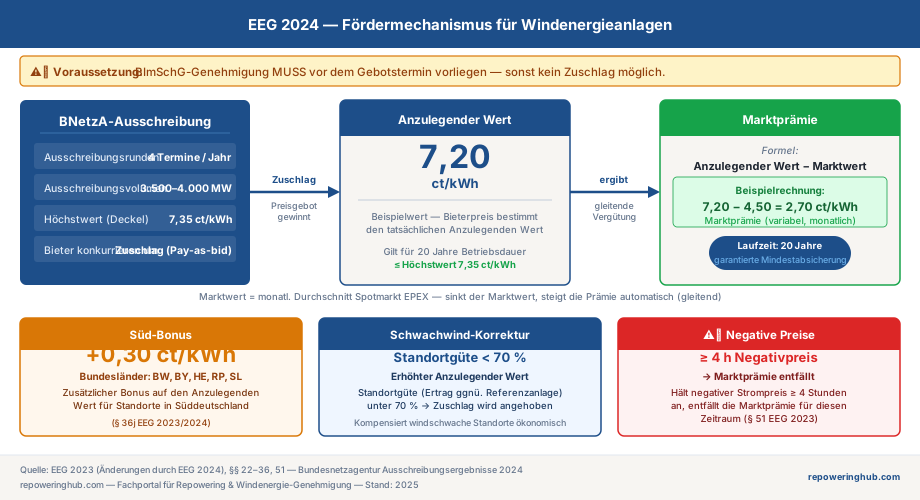
EEG support mechanism — from auction through award to market premium
Bid Bonds and Securities in the Auction
Anyone participating in a BNetzA auction must post a first and second security, which is forfeited if the project is not realized. The first security falls due with the bid itself and is designed to keep out speculative or non-serious bids; the second security is tied to later progress toward realization. These securities are a deliberate steering instrument: they shift the risk of a failed project from the auction system onto the bidder, which is why developers typically only bid once the permit and financing are largely secured.
Relationship to Other Marketing Routes
The market premium is the standard route, but not the only one. Alternatively, a turbine can be marketed directly to industrial customers through a long-term power purchase agreement (PPA) — without auction participation, but also without the price protection of the market premium. In practice, larger projects often combine both routes: part of the output runs through EEG support, another part is marketed separately via PPA, spreading the risk of negative-price hours.
Award to commissioning — deadlines
- Maximum 30 months from award to commissioning
- If exceeded: penalty of EUR 10/kW
- If not commissioned after 30 months: forfeiture of award + penalty
- 6-month extension possible with proven unattributable supply shortages
Bidding strategy for your wind farm?
We connect you with a specialized energy law firm and an experienced energy auditor for bidding strategy and profitability analysis.
Contact usCommon Questions
What if the bid exceeds the maximum value?
Such bids are invalid — participation in the next auction date is possible. Since 2023, award values have frequently been near the maximum value, indicating high competition.
Can I build without EEG support?
Yes — via PPAs (Power Purchase Agreements) directly with industrial customers or as self-supply. Without subsidy, a marketing partner with a long-term contract is needed.
What about community wind participation?
The EEG has no mandatory participation requirement, but individual federal states (MV, BB, NRW since 2025) do. There, typically a 20 % participation offer to residents + host municipality is required. This improves acceptance but reduces the owner share.
What happens after the 20-year EEG period expires?
The market premium ends. The turbine continues as a post-EEG installation — either via PPA, direct marketing at market price, or repowering with a new turbine.
Does a repowering turbine count as "new" in the auction system?
Yes, without restriction. The new turbine competes in the same auction procedure as any new build for the same maximum value — there is no separate repowering auction pot. The only advantage is the often faster permit at an already developed site.
How do the reference value and actual revenue relate to each other?
The reference value is a ceiling, not a guaranteed payout. In months with high market prices, the actual market value can even exceed the reference value — in that case the market premium is suspended and the operator sells at the higher market price. Averaged over a year, actual revenue usually sits close to the reference value, but it fluctuates with market price trends and the frequency of negative-price hours. This range should enter every profitability calculation as a bandwidth rather than a fixed figure — sound financing models therefore always run conservative and optimistic scenarios side by side rather than relying on a single point estimate.