Demand-Driven Night Marking (BNK) for Wind Turbines
Demand-driven night marking (BNK) is an anti-blink regulation: the red night lighting of a turbine only activates when an aircraft is nearby — instead of blinking continuously. This reduces nighttime light pollution by over 95 %.
Legal Basis
- § 9 para. 8 EEG: subsidy sanction if BNK is not installed
- Air Traffic Regulation (LuftVO): technical requirements for obstacle marking
- General Administrative Regulation on Marking of Aviation Obstacles (AVV-Kennzeichnung): detail regulations, last revised 2020
- Mandatory for turbines with total height > 100 m (= practically all modern onshore WTGs)
How It Works — Three Technology Lines
| Technology | How does it work? | Advantages | Providers |
|---|---|---|---|
| Primary radar | Ground/mast-mounted radar detects approaching aircraft within radius | Detects all aircraft, even without transponder | Lanthan Safe Sky, Dark Sky, Reetec |
| Transponder-based | Evaluates ADS-B signals of commercial aircraft | Lower hardware costs, no radar permit needed | Quantec Networks, ENERTRAG |
| Secondary radar / Hybrid | Combines primary and secondary radar data | Maximum detection performance | AvioSafe, Air Avionics |
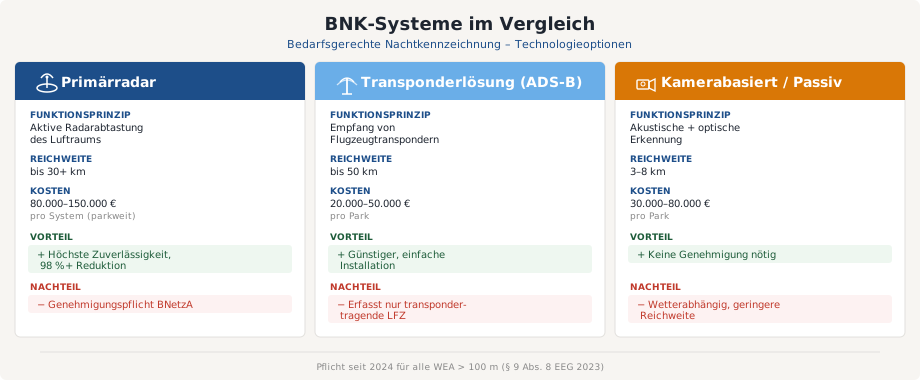
BNK systems compared — primary radar vs. transponder vs. passive/camera (mandatory since 2024 for WTGs > 100 m)
Retrofit Costs
Per turbine (existing fleet retrofit) typically EUR 25,000–40,000, depending on:
- Technology choice (radar significantly more expensive than ADS-B evaluation)
- Park size (radar rarely worthwhile for 1 turbine, economical from 3–5 turbines onward)
- Shared solution with neighbouring parks (shared radar reduces cost per turbine significantly)
- Permit process for the BNK system itself (own procedure at the Federal Network Agency and aviation authority)
Additionally, running costs of approx. EUR 1,000–3,000 per turbine per year for maintenance, software updates and ADS-B signal licence.
Existing Fleet Retrofit — Status
The original deadline of 31.12.2022 was extended multiple times due to supply shortages. Current status: mandatory retrofit by 31.12.2024, with exceptions for turbines where a shared BNK system with neighbouring parks is in preparation.
Typical Light Signals
- Daytime (good visibility): usually no lighting needed, or white daytime lights (for turbines > 150 m)
- Night without aircraft: lights off (= the BNK effect)
- Night with aircraft in detection radius: red lighting active (typically 4–8 minutes, then re-check)
- Poor visibility conditions: BNK system switches to permanent lighting as safety standard
BNK in Repowering: Don't Forget It
In repowering projects, the BNK question often surfaces too late because it doesn't appear as its own review point in the BImSchG permit procedure. New turbines are almost always taller than 100 m total height and therefore subject to marking from day one — an existing BNK system from the old turbines generally cannot simply be carried over, because the number, position, and detection radius of the turbines change. It makes sense to start BNK planning in parallel with grid-connection and expert-report planning, so the turbine doesn't go live without a functioning marking system.
Permit Procedure for the BNK System Itself
Night marking is not a mere accessory — it goes through its own procedure, downstream of the wind turbine permit itself. The BNK provider registers the system with the Federal Network Agency and, for radar systems, coordinates frequency use and possible interference with other radio applications with the relevant aviation authority. For primary radar solutions, the authority additionally checks whether neighbouring wind farms lie within the detection radius and whether a shared system makes sense. This coordination process typically takes several months and should therefore be started well ahead of the planned commissioning date.
Who Handles the Planning?
BNK providers (Lanthan, AvioSafe etc.) typically handle complete planning + the permit procedure at the Federal Network Agency + aviation supervisory authority. Independent engineering firm planning is possible but rarely economical.
BNK retrofit for your wind farm?
We connect you with a certified BNK provider — optionally including a comparison of multiple technology options and shared radar solutions with neighbouring parks.
Get in touchFrequently Asked Questions
Does BNK work for very small aircraft or drones?
ADS-B-based systems only detect aircraft with an active transponder (all commercial aircraft, many private pilots). Radar systems detect all objects above a certain minimum size. Drones are technically difficult to detect — with dense drone traffic (rare) radar is superior.
What about turbines built before 2017?
They must also retrofit — the deadline applies to the entire existing fleet. Exception: turbines to be replaced by repowering within the next 5 years can apply for a justified deferral.
Can multiple parks share one BNK system?
Yes — this is in fact the most economical approach. A primary radar can cover a radius of up to 10–15 km. Common practice in northern German park clusters; costs per turbine drop to EUR 10,000–15,000.
What is the state of BNK research?
The AVV-Kennzeichnung is continuously updated. Currently under discussion: extension to demand-driven daytime marking (daytime BNK) and automatic visibility detection for reduced daytime flashes.
Must BNK be functional before commissioning?
Yes. A turbine may not go live without a working night marking system — the permit ties commissioning to proof of a functional lighting system. A subsequent trial run without BNK is not permitted.
How reliable are the detection systems in practice?
Certified systems must meet defined detection rates and maximum response times, which are checked during the approval process. In day-to-day operation, providers report high availability; failures of individual components generally trigger an automatic fallback to permanent lighting as the safety default, so aviation safety is maintained even if the BNK system malfunctions. This fail-safe mechanism is a central review point in the authority's approval of the system and is separately checked and documented during system acceptance.