EIA for Wind Turbines in Germany
The Environmental Impact Assessment (EIA) under the UVPG is, alongside noise protection, the second major hurdle in the BImSchG permitting procedure. The required depth is determined by Annex 1 Nr. 1.6 UVPG in three tiers — depending on park size.
The Three Tiers — Which Applies?
| Number of WEA (total height > 50 m) | Tier | What does it mean? |
|---|---|---|
| 20 or more | X — Mandatory EIA | Full EIA with environmental impact study (UVS), public participation, hearing |
| 6 to 19 | A — General screening | Authority checks whether full EIA is needed; result: usually a negative certificate (= no EIA required); upstaging to X if issues arise |
| 3 to 5 | S — Site-specific screening | Shorter authority screening, almost always a negative certificate. Upstaging only with protected area location. |
| 1 to 2 | — | No EIA obligation, only BImSchG pre-screening |
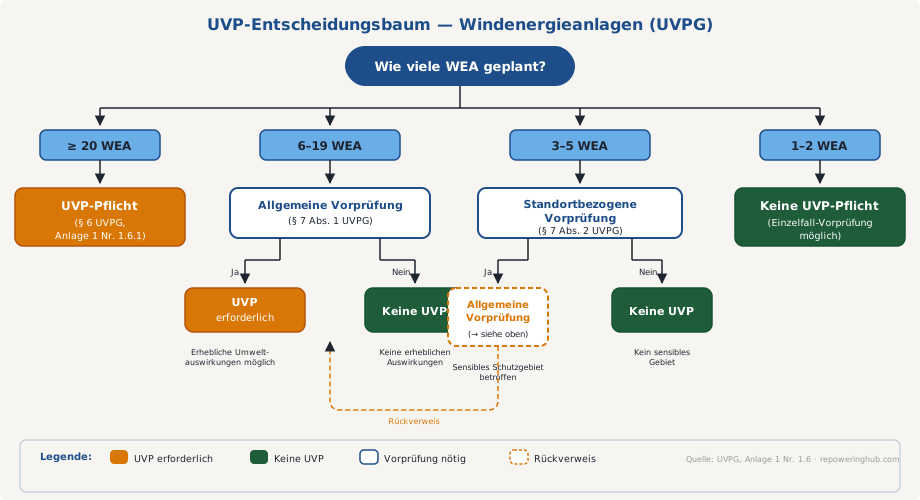
EIA decision tree under UVPG Annex 1 Nr. 1.6 — depending on park size and protected area location
Upstaging Through Protected Areas
Even if park size only requires S or A screening: when located in or directly adjacent to an FFH, bird protection, nature reserve, or landscape protection area, the screening is practically always upstaged to a full EIA, because FFH compatibility alone already triggers the investigation effort of a full UVS.
What Does the UVS Contain?
The environmental impact study (UVS) is the core document of a full EIA. It covers all protected interests:
- Human — noise, shadow flicker, visual impact, ice throw, visibility, recreational use
- Animals & plants — avifauna assessment, bats, biotope mapping, FFH compatibility assessment
- Soil — foundation intervention, road construction, soil function loss
- Water — groundwater for deep foundations, surface water for access roads
- Climate & air — usually presented as a positive impact (CO₂ avoidance)
- Landscape — visualization assessment with photo-montages from 6–12 viewpoints
- Cultural & material assets — monuments, archaeologically sensitive areas
- Interactions between protected interests
Per protected interest: inventory, impact prognosis, assessment, measures (avoidance, mitigation, compensation), and residual impact.
The Five Phases of an EIA
- Scoping — authority and applicant agree on the scope of investigation
- UVS preparation by the applicant (with expert consultants) — typically 9–18 months
- Public participation — public display, objection period (minimum 1 month)
- Hearing in formal procedure
- Assessment & decision by the authority — integral part of the BImSchG permit
What Does an EIA Cost?
The UVS itself (the core document) typically costs EUR 30,000–80,000 in consultant fees. In addition, individual expert reports (noise, shadow flicker, species protection, landscape) together amount to EUR 50,000–150,000. The total expert report burden for a full EIA is therefore typically EUR 80,000–230,000.
Cumulation: When Neighboring Projects Are Added Together
The X/A/S classification is not based solely on the project itself, but also on cumulating projects nearby — for example already-permitted or simultaneously applied-for wind farms in spatial and functional proximity. A project with only 4 of its own turbines can effectively slide into the A or even X tier if a neighboring park a few kilometers away is counted alongside it. This cumulation check is a frequently underestimated point in early project planning, because it depends on the site choices of other, independent developers and is only conclusively resolved during the procedure itself.
Simplification for Repowering
For repowering at already anthropogenically impacted sites, the EIA depth can be justified as reduced — many protected interests have already been assessed for the existing turbines. The WaLG (2022) has explicitly strengthened repowering facilitations.
EIS preparation for your wind farm?
We connect you with an EIA-experienced engineering firm that coordinates the UVS and all required individual expert reports.
Contact usFrequently Asked Questions
What if screening finds "no EIA needed"?
The authority determines that no significant environmental impacts are expected. The procedure continues without a UVS — however, individual expert reports (noise, shadow flicker, species protection) are still mandatory.
Who decides whether an EIA is needed?
The competent BImSchG authority (county office, district government, varies by federal state) — based on the screening. The decision is challengeable.
What is the difference between EIA and FFH assessment?
The EIA is the overarching environmental review. The FFH compatibility assessment is an independent procedure under § 34 BNatSchG that specifically examines compatibility with FFH conservation objectives. At FFH sites, both are usually required.
Can an NGO challenge the EIA decision?
Yes — recognized nature conservation organizations (BUND, NABU) have legal standing under the Environmental Legal Remedies Act (Umweltrechtsbehelfsgesetz). In recent years, numerous wind farms have been stopped through successful lawsuits — mostly due to deficiencies in the EIA or the species protection report.
What happens when the authority demands additional studies mid-procedure?
This is the most common reason for delays in EIA-obligated projects. If the authority, after reviewing the submitted UVS, finds that a protected interest was insufficiently investigated — for example too short a survey period for species protection — it requests supplementary work. Because field surveys are tied to vegetation periods and migration seasons, such a request can extend the procedure by a full survey season, up to 12 months. Careful agreement on the scope of investigation at the scoping meeting is therefore the most effective lever against procedural delays.
How does the EIA obligation differ for ground-mounted solar parks?
For ground-mounted solar parks, the UVPG applies its own area-based threshold instead of the turbine-count threshold used for wind energy. The underlying system of mandatory EIA, general screening, and site-specific screening is otherwise identical.
Must the screening decision itself be publicly accessible?
Yes. Even when no full EIA is carried out, the result of the screening — the finding on whether significant environmental impacts are expected — must be publicly announced and justified under § 5 UVPG. This screening decision can be challenged independently of the later permit decision itself — a point that lawsuits against wind farms regularly raise in practice — making a carefully documented screening an effective safeguard against later delays from litigation.