TA Lärm for Wind Turbines
The Sixth General Administrative Regulation to the BImSchG (TA Lärm — Technical Instructions on Noise) is the binding assessment standard for wind turbine noise in Germany. It regulates permissible noise levels at residential buildings and provides the methodology for prognosis and evaluation.
Immission Thresholds (Section 6.1 TA Lärm)
| Area type | Day (06–22 h) | Night (22–06 h) |
|---|---|---|
| Industrial area (GI) | 70 dB(A) | 70 dB(A) |
| Commercial area (GE) | 65 dB(A) | 50 dB(A) |
| Mixed/core area (MI/MK), village area (MD), urban area (MU) | 60 dB(A) | 45 dB(A) |
| General residential area (WA), small settlement area (WS) | 55 dB(A) | 40 dB(A) |
| Pure residential area (WR) | 50 dB(A) | 35 dB(A) |
| Health resort areas, hospitals, care facilities | 45 dB(A) | 35 dB(A) |
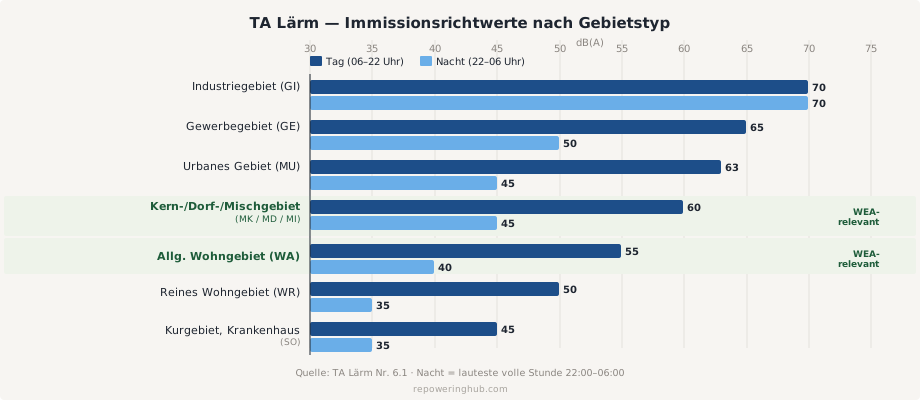
TA Lärm thresholds by area type — day vs. night (WTG-relevant areas highlighted)
For wind turbines, the night-time threshold at the nearest WA area (40 dB(A)) or MI/MK/MD area (45 dB(A)) is decisive in practice — wind and therefore noise are often strongest at night, and WTGs operate 24/7.
How Is Noise Measured / Predicted?
- Sound power level LWA of the individual turbine from manufacturer measurement (FGW TR 1, IEC 61400-11) — the unrounded source value
- Propagation calculation per DIN ISO 9613-2 (point source model, octave bands)
- Level addition for multiple WTGs + pre-existing noise from other sources at the immission point
- Worst-case additions: +2σ on manufacturer LWA, unfavorable weather/wind direction assumed
- Comparison with threshold for the area type at the immission point
When the Threshold Is Exceeded
The noise protection report must propose mitigation measures:
- Noise-reduced night mode: RPM/pitch reduction 22–06 h, documented in the manufacturer mode (e.g. "Mode 3"). Reduces LWA by 2–6 dB. Yield loss 1–4 % p.a.
- Alternative turbine selection: switch to a type with lower LWA or a certified quiet mode
- Layout adjustment: move critical turbines further from the immission point
- Receiver-side noise protection (sound-insulated windows): theoretically possible, rarely applied in practice
Peak Level Criterion (Section 6.1 Sentence 2)
Individual short-term noise peaks may not exceed the threshold by more than 30 dB(A) during daytime and 20 dB(A) at night. For wind turbines, this is practically never relevant because the noise is continuous and even.
Tonal and Impulsive Character
If the turbine produces tonal or impulsive noise (e.g. gearbox whine, "thumping"), a surcharge of 3–6 dB is added to the assessment level. In modern wind turbine technology, this has been practically eliminated; it was relevant for some older gearbox types.
Pre-Existing and Additional Noise Load
If the pre-existing noise is less than 6 dB below the threshold, the WTG may be added as long as the total does not exceed the threshold. If the pre-existing noise is already at the threshold, the WTG may contribute practically nothing. This is critical at sites near commercial areas or railway lines.
TA Lärm in Repowering: New Source, Old Neighbors
Even at an existing site, no earlier permit substitutes for a fresh noise prognosis for the new turbines. Modern repowering turbines typically have a higher absolute sound power level than the old ones, but sit on taller hubs and in smaller numbers — the result at the immission point cannot be inferred from the old permit; it must be recalculated in full. In practice, this effect is one of the most common reasons a repowering project at an otherwise suitable site ends up needing a noise-reduced night mode or a different turbine choice, even though the old turbine ran there without complaint.
Interplay With Other Immission Control Topics
TA Lärm is one of several administrative regulations that interact within the BImSchG procedure: noise is assessed under TA Lärm and DIN ISO 9613-2, shadow flicker under the LAI guidelines, and night marking under the requirements for demand-driven night marking. These reviews run in parallel within the BImSchG procedure but are handled by different specialist authorities or expert consultants — early coordination between the commissioned firms prevents contradictory layout requirements, for instance when a turbine position is acoustically optimal but problematic for shadow flicker.
Acceptance Measurement After Commissioning
The permit almost always includes the condition of an acceptance measurement within 6 months after commissioning. The actual sound power level of the built turbine is checked against the value used in the prognosis. If there is a deviation, retrofitting or night-mode adjustments are required.
Noise protection concept for your wind farm?
We forward your enquiry to an accredited acoustic engineering firm — from site feasibility check to the complete acoustic emission prognosis and acceptance measurement.
Get in touchFrequently Asked Questions
What about infrasound?
TA Lärm only covers the audible frequency range (16 Hz – 16 kHz). Infrasound (< 20 Hz) is not captured. Studies (e.g. UBA 2020, "Mensch+Umwelt") show no health effects below the perception threshold. For low-frequency components (8–100 Hz), DIN 45680 applies but is rarely required in WTG permitting procedures.
Does TA Lärm apply to the construction phase?
Yes, but with separate rules (AVV-Baulärm). Construction noise is assessed differently from operational noise — mitigation measures are required when thresholds are exceeded, but higher tolerance applies given the temporary character.
Is there a TA Lärm revision 2024/25?
TA Lärm has been under revision for years. As of 2026, the 1998 version still applies unchanged with minor amendments. The expected key change: updated methodology for pre-existing and additional noise load assessment.
Can noise from other nearby facilities jeopardize a WTG permit?
Yes, through the pre-existing noise rule: if other noise sources at the immission point (commercial operations, roads, other turbines) already sit close to the threshold, little or no room remains for the new turbine. The noise report must therefore always capture the real pre-existing situation at the site, not just assess the planned turbine in isolation.
When multiple WTGs are at the same site, is the noise simply added up?
Yes, but logarithmically, not linearly: two equally loud sources raise the overall level by roughly 3 dB, not double. In practice this means a wind farm with many turbines does not get proportionally louder at the immission point — the level addition per DIN ISO 9613-2 captures this effect precisely, and it's why larger parks are often more manageable acoustically than a naive multiplication would suggest.