LAI Guidelines for Wind Turbines
The LAI (Bund/Länder-Arbeitsgemeinschaft Immissionsschutz) published uniform guidelines in 2002 for assessing periodic shadow flicker from wind turbines. These have been adopted in nearly all federal states as a binding assessment basis — the so-called 30/30/8 rule.
The Three Thresholds (Core of the Guidelines)
| Threshold | Value | What does it mean? |
|---|---|---|
| Astronomical (worst-case) | ≤ 30 h per year | Assumption: sun always shines, turbine always rotates, wind from unfavorable direction |
| Daily value | ≤ 30 min per day | Maximum shadow duration on a single day |
| Real-meteorological | ≤ 8 h per year | Actual shadow duration accounting for clouds, wind, and standstill |
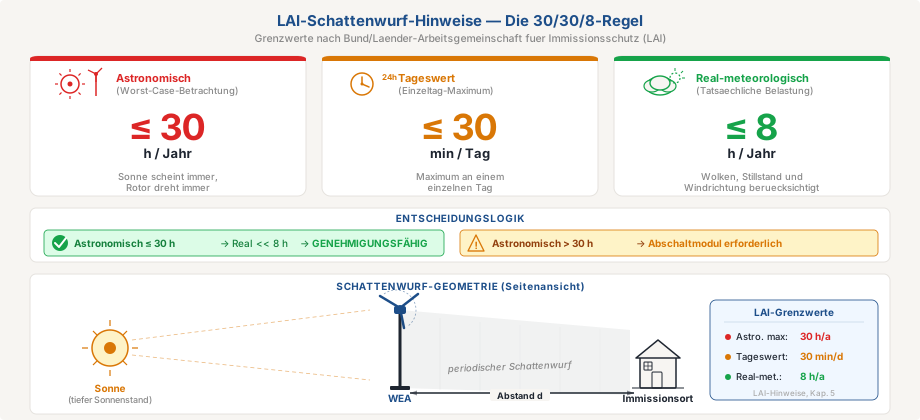
The three LAI thresholds for shadow flicker — astronomical, daily, and real-meteorological
In practice, the astronomical 30 h value is usually decisive — if met, the real value is automatically well below the threshold.
How Is It Calculated?
- Geometric modeling of the turbine (rotor diameter, hub height, site coordinates)
- Sun position calculation year-round (astronomy algorithm, second-precise)
- Shadow projection onto the immission point (residential building, mapped with protection status)
- Accumulation per day and total — comparison against the three thresholds
- Cartographic display as iso-line maps
Shadow Flicker Shutdown Module
If calculations show that thresholds would be exceeded at an immission point, a shadow flicker shutdown module is prescribed:
- Astro-clock pre-programmed with site coordinates and immission point locations
- Brightness sensor detects whether the sun is actually shining (no sun = no shadow)
- Optional: wind direction sensor to shut down only when the rotor faces the critical direction
- Module shuts down the turbine preventively once the daily or annual budget at the immission point is reached
- Yield loss typically < 1% per year
Other Content of the LAI Guidelines
- Reflection ("disco effect"): practically eliminated by matte rotor blade coating. Addressed in the guidelines but rarely relevant in practice.
- Concept of immission points: calculations are performed at habitable rooms (bedroom, living room), not at the exterior wall.
- Pre-existing load: for multiple turbines, shadow effects are accumulated per immission point.
Why the Astronomical Value Is What Counts in the Procedure
The authority almost always bases the permit on the astronomical worst-case value (30 h/year), not the more realistic 8-hour limit — for precautionary reasons and because actual meteorology cannot be reliably forecast over the turbine's lifetime. For the operator this means: a site that narrowly exceeds the 30-hour threshold astronomically will practically always need a shutdown module — even if the real impact from cloud cover and wind direction would foreseeably be much lower. Calculation software therefore routinely computes both values in parallel, so permit risk and expected yield loss from shutdown can already be estimated at the planning stage.
Repowering: New Geometry, New Calculation
Even where a shadow flicker report already exists for the old turbine at a site, repowering requires a complete recalculation. Larger rotors and higher hub heights change both the shadow length and its distribution over the day — an immission point that was unproblematic for the old turbine can exceed the thresholds for the new, larger one, even if the number of turbines at the site decreases. Conversely, the lower turbine count often reduces the cumulative effect at some immission points. Both effects can only be captured cleanly through a full recalculation.
Revision of the LAI Guidelines — Status 2026
The LAI has announced a revision of the guidelines. Triggers include the EEG 2024 reforms that make larger turbine heights common, and lawsuits challenging detail aspects of the existing version. A new version is expected in 2026/27. Until then, the 2002 version applies unchanged.
Shadow flicker report for your site?
We connect you with an engineering firm that calculates according to LAI using certified software (WindPRO, WindFarmer) — including the shutdown module concept.
Contact usFrequently Asked Questions
Are the LAI guidelines legally binding?
They are an administrative regulation, not statutory law, but consistently applied by permitting authorities and recognized by courts. Any deviation requires special justification.
Who checks compliance with the 30/30/8 rule after commissioning?
The permitting authority, in complaint cases via spot measurements at the immission point or readout logs from the shadow flicker shutdown module.
What about federal states that haven't adopted the LAI guidelines?
Very few states deviate — and even there the LAI values are the de facto standard because no competing regulation exists. Bavarian practice is identical to other states.
Does the 30/30/8 rule apply to offshore turbines?
No — offshore turbines have no relevant shadow flicker impact on residential buildings. The LAI guidelines apply exclusively to onshore turbines.
Can a shutdown module be retrofitted?
Yes, this is technically straightforward and common in practice when it turns out after commissioning that the real impact is higher than forecast, or nearby development changes. The retrofit is handled through the turbine control system and typically requires no new permit, only a notification to the competent authority.
How are multiple affected immission points handled at the same time?
Each relevant immission point is checked individually against the three thresholds. The shutdown module is programmed separately for each immission point — the turbine shuts down as soon as the daily or annual budget is reached for any monitored location, regardless of whether other locations have already used up their budget. With many immission points in different compass directions, the turbine's total shutdown time can therefore increase noticeably compared with a single-location site.