Power Purchase Agreement (PPA) for Wind Energy
A PPA is a long-term power supply contract between a wind farm operator and an off-taker (typically an industrial customer). It is the standard marketing route after EEG expiry — and increasingly an alternative to the EEG market premium for new installations as well.
Three PPA Types
| Type | Power Flow | Practice |
|---|---|---|
| Physical PPA | Direct power flow from wind farm to off-taker | Where sites are close (e.g. aluminium smelter directly adjacent) |
| Financial PPA | Cash flow only, no physical power delivery. Difference payments between agreed PPA price and market price | Most common form, location-independent |
| Sleeved PPA | Power flow via a utility as intermediary, which assumes balancing group risks | Very common in practice — utility as intermediary |
Current PPA Prices Onshore Wind 2026
| Term | Pay-as-Produced | Baseload-Structured |
|---|---|---|
| 5 years | 50–65 €/MWh | 60–80 €/MWh |
| 10 years | 45–60 €/MWh | 55–75 €/MWh |
| 15 years | 40–55 €/MWh | 50–70 €/MWh |
“Pay-as-Produced” = power is sold as generated (volatile). “Baseload-Structured” = delivery is reshaped to constant load via storage/gas backup — significantly higher prices because marketing risk is covered.
PPA Buyer Types
- Energy-intensive industry: Aluminium (TRIMET, NorAl), steel (Salzgitter, ArcelorMittal), chemicals (BASF, Dow)
- Data centre operators: Microsoft, Google, AWS — very active in the PPA market
- Utilities for their own retail portfolio (RWE, EnBW, Vattenfall)
- On-site consumers: industrial facilities with direct grid connection
PPA vs. EEG Market Premium
| EEG Market Premium | PPA | |
|---|---|---|
| Remuneration | Auction cap 7.35 ct/kWh | 4–6.5 ct/kWh |
| Term | 20 years guaranteed | 5–15 years negotiable |
| Bankability | Very high | Depends on buyer creditworthiness |
| Risk | Negative-price hours without market premium | Buyer credit risk, price risk after contract end |
| Complexity | Standard BNetzA process | Individual negotiation, lawyer-intensive |
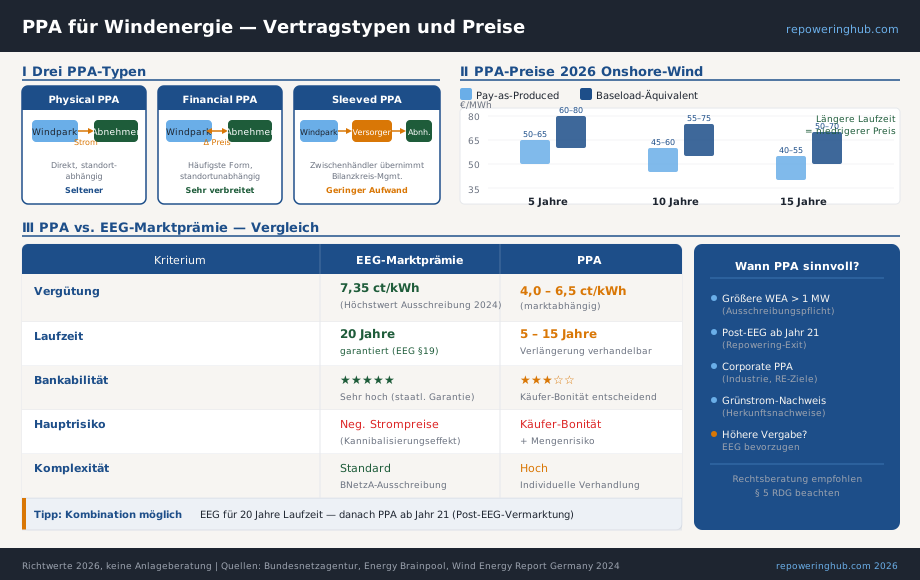
PPA for wind energy — contract types, prices and comparison with EEG market premium
Typical PPA Clauses
- Minimum/maximum delivery volume per year
- Bandwidth corridor (e.g. 80–120 % of expected delivery volume)
- Force majeure: extreme weather, regulatory requirements
- Balancing group responsibility: usually with the buyer (sleeved) or utility intermediary
- Price adjustment clauses: often fixed, occasionally CPI-indexed
- Credit security: bank guarantee, parent company guarantee, prepayment options
PPA Brokerage for Your Wind Farm?
We connect you with PPA-specialised energy brokers (Schneider Electric, Statkraft, Axpo) — buyer search, structuring, contract negotiation.
Get in TouchThe Path to Signing a PPA
In practice, several months typically pass before a PPA is ready for signature. It begins with a structuring phase: the seller (wind farm operator), together with an energy broker or directly with prospective buyers, determines whether a physical, financial or sleeved model is appropriate, and prepares a yield forecast based on expected full-load hours. A marketing phase follows, in which the project is presented to prospective off-takers — often through structured tender processes in which several industrial customers or utilities participate in parallel. Once a buyer is selected, a term sheet covering the key parameters (price, term, delivery volume, structure) is negotiated before the actual PPA contract is finalised by energy-law specialist firms on both sides. In parallel, the financing bank usually reviews the PPA draft, since the buyer's creditworthiness and the contract structure have a direct bearing on the wind farm's financing terms.
Price Risk and Hedging Strategies
A central risk of any PPA is how the wholesale electricity price develops over the contract term. Under a financial PPA, the seller receives the agreed fixed price regardless of the actual market price — if the market price rises above the PPA price, the seller forgoes the difference; if it falls below, the seller is correspondingly protected. The reverse applies for the buyer: industrial customers with high electricity consumption often use PPAs specifically to hedge against future electricity price increases, comparable to insurance against price volatility. Another, often underestimated, risk is so-called basis risk: if the wind farm's actual generation timing (a lot of wind, a lot of power at times of low exchange prices) systematically deviates from the agreed delivery pattern, realised revenue can fall noticeably short of the original calculation — an effect that tends to increase rather than decrease as the share of renewables in the grid grows, and should be factored in conservatively when assessing economics.
PPAs and Repowering — Contract Adjustment on Turbine Replacement
An ongoing PPA contract as a rule refers to a specifically defined generation asset with a particular capacity and expected yield curve. In repowering with new, higher-capacity turbines, both total capacity and the generation profile change — an existing PPA therefore regularly needs to be renegotiated or at least contractually adjusted. In practice, it is advisable to already anchor a repowering clause when the original PPA is signed, setting out the basic conditions for adjusting delivery volume and price in the event of a later turbine replacement. Without such a clause, the transition from the old to the new turbine can create a contractual gap in which the wind farm is temporarily covered by neither the old nor a new PPA — a risk that should be explicitly considered when scheduling repowering.
Role of Energy Brokers and Market Platforms
Because PPA contract negotiations are individual and legally demanding, most transactions run through specialised energy brokers or the trading desks of large utilities. These brokers typically handle buyer sourcing, market price assessment and pre-structuring of the contract, before energy- law specialist lawyers take over the final contract drafting. For smaller wind farms below a certain generation volume, it is often worthwhile bundling with other generation assets into a joint PPA portfolio, since individual buyers tend to be interested in larger, more predictable delivery volumes than the output of a single turbine. When selecting a broker or marketing partner, look for demonstrable experience with comparable wind projects, transparency in price formation, and a clear separation between advisory fees and any hidden margins in the electricity price.
Frequently Asked Questions
Are PPAs suitable for repowering projects?
Rarely as primary marketing route — banks prefer financing against EEG market premium due to credit stability. PPAs are the standard option for the post-EEG phase or for top-tier sites without an EEG award.
What happens after PPA expiry?
Extension or new PPA with a different buyer, or spot market marketing. The electricity market outlook for 2030+ is the central uncertainty in investment appraisals.
Who bears the volume risk?
Under “pay-as-produced” the buyer does (they take whatever comes). Under “baseload-structured” the seller does (they must reshape output to constant load via storage/backup).
Does a PPA always require an energy broker?
Not strictly, especially for direct negotiations between a wind farm operator and a single large off-taker. In practice, however, an experienced broker considerably eases buyer sourcing and market-based price discovery, particularly for smaller generation volumes without an established buyer relationship.