Wind Energy Subsidies in Germany
Onshore wind in Germany is primarily supported through the EEG market premium. In addition, KfW loans, regional subsidy programmes and tax incentives are available. Overview of the key instruments in 2026.
EEG Market Premium (Main Instrument)
- Participation in auctions run by the Federal Network Agency (BNetzA, 4 rounds per year)
- Award = reference value (anzulegender Wert; subsidy period 20 years from commissioning)
- Cap value 2026: 7.35 ct/kWh
- Market premium = reference value minus monthly market value for wind
- Lapses after more than 4 consecutive hours of negative power prices
- More: EEG 2024 in detail (DE)
South Bonus
For sites in BW (Baden-Württemberg), BY (Bavaria), HE (Hesse), RP (Rhineland-Palatinate), SL (Saarland): +0.30 ct/kWh on top of the reference value. Intended to promote regional distribution of wind turbines across Germany.
Low-Wind Correction (Site Quality Factor)
Turbines at low-wind sites receive a correction factor that increases remuneration:
| Site Quality | Factor |
|---|---|
| 100 % (reference) | 1.00 |
| 90 % | 1.11 |
| 80 % | 1.29 |
| 70 % | 1.49 |
| 50 % | 2.07 (lower bound) |
Assessment at 5/10/15 years — actual yield is compared with the reference yield, and remuneration is adjusted retroactively.
KfW Funding Programmes
- KfW Programme 270 “Renewable Energies Standard”: promotional loan up to 50 million € per project, interest rate currently from approx. 3.5 % p.a., term up to 30 years
- KfW Programme 277 “Renewable Energies Premium”: repayment subsidies for particularly innovative projects
- State-level programmes: BB (Brandenburg), NDS (Lower Saxony), MV (Mecklenburg-Vorpommern) have their own programmes for community wind and cooperatives
Tax Incentives
- Investment deduction allowance (§ 7g EStG): 50 % of the investment can be claimed in advance for tax purposes
- Special depreciation (§ 7g para. 5 EStG): 20 % in the first 5 years
- Trade tax: 70 % goes to the host municipality — an important factor for local acceptance
Community Wind Subsidies (State Level)
Mecklenburg-Vorpommern (MV, since 2016), Brandenburg (BB, since 2024), North Rhine-Westphalia (NRW, from 2025) — mandatory citizen participation with 20 % equity share at preferential conditions. Facilitates bank financing and improves local acceptance.
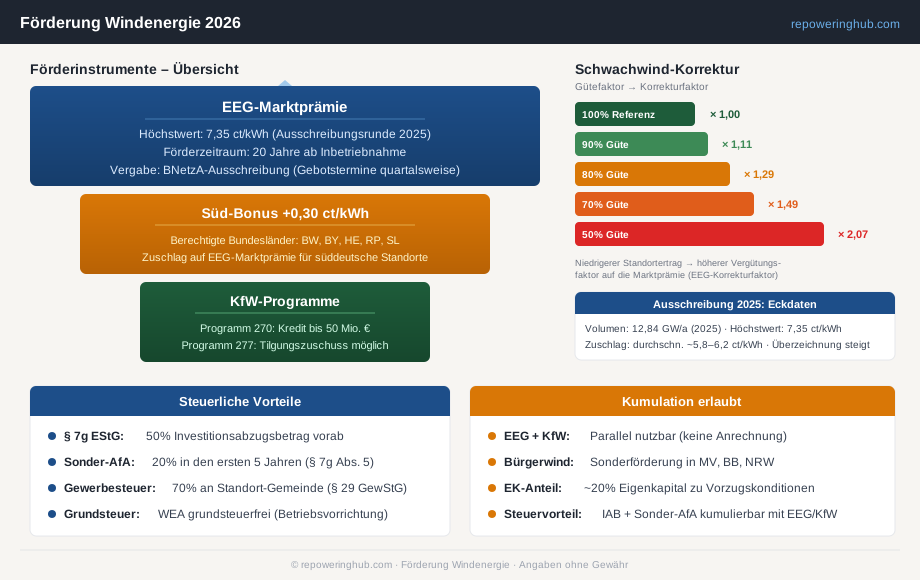
Wind energy subsidies — subsidy pyramid, site quality correction and tax incentives
Subsidy Advice for Your Project?
We connect you with a specialist subsidy advisor and KfW application support. Optimum subsidy combination and tax optimisation.
Get in TouchThe Auction Procedure in Detail
The Federal Network Agency (BNetzA) runs onshore wind auctions under §§ 28 ff. EEG 2024 in four rounds per year (1 February, 1 May, 1 August, 1 November). Participation requires a BImSchG permit as a pre-qualification condition — without a legally valid permit, a bid is formally inadmissible. The procedure runs pay-as-bid: each successful bidder receives their own bid value, not a single uniform cap value, as long as the bid is below the statutory cap. In under-subscribed rounds — where fewer bids arrive than the tendered volume — virtually all formally admissible bids are awarded regardless of price, up to the cap value. This happened in several rounds in 2023/24 and noticeably increased the realised support rate.
After an award, a 30-month realisation deadline begins (extendable by up to 24 months in case of litigation). If the turbine is not commissioned in time, part of the security deposit is forfeited — the so-called penalty (Pönale), tiered by project size and currently typically in the range of €10,000–15,000/MW in practice.
Grid Expansion Area and South Quota
Two regional steering instruments supplement the regular auction. The grid expansion area (parts of Schleswig-Holstein, Lower Saxony, Mecklenburg-Vorpommern) caps the buildable capacity to avoid further aggravating grid bottlenecks — the realisable build-out volume per auction round is capped there. Conversely, the south quota under § 36h EEG reserves a minimum share of the auction volume for southern sites (BW, BY, HE, RP, SL), to balance out wind energy distribution that is heavily concentrated in northern Germany. For developers in southern Germany, this effectively means a higher award probability compared with open competition against sites near the North Sea coast.
Innovation Auction and Hybrid Plants
Since 2021 a separate innovation auction has existed for combinations of at least two renewable technologies sharing a single grid-connection point (e.g. wind + solar + storage). The goal is a more even feed-in profile over the course of the day and better utilisation of the grid connection. The award is technology-open, based on the bid price per kW of combined capacity. For repowering sites with an existing, often not fully utilised grid connection, adding solar or storage afterwards can be economically attractive — permitting hurdles are usually lower than for a standalone new build, because the infrastructure already exists.
Repowering and Its Special EEG Treatment
Repowering projects formally participate in the regular auction like new builds — there is no separate repowering subsidy pot. There is a practical advantage nonetheless: because wind-measurement data for the old turbine's site is often available for years, the reference yield for the site quality factor can be calculated very reliably, which lowers the forecasting risk in the auction bid compared with an unknown new-build site.
Bid Strategy: Not Always Bid the Cap Value
A common misconception is that every bid should be submitted at the statutory cap value of 7.35 ct/kWh. In fact, a lower bid value reduces award risk in an over-subscribed auction round, because in the wind-energy segment the cheapest bids are generally awarded first, until the tendered volume is reached. Developers with very windy sites and correspondingly low LCOE can therefore deliberately position themselves below the cap value to increase their award probability — a trade-off between remuneration level and realisation certainty that should be underpinned project-by-project with an LCOE calculation, see LCOE calculation. In under-subscribed rounds with little competition, this calculus shifts back in favour of the maximum bid, since practically every formally admissible bid receives an award.
Frequently Asked Questions
What happens after the 20-year EEG period expires?
Subsidy ends. Marketing options include PPA, spot market direct marketing, self-consumption, or a new EEG award (in the case of repowering).
Can repowering be combined with subsidies?
Yes — repowering follows the same EEG process as new build. Plus potential KfW funding. Details: Repowering and EEG (DE).
Are there still investment grants?
At federal level, no. Individual states (mainly in northern Germany) occasionally have programmes for community wind or cooperatives — temporary and budget-limited.