Direct Marketing of Wind Power
Since EEG 2014, all wind turbines > 100 kW must sell their power via direct marketing — i.e. through a marketer at the power exchange or to industrial off-takers. The EEG market premium (German: Marktprämie) compensates the difference between market price and the reference value (anzulegender Wert). Overview: obligation, marketers, cash flow.
How Does Direct Marketing Work?
- Wind turbine physically feeds power into the grid
- Marketer (“Direktvermarkter”) takes the power into their balancing group (Bilanzkreis)
- Marketer sells power at the power exchange (EPEX, EEX) or to off-takers (PPA)
- Revenue = spot market price × MWh, less marketer fee
- Transmission system operator additionally pays the market premium: reference value minus monthly market value for wind (Monatsmarktwert Wind)
- Total revenue for operator = market value + market premium − marketer fee
Choosing a Marketer
| Marketer | Profile | Fee (indicative) |
|---|---|---|
| Statkraft Deutschland | Market leader, multi-asset | 1.2–1.8 €/MWh |
| EnBW Direktvermarktung | Major utility subsidiary | 1.5–2.2 €/MWh |
| Axpo Deutschland | Swiss utility, RE specialist | 1.3–2.0 €/MWh |
| Trianel | Municipal utility consortium | 1.5–2.5 €/MWh |
| Next Kraftwerke | Virtual power plant, tech focus | 1.8–2.5 €/MWh |
| Vasa Energy | Small, agile marketer | 1.4–2.0 €/MWh |
Market Premium Calculation
Market premium [€/MWh] = reference value − monthly market valuewind
Example March 2026: auction award value 72 €/MWh, monthly market value for wind March 48 €/MWh → market premium 24 €/MWh. Revenue per MWh = 48 € (marketing) + 24 € (premium) − 1.5 € (marketer) = 70.5 €/MWh for the operator.
Other Direct Marketing (Post-EEG)
After the 20-year subsidy period expires, the turbine operates under “other direct marketing” (Sonstige Direktvermarktung):
- Marketer sells power at market price
- No more market premium
- Revenue = spot price − marketer fee
- Currently approx. 35–55 €/MWh (volatile) — tight for existing plants with high OPEX
- Alternative: PPA with industrial off-taker for greater stability
Balancing Group Risk
When the wind forecast deviates from actual wind, balancing group deviation costs arise (difference to the forecast delivery volume). The marketer typically assumes this risk in exchange for a fee. During the volatile power prices of 2022/23, these risks increased — some marketers adjusted contracts (volume corridors).
Redispatch 2.0 and Curtailment Management
Since the Redispatch 2.0 reform (Section 13(1a) of the Energy Industry Act, EnWG, in force since October 2021), turbines from 100 kW upward have been mandatorily integrated into the grid operator's digital curtailment management. If a turbine is curtailed due to grid congestion, so-called curtailment compensation (Ausfallarbeitsentschädigung) applies: the operator receives approximately the revenue they would have earned without the curtailment, including market premium and market value. In practice, this creates an additional settlement step for the direct marketer: they must separate the electricity actually fed into the grid from the theoretically possible volume and report both separately to the transmission system operator and the grid operator. In grid-expansion-constrained, wind-rich regions (Schleswig-Holstein, parts of Lower Saxony), Federal Network Agency (Bundesnetzagentur) monitoring reports regularly show double-digit curtailment shares of annual output; existing turbines without upgraded remote-control (Fernwirktechnik) equipment risk compensation shortfalls, which is why a technically current remote-control connection should be part of the marketer due-diligence process.
Managing Price Risk: PPA versus Pure Spot-Market Marketing
Within direct marketing there are essentially two basic models, which can also be combined:
- Spot-market marketing with market premium: the standard model, with full exposure to the price volatility of day-ahead and intraday trading on EPEX Spot. Advantage: no counterparty risk beyond the marketer. Disadvantage: revenue fluctuates with the market value for wind, which typically falls below the average baseload price during periods of high wind feed-in (the “cannibalisation effect”).
- PPA (Power Purchase Agreement) with an industrial off-taker: a fixed price or floor price over several years, typically 5–15 years. Reduces price risk but requires a creditworthiness check of the off-taker and dedicated contract drafting. Especially relevant for post-EEG turbines without market-premium protection — see PPA in detail.
In practice, larger portfolios combine both models: a baseload share hedged via PPA, the remainder marketed on the spot market — this reduces the volatility of total cash flow without giving up the full price upside.
The Marketing Contract in Detail: What to Check Before Switching
A direct marketing contract typically governs the following points, which should be checked before signing:
- Fee model: fixed per MWh, a percentage of market value, or tiered by volume — the three models are not directly comparable, so converting them to expected annual revenue is necessary.
- Forecasting responsibility: who prepares the wind feed-in forecast (the marketer or an external service provider), and who bears the balancing group deviation costs in the event of forecast errors?
- Minimum term and notice period: standard 1–3 year term, 3–6 months' notice at the end of the term; special terms sometimes carry a 24-month tie-in.
- Exit clauses: extraordinary termination rights in the event of the marketer's insolvency or a material deterioration in creditworthiness.
- Reporting: monthly settlement transparency (market value, premium and fee shown separately) is the minimum standard — opaque lump-sum settlements make it harder to verify.
Switching marketers during ongoing operation is straightforward provided the notice period is observed; the new marketer usually completes the registration with the transmission system operator within a few weeks.
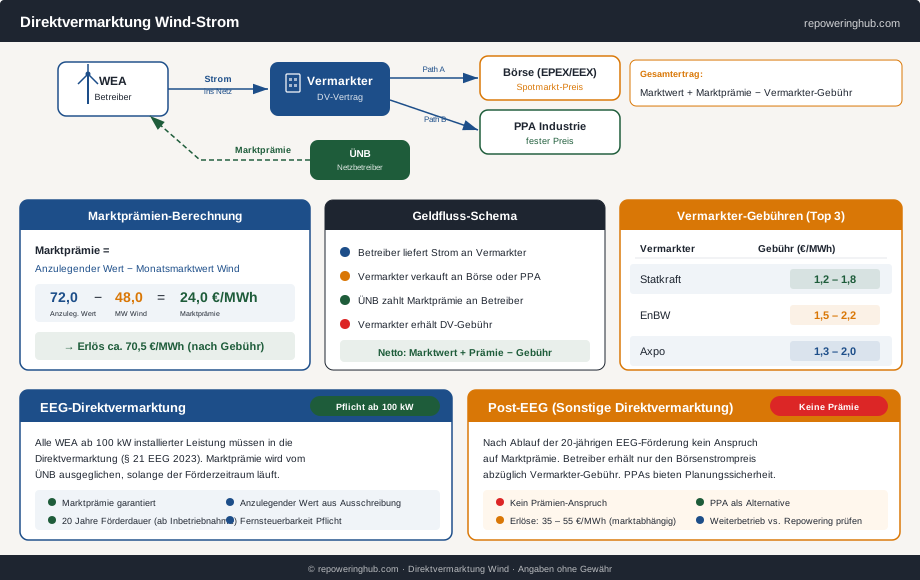
Direct marketing of wind power — cash flow, market premium and marketer comparison
Marketer Comparison for Your Turbine?
We connect you with a direct marketing advisor — competitive quotes from multiple marketers with risk analysis.
Get in TouchFrequently Asked Questions
What happens during negative power prices?
Under EEG 2024, the market premium lapses after more than 4 consecutive hours of negative power prices. Marketers often have their own negative-price clauses. In practice 2023–2026 increasingly relevant (20–80 hours per year).
How often can I switch marketer?
Typical: notice period of 3–6 months, then switching is possible. For long-term contracts 24 months.
What does switching marketer cost?
Usually free of charge — for large portfolios, marketers negotiate fee reductions. In practice, an annual comparison pays off.
Who bears the risk from redispatch curtailment?
Legally, the grid operator does, via the curtailment compensation under Section 13a EnWG — in practice, the marketer handles the settlement and the claim against the grid operator, usually for a small additional fee.
Is a PPA realistic for smaller existing turbines?
For individual turbines under 3 MW, the PPA volume is too small for many industrial off-takers — some marketers bundle several turbines into a portfolio PPA instead. As a rule of thumb, the effort becomes worthwhile from a bundled volume of 10–15 GWh/a.