LCOE — Levelized Cost of Energy for Wind Power
Levelized Cost of Energy (LCOE) is the central economic metric: what does one MWh of generated electricity cost over the turbine's lifetime? A project is only profitable if the LCOE is below the achieved marketing price.
Formula
LCOE = (CAPEX × CRF + OPEXfixed) / Annual Yield + OPEXvariable
CRF (Capital Recovery Factor) = r · (1+r)n / ((1+r)n − 1)
r = discount rate (WACC), n = project lifetime in years. At r=5% and n=20: CRF ≈ 0.0802.
Current LCOE Values — Onshore Wind Germany (2026)
| Site Type | LCOE | Full-Load Hours |
|---|---|---|
| Top coastal site | 40–55 €/MWh | 3,500+ h/a |
| Northern Germany inland | 55–70 €/MWh | 2,800–3,500 h/a |
| Central uplands / southern inland | 65–85 €/MWh | 2,300–2,800 h/a |
| Low-wind southern site | 75–95 €/MWh | 2,000–2,500 h/a |
Comparison with Other Generation Technologies
| Technology | LCOE 2026 (Germany) |
|---|---|
| Onshore wind | 40–95 €/MWh |
| Offshore wind | 50–85 €/MWh |
| Solar PV (ground-mounted) | 40–70 €/MWh |
| Solar PV (commercial rooftop) | 60–110 €/MWh |
| Gas-fired power plant (incl. CO₂ certificate) | 80–130 €/MWh |
| Hard coal (incl. CO₂ certificate) | 100–160 €/MWh |
| Nuclear (new build) | 110–200 €/MWh |
Source: Fraunhofer ISE "Study on Levelized Cost of Electricity from Renewable Energies" 2024/2026, supplemented with own estimates.
LCOE Sensitivity
Which parameters have the strongest impact on LCOE?
| Parameter | LCOE Sensitivity |
|---|---|
| Full-load hours ±10% | ±10% LCOE (inverse) |
| CAPEX ±10% | ±6–8% LCOE |
| OPEX ±10% | ±2–4% LCOE |
| WACC 4% vs. 6% | ±13% LCOE |
| Lifetime 20 yrs vs. 25 yrs | −10% LCOE |
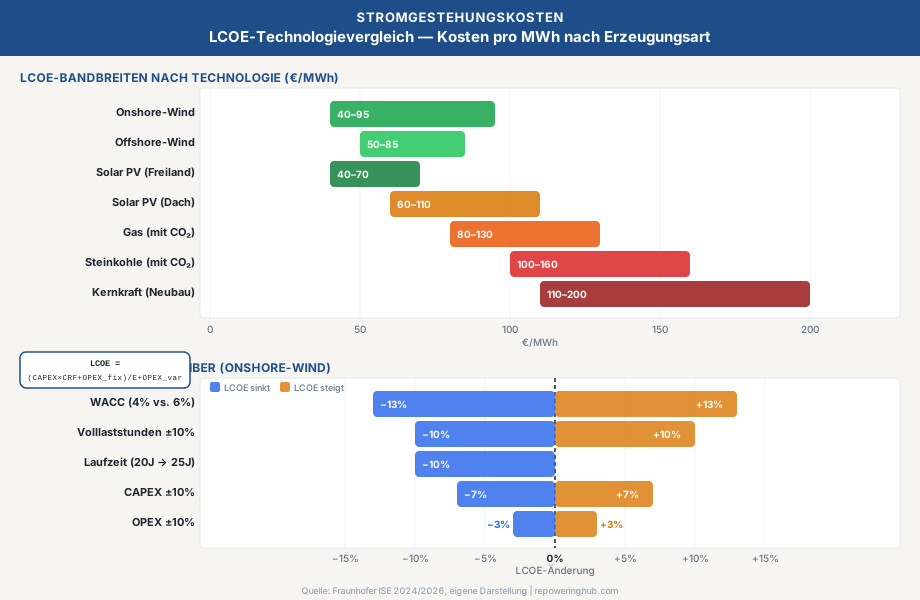
LCOE technology comparison and sensitivity analysis — onshore wind in context
LCOE Calculation Step by Step: A Worked Example
For a 6 MW turbine with the following assumptions, the LCOE can be derived transparently:
| Parameter | Value |
|---|---|
| CAPEX | 1,400 €/kW × 6,000 kW = 8.4 million € |
| Full-load hours | 3,000 h/yr |
| Annual yield | 18 GWh |
| OPEX fixed (maintenance, lease, insurance) | 15 €/MWh |
| WACC (r) | 5% |
| Lifetime (n) | 20 years |
The Capital Recovery Factor at r=5% and n=20 is CRF ≈ 0.0802. This gives a capital-related annual annuity of 8.4 million € × 0.0802 ≈ 673,700 €/yr. Relative to the annual yield of 18,000 MWh, that equals roughly 37.4 €/MWh in capital-related cost. Adding the fixed OPEX component of 15 €/MWh yields an LCOE of approximately 52.4 €/MWh — a plausible value for a good inland site in northern Germany, consistent with the values table above. At an awarded bid value of 70 €/MWh in the EEG auction, this leaves a margin of roughly 17.6 €/MWh before tax and before debt-service interest (the WACC is already priced into the capital cost annuity).
Repowering LCOE: Why It's Usually Lower Than for New Build
Repowering projects benefit twice over on LCOE. First, CAPEX per kW is lower because site development, access roads and in some cases the grid connection already exist — see CAPEX for the specific breakdown of typical savings of 50–140 €/kW. Second, the site usually has several years of real wind measurement data from the existing turbine, allowing the full-load-hours forecast for the new, larger turbine to be derived with considerably less uncertainty than for an unknown greenfield site. A more robust yield forecast in turn often lowers the required risk premium on the interest rate in bank financing — which, via the WACC lever (±13% LCOE at 4% vs. 6% WACC, see sensitivity table), feeds directly into the LCOE. In project practice, repowering LCOE is therefore often 10–20% below a comparable new-build calculation at the same site type.
Limits of LCOE as a Standalone Metric
LCOE is a pure average-cost view over the project lifetime and does not capture time-varying price fluctuations. Two limitations matter in practice:
- No link to the actual timing of revenue: wind power is generated preferentially at times of high overall feed-in, when market value is often below average (the cannibalisation effect). LCOE says nothing about whether achievable market revenue actually covers the cost — that requires a separate market-value forecast.
- No statement on financeability: a low LCOE does not automatically mean a bank will finance the project — collateral, operator creditworthiness and the marketing contract structure all play an independent role.
For a complete economic assessment, LCOE is therefore typically supplemented with a discounted cash flow (DCF) calculation using P50/P90 yield scenarios, as lenders also require for credit approval.
LCOE vs. EEG Market Premium
The EEG auction ceiling value for 2026 is 7.35 ct/kWh = 73.50 €/MWh. A project with an LCOE of 65 €/MWh and an awarded bid at 72 €/MWh has a margin of approximately 7 €/MWh — given an annual yield of 18 GWh, that translates to 126,000 €/a cash flow after all costs. This is sufficient to provide a return on equity over 20 years.
Bankable LCOE Calculation?
We connect you with an energy finance consultant — full DCF model with P50/P90 yield forecast, sensitivity analysis and stress tests.
Request a QuoteFrequently Asked Questions
What is the difference between LCOE and the EEG reference value?
LCOE represents the cost perspective (what does production cost). The EEG reference value ("anzulegender Wert") is the bidder-specific remuneration rate (what the operator receives). For a project to be viable: EEG reference value > LCOE.
Are subsidies included in the LCOE?
By standard LCOE definition: no subsidies are included. The "subsidised LCOE" (LCOE net of subsidies) is a variant calculation. For honest comparability across technologies, the pure LCOE is used.
What does the decommissioning reserve add to the LCOE?
Typically 0.5–1.5 €/MWh — the reserve is annualised over the project lifetime.
Why does LCOE fall by roughly 10% when the lifetime is 25 instead of 20 years?
Because the capital-related cost (CAPEX × CRF) is spread over more generated MWh, while the Capital Recovery Factor itself decreases with a longer lifetime. The precondition is that the turbine is technically and legally rated for the extended lifetime — increasingly standard for repowering projects with modern turbines, but often needs confirmation via a structural integrity assessment for legacy turbines.
How accurate can an LCOE forecast realistically be before construction starts?
The biggest uncertainty lies in the yield forecast (full-load hours), not in the costs. A credible forecast is based on at least 12 months of on-site wind measurement or on validated reference yield data from neighbouring existing turbines — pure wind-atlas values without on-site measurement are considered too uncertain in practice for a bankable LCOE calculation.