Wind Turbine Project Planning
Before permitting comes planning: Where should the turbine be located? How much wind is available? How economically viable is the site? Who should own and operate the project? Here you will find the key planning topics — from site assessment to operator structures.
The thread running through it: from land to investment decision
A wind project does not begin with the permit application — it begins years earlier, in planning. This phase decides whether a site is viable at all, and it is where the returns of the following two decades are effectively locked in. The order in which the questions arise is not arbitrary: first comes the question of a suitable plot. Site selection weighs wind resource, grid proximity, access, land availability and permitting risk against one another — a single one of these factors can sink a project, for example if the nearest grid connection point is too far away or a species-protection conflict is foreseeable.
Once the site is broadly settled, the yield side follows. Wind resource — the mean wind speed and its distribution across the year — together with the turbine type determines the expected full-load hours. Because many inland sites in Germany are comparatively wind-poor, low-wind turbines with a large rotor and moderate rated power now dominate there. Only once this yield forecast exists can the economics be calculated: levelised cost of energy (LCOE) sets investment, operation and lifetime against the electricity produced, making projects comparable across sites.
At the end comes the question of who owns, operates and finances the turbine. Whether a conventional project company, a community wind cooperative, or a long-term power purchase agreement (PPA) instead of the EEG market premium — these choices shape the capital structure, local acceptance and revenue stability over two decades. The topics below are grouped along these three blocks — site and yield, economics, operator model — and are aimed at landowners, project developers and operators preparing a repowering or new-build project, cross-referencing the adjacent permitting and expert report topics where relevant.
Site and Yield
Site Selection
Criteria for good wind turbine sites: wind resource, grid connection, access roads, permitting risk, land availability.
Wind Resource
Mean wind speed, Weibull distribution, height extrapolation, wind index — how the site is assessed.
Full-Load Hours (FLH)
How FLH are determined, which turbine types achieve which FLH, low-wind vs. high-wind turbines.
Low-Wind Sites
Large rotor, low rated power — the modern solution for inland sites.
Economics
Levelised Cost of Energy (LCOE)
EUR/MWh as the key economic metric — investment, operation, lifetime, discounting.
Capital Expenditure (CAPEX)
What a modern wind turbine really costs: turbine, foundation, grid connection, access roads, surveys, insurance.
Operating Expenditure (OPEX)
Maintenance, insurance, administration, land lease, decommissioning reserve — annual running costs.
Subsidies & Market Value
EEG market premium, auction award, reference value, direct marketing.
Operator Models
Community Wind
Participation models: cooperative, GmbH & Co. KG, resident participation — mandatory from mid-2026?
PPA — Power Purchase Agreements
Power Purchase Agreement: long-term direct supply to industrial off-takers, often more attractive than EEG market premium.
Direct Marketing
Mandatory for all installations > 100 kW since EEG 2014. Market premium + marketer — how the model works.
Land Lease Agreements
Who gets what — site owner, access rights, cable corridors. Typical lease rates.
Who Needs Which Planning Topics
The planning topics in this hub address different roles in a project — landowners, project developers, investors and municipalities each ask different questions about the same site. Rather than a single linear reading list, it helps to know your own role and jump from there into the relevant topics.
Landowners mainly want to know whether their land qualifies at all and what lease payments they can expect. Site selection and land lease agreements are the natural entry points — both explain which criteria a developer checks before offering a lease, and which compensation models are common in practice. Anyone who wants to invest directly as a cooperative member or nearby resident will find the legal framework under community wind.
Project developers and planning firms usually work through the topics in the order described above: site, wind yield, full-load hours, then the economic calculation via LCOE, CAPEX and OPEX. This group also needs early clarity on grid connection, because an unfavourable connection point can shift the entire calculation — and a look at the adjacent permitting topics, since planning and permitting run in parallel in practice, not one after the other.
Investors and capital providers — whether institutional or part of a community wind structure — mainly ask about the revenue side: does marketing run via the EEG market premium or via a long-term power purchase agreement (PPA)? The two paths differ considerably in revenue stability and risk profile beyond the 20-year EEG support period, and the choice in turn affects the financing terms a bank or fund applies to the project.
Host municipalities and local politics typically encounter the planning topics through the participation obligations now enshrined in law in several German federal states. Here, too, community wind is the central reference point, since it describes the state-specific mandatory models and the municipal share in project revenue — a topic that increasingly determines local acceptance of a project, independent of its technical or economic quality.
Regardless of role: all planning topics build on one another, but none is decision-ready on its own. A good wind resource without an affordable grid connection carries a project no further than a low LCOE without a viable operator model. Anyone planning a project should therefore consider at least one representative from each of the three blocks — site/yield, economics, operator model — before an investment decision is made.
In practice this means: a landowner who only checks the lease terms easily overlooks whether the grid connection is even affordable. An investor who only looks at the LCOE figure easily overlooks whether a community-participation requirement changes the capital structure. That is why the individual pages in this hub link to one another — they are deliberately not isolated glossary entries, but stations in a connected planning process that ultimately converges on a single, robust investment decision.
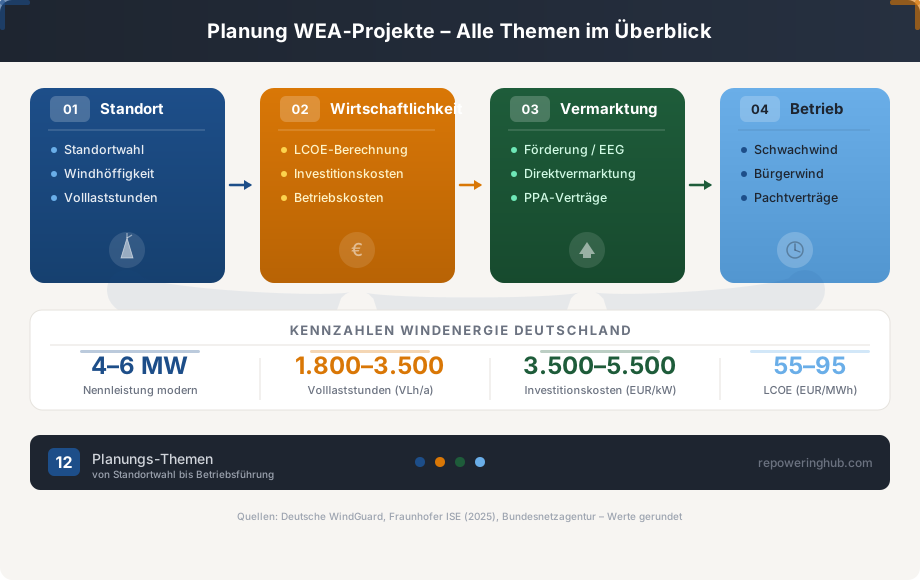
Wind turbine project planning – All topics from site selection to operation at a glance
Planning support for your wind farm?
We connect you with specialist firms for site analysis, economic viability assessment, operator concept and community participation — from the first idea to the investment decision.
Get in touch