Wind Repowering in Saxony
Saxony is among the more restrained federal states when it comes to wind build-out. For years the 1,000-metre setback rule in the state development plan, restrictive regional planning and widespread reservations braked new build — installed capacity grew markedly more slowly than in the northern German states. Precisely from this a noticeable need to catch up now arises: the WaLG (Wind Energy Areas Act) forces the state to reorganise land and procedures. For developers this creates a market that lives less off the existing fleet than off the coming area designation.
Catch-up Need: Why Saxony Lags
The combination of a blanket setback and sparse priority-area designation has structurally capped the build-out. At around 1.0% of designated area, Saxony sits at half the WaLG target of 2.0% by 2032. This is less a permitting problem than a land problem: without sufficient priority areas there is a lack of sites on which applications can even be filed. The shortfall increases the pressure on the regional-planning bodies to steer in additional area at short notice — for developers that means following the update of the regional plans closely. A second point comes on top: the slow build-out of the past means that Saxony's turbine fleet is on average younger and more small-scale than in the wind states of the north. Large, contiguous repowering clusters are correspondingly rarer, and the market is carried more by new build on freshly designated priority areas than by the renewal of dense old fleets. Anyone developing in Saxony should therefore put site control and regional-plan monitoring at the start, not the turbine technology.
Market Data for Saxony
| Installed turbines | approx. 1,200 turbines |
| Installed capacity | 2.9 GW |
| Repowering candidates 2026–2030 | approx. 250 |
| Top regions | Lusatia, Upper Lusatia, Ore Mountains foothills |
| Minimum setback | 1,000 m to residential development (state development plan) |
| Permitting authority | Landesdirektion Sachsen (Dresden/Chemnitz/Leipzig) |
Regional Planning and Priority Areas
In Saxony, area steering runs through the four planning associations (among them Upper Elbe Valley/Eastern Ore Mountains, Leipzig Region, Upper Lusatia-Lower Silesia). They designate priority and suitability areas in which wind energy is concentrated. In practice, location within a priority area is the decisive lever: only there is admissibility under building-planning law robustly secured. As long as the WaLG interim target is missed, the exclusionary effect of the existing concentration zones is at risk of lapsing — the privileged status under § 35 BauGB then applies more broadly across the outlying area, undermining the associations' steering. Anyone securing sites should know the current update of the respective regional plan precisely. The underlying system is covered in the Planning section.
Repowering and Structural-Change Land
The lignite phase-out in Lusatia (Bautzen, Görlitz) creates reclaimed large sites with comparatively low conflicts of use; pilot projects for wind energy on post-mining landscapes are in preparation and can be supported through federal structural-change funding. For the roughly 250 repowering candidates the rule holds: larger rotors and higher hubs change the noise and shadow-flicker contour, which is why new expert reports become necessary. The formal steps of approval are summarised in the BImSchG (German Federal Immission Control Act) procedure; a first yield estimate is provided by the repowering tools. In species-protection terms, the black stork in Lusatia is above all relevant.
Ore Mountains: Wind versus Nature Conservation
The highest wind speeds in the state lie in the Ore Mountains and their foothills — but there the build-out regularly collides with nature and landscape-protection interests as well as with tourism use. The tension is typical of Saxony: where the wind carries, the land is sensitive; where the land would be unproblematic, the wind carries more weakly. For developers this means an early, honest site assessment. At the weaker-wind locations, low-wind turbines with large rotors and high hubs are the technical answer; the yield estimate needed for this is provided by the repowering tools. The species-protection assessment — in the Ore Mountains area as in Lusatia — runs through the relevant expert reports.
Grid Connection in Lusatia: Opportunity and Bottleneck at Once
The lignite phase-out leaves Lusatia not only with land but also with grid infrastructure: former power-plant sites have high-voltage connections that can be used to feed in new wind and solar capacity. This can substantially simplify the grid connection for projects in the immediate vicinity, while sites away from these routes remain dependent on regular distribution-grid capacity, which is not available everywhere in structurally weak regions such as Upper Lusatia. Developers therefore benefit from looking closely at the concrete grid situation at the site before starting site acquisition — proximity to a former power-plant site can make a repowering or new-build project economically substantially more attractive than a comparable site without this connection.
Permitting Practice at the Landesdirektion Sachsen
The Landesdirektion Sachsen bundles the immission-control procedures at three locations (Dresden, Chemnitz, Leipzig), which allows for a certain standardisation of permitting practice compared with states where districts hold jurisdiction. For repowering projects on existing sites this means more predictable procedures, provided the application documents — in particular the species-protection surveys for the black stork in Lusatia — are complete and at the required level of survey detail. The repowering tools help to classify the economics of a project taking grid connection costs and procedure duration into account. Important for application completeness: black-stork surveys should cover a full breeding season, since shortened survey periods are the most common reason for follow-up requests from the Landesdirektion and can delay a procedure by a whole vegetation period. Coordinating the survey scope with the technical authority early in practice often saves more time than a shortened survey saves in expert-report costs.
Regionally Active Engineering Firms
- VSB Neue Energien Deutschland (Dresden) — largest regional developer
- UmweltPlan GmbH (Stralsund-Nieder.) — environmental expert reports
- LfULG Sachsen (Freiberg) — nature conservation authority
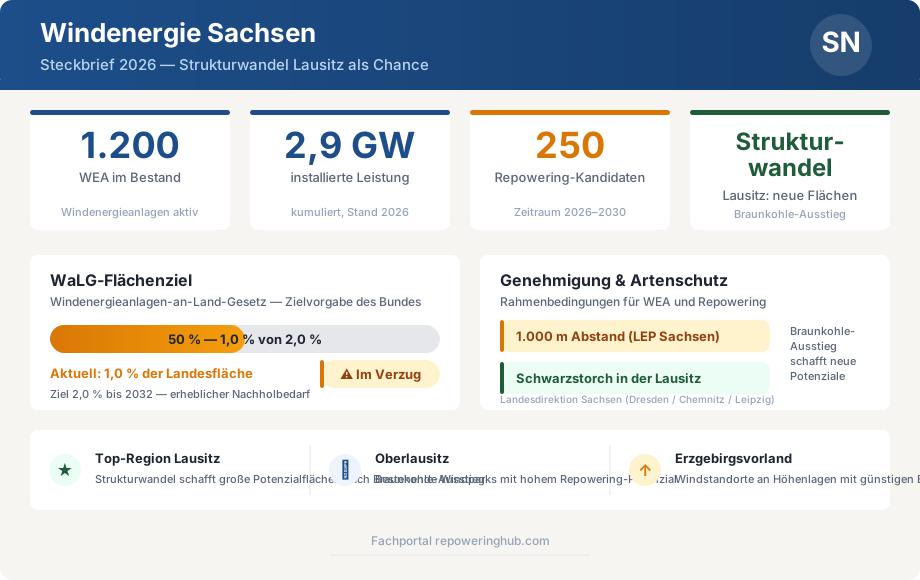
Wind energy in Saxony – market data, structural change and permitting framework
Repowering or new build in Saxony?
We connect you with planning firms experienced in Saxony — including for the structural-change potential sites in Lusatia.
Send enquiry