Wind Energy by Federal State
Installed fleet, minimum setback rules, WaLG (Wind Energy on Land Act) status, repowering market and permitting authority — per federal state. Click a state for the detail page with regionally active engineering firms and permitting practice.
Why state law decides wind projects
Wind energy is permitted under federal law — through the BImSchG (German Federal Immission Control Act) and § 35 of the Building Code — yet the decisive levers sit with the individual states. That is exactly why the repowering market in Kiel looks nothing like the one in Munich. The single most important factor is the minimum setback from residential buildings: Bavaria clings to its 10H rule, several eastern states and North Rhine-Westphalia apply a flat 1,000-metre setback, while Lower Saxony and Baden-Württemberg use no blanket rule at all. A difference of a few hundred metres can decide whether repowering on an existing site is possible or whether the whole project fails.
On top of this comes the Wind Energy Areas Act (WaLG): every state must designate a binding share of land for wind energy. States that have already met their target can plan with legal certainty; those behind schedule often face blocked or delayed regional planning. Permitting authorities also differ sharply in practice, processing time and conservation focus — in Hesse the red kite plays a special role, while Mecklenburg-Western Pomerania and North Rhine-Westphalia enforce community-participation obligations.
In practice this means: anyone planning a repowering project must first understand the state law of their site before economics and turbine type can be calculated sensibly. The overview below groups the 16 federal states by wind region and states, for each, the installed fleet, setback rule, WaLG status and repowering potential. It is aimed at operators, developers and landowners who want to gauge how favourably their site is positioned in regulatory terms.
How to Use This Overview
Each state page below follows the same structure: installed turbine fleet and capacity, the number of turbines old enough to be realistic repowering candidates, the applicable minimum setback rule, the state's WaLG (Wind Energy Areas Act) target and current status, and the permitting authority responsible for BImSchG (German Federal Immission Control Act) procedures. Click through to the state page for regionally active engineering firms and permitting practice notes specific to that authority.
The states are grouped into four wind regions — North, East, Central/West and South — because neighbouring states inside a region tend to share similar wind conditions, grid infrastructure and, often, permitting culture. This grouping helps when comparing a specific site against its regional peers rather than against a state on the opposite end of the country with an entirely different wind regime.
What the Figures Mean for a Repowering Decision
A high number of repowering candidates in a state is not, on its own, a green light — it mainly signals that a wind market exists there with enough operating history to generate replacement projects over the coming years. The setback rule and WaLG status matter more for an individual project: a state with no blanket setback rule (such as Lower Saxony or Baden-Württemberg) leaves more room for a site-specific assessment, while a fixed distance (1,000 metres in North Rhine-Westphalia and several eastern states, or Bavaria's 10H rule) can rule out repowering on an existing footprint outright if nearby residential buildings are too close.
WaLG status shapes the regional planning timeline: states that have already met their designated area target can generally issue permits with more legal certainty, while states behind schedule often see regional plans delayed or challenged, which extends the time until a repowering project reaches construction. For an initial economic estimate independent of these regulatory factors, the repowering yield calculator provides a starting point; the formal steps of a repowering procedure are described in our repowering overview.
Northern Germany — Wind Heavyweight
Lower Saxony
6,300 turbines · 13.0 GW · 1,800 repowering candidates · no blanket setback rule.
Schleswig-Holstein
3,200 turbines · 7.9 GW · 1,000 candidates · 400 m minimum setback · top sites.
Mecklenburg-Western Pomerania
1,900 turbines · 3.9 GW · 400 candidates · community-wind obligation since 2016.
Hamburg
City-state · hardly any turbine sites of relevant size.
Bremen
City-state · very small, hardly any repowering potential.
Eastern Germany
Brandenburg
3,900 turbines · 8.3 GW · 1,100 candidates · 1,000 m blanket setback · WaLG target met.
Saxony-Anhalt
2,900 turbines · 6.2 GW · 700 candidates · WaLG 2.2 % (currently 1.5 %).
Saxony
1,200 turbines · 2.9 GW · 250 candidates · 1,000 m blanket setback · behind on WaLG.
Thuringia
800 turbines · 1.8 GW · low mountain ranges dominant · behind on WaLG.
Berlin
City-state · no notable turbine potential.
Central / West
North Rhine-Westphalia
3,700 turbines · 7.0 GW · 1,200 candidates · 1,000 m blanket setback · community-wind obligation 2025.
Hesse
1,200 turbines · 2.5 GW · 250 candidates · red kite focus.
Rhineland-Palatinate
1,800 turbines · 3.9 GW · 450 candidates · behind on WaLG.
Saarland
200 turbines · 0.4 GW · small, but WaLG obligation 1.8 %.
Southern Germany — Low-Wind Country
Bavaria
1,100 turbines · 2.5 GW · 10H rule · WaLG pressure rising.
Baden-Württemberg
800 turbines · 2.0 GW · no blanket setback · low wind dominant.
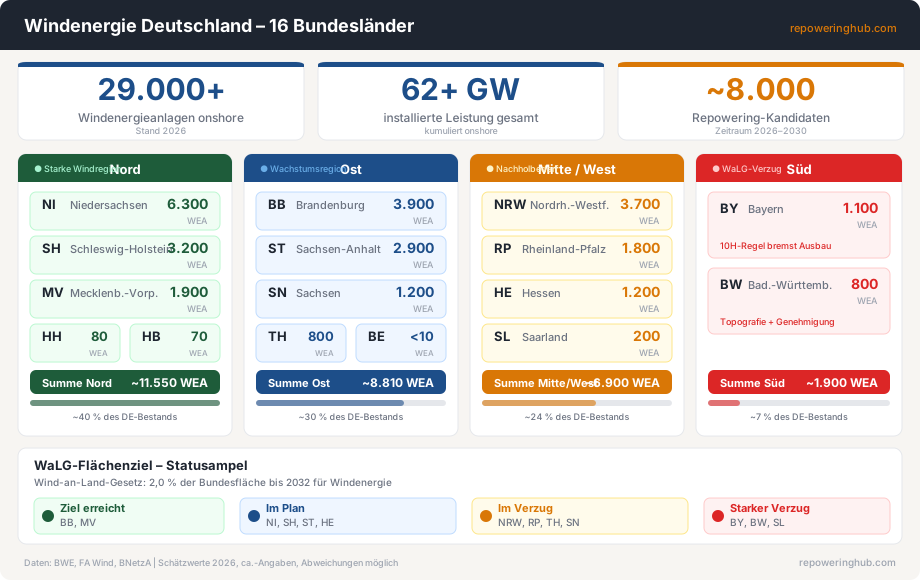
Wind energy Germany – overview of all 16 federal states with WaLG status
Site assessment for your federal state?
We connect you with a planning office experienced in regional permitting — authority practice and the provider landscape differ widely from state to state.
Submit an enquiry