Wind Energy in Thuringia
Few federal states have wrestled with wind energy as hard as Thuringia. At the centre stands a fundamental political question: wind in the forest — yes or no? The dispute over opening up forest areas, particularly along the Rennsteig and the upland locations of the Thuringian Forest, has braked the build-out for years. Topographically the state is a low-wind location in any case: low mountain ranges shape the land, high hubs and large rotors are mandatory. The shortfall against the WaLG (Wind Energy Areas Act) target now intensifies the pressure to decide these fundamental questions.
The Forest-Area Debate
Whether and to what extent wind energy is permitted in the forest is politically contested in Thuringia. Because a large part of the wind-rich upland locations is wooded, the answer directly determines how much area is available for the WaLG target at all. If the forest is largely excluded, the build-out concentrates on the open locations of the Eichsfeld, Nordhausen and the Thuringian Basin — then the land picture becomes tight. For developers this debate is no sideshow: it determines which sites even come into consideration under planning law. The fundamentals of area and site steering are covered in the Planning section.
Rennsteig and Uplands: Low-Wind Technology
The Rennsteig ridge and the crests of the Thuringian Forest offer the best wind conditions in the state — but are at the same time scenically sensitive and predominantly wooded. On the open heights of the Eichsfeld the wind yield is decent, yet there the build-out frequently collides with red kite (Rotmilan) occurrences; the black stork is likewise relevant in the Eichsfeld. Technically, low-wind turbines with a hub height of around 175 m and a large rotor are standard, in order to offset the weaker wind speeds of the interior. A first yield estimate for a turbine replacement is provided by the repowering tools; the nature-conservation assessment runs through an avifauna survey.
Market Data for Thuringia
| Installed turbines | approx. 800 turbines |
| Installed capacity | 1.8 GW |
| Repowering candidates 2026–2030 | approx. 200 |
| Top regions | Eichsfeld, Nordhausen, Thuringian Basin |
| Minimum setback | no blanket state rule (TA Lärm + protected interests) |
| Permitting authority | TLUBN |
At around 1.2% of designated area, Thuringia lies well below the WaLG target of 2.2% by 2032. If the state misses the interim target, the exclusionary effect of the concentration zones is at risk of lapsing, so that the privileged status under § 35 BauGB applies more broadly across the outlying area. The formal steps of turbine approval are summarised in the BImSchG (German Federal Immission Control Act) procedure.
Politically Contested Build-out: What It Means for Projects
Wind build-out has remained a permanent topic of state politics in Thuringia, and the stance on forest use has shifted with changing majorities. For developers this creates planning uncertainty: land pictures, regional-plan updates and the interpretation of forest exclusions can change before a project is ready for approval. Anyone developing here should follow the state of the respective regional planning closely and prefer sites with a robust planning-law basis — ideally in designated priority areas outside the particularly contested forest locations. The WaLG delay acts here as an accelerator, because the state is forced to provide additional land. At the same time, species protection — red kite and black stork in the Eichsfeld — remains a reliable touchstone that rewards early avifauna surveys. What has proven effective in practice is to spread the species-protection survey over a full vegetation and breeding period rather than shortening it under time pressure — truncated mapping is the most common reason for follow-up demands and thus for delays in the procedure.
Regionally Active Engineering Firms
- JUWI AG (Wörrstadt, with a Saxony-Thuringia branch) — project development
- TLUBN — specialist nature conservation authority
- Thuringian energy companies
Grid Infrastructure: Bottlenecks in Thuringia's Distribution Grid
Thuringia's distribution grid was largely designed for the decentralised feed-in of smaller generation units and is increasingly reaching its limits in high-wind districts. For repowering projects in which an older megawatt-class turbine is replaced by a substantially more powerful low-wind turbine, checking the existing grid connection capacity is therefore an early project step rather than a downstream detail. Where reinforcement measures become necessary at the grid connection point, this often extends the lead time more than the permitting procedure itself. Anyone assessing the economics of a repowering project while accounting for such additional costs finds a starting point in the investment cost calculator.
Municipal Value Creation in Structurally Weak Districts
For many Thuringian districts in the Eichsfeld and around Nordhausen, municipal value creation from wind energy is an economically relevant factor, especially in structurally weak regions with a limited business-tax base. The voluntary or statutory participation of host and neighbouring municipalities under § 6 EEG can tip the scales for or against political support for a project in these municipalities. Repowering projects at established sites often benefit from existing participation models from the original installation, which are renegotiated at turbine replacement but rarely called into question in principle. The political uncertainty around the forest-area question makes this municipal backing all the more important, because it makes procedures more robust against shifting state-level majorities. In practice, sites with an early-involved host municipality get stuck less often in lawsuits or politically motivated delays in the procedure than comparable projects without municipal backing.
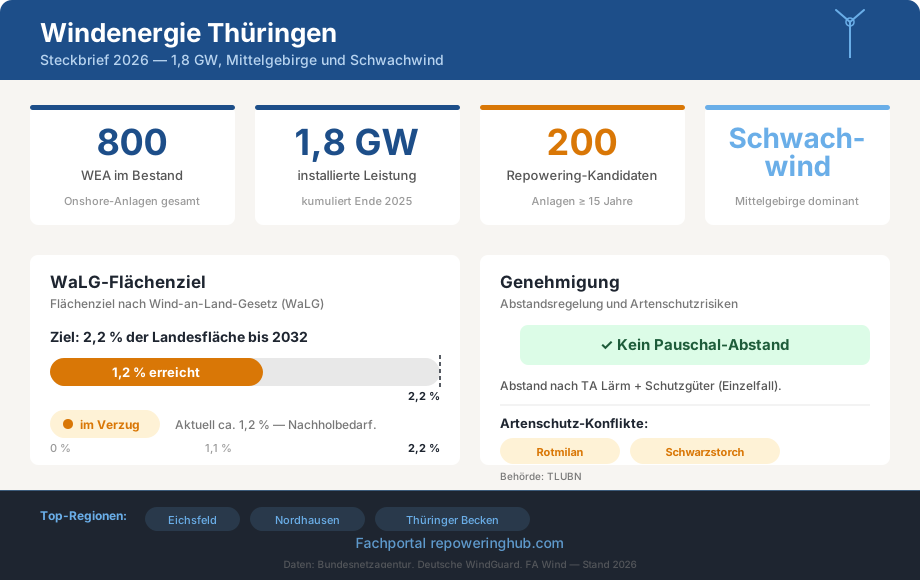
Wind energy in Thuringia – market data, WaLG status and permitting framework
Repowering in Thuringia?
We connect you with planning firms experienced in Thuringia — selecting low-wind turbines + TLUBN application practice.
Make an enquiryGround-Mounted Solar in Thuringia
The Thuringian Basin, with its flat arable land, is suitable for ground-mounted solar. The combination of wind on the ridges and solar in the lowlands enables complementary site use within the federal state. Privileged sites along motorways and railway lines speed up the permitting. For farmers and landowners in the Thuringian Basin, this combination of wind and solar leasing can be an additional building block for site economics, independent of the ongoing political debate over forest areas for wind energy.