Wind Repowering in Brandenburg
Brandenburg is the leading federal state for onshore wind energy in Germany: nowhere else do so many turbines turn relative to the land area. Over the coming years the focus of this market is shifting noticeably — away from greenfield additions and towards replacing ageing existing turbines. That is precisely why Brandenburg is the place where repowering at scale will be decided.
A Turbine Stock at a Turning Point
Brandenburg carries one of the oldest and densest turbine fleets in the country. A large share of the roughly 3,900 wind turbines was erected in the first and second expansion waves and is now approaching the end of its service life, both technically and in terms of subsidy eligibility. Of this stock, about 1,100 turbines count as repowering candidates for the period 2026 to 2030. The leverage is considerable: where several smaller old turbines with limited hub heights stand today, repowering typically replaces them with fewer but far more powerful machines — at the same or a lower turbine count, annual output rises substantially. A first approximation of the additional yield can be estimated with the repowering economics analysis before expert reports and planning are commissioned.
| Turbine stock | approx. 3,900 turbines |
| Installed capacity | 8.3 GW |
| Repowering candidates 2026–2030 | approx. 1,100 |
| Turbine density | highest per unit area in DE |
Local Acceptance and Financial Participation
High turbine density also means high visibility — and so, in Brandenburg, public acceptance is at the heart of every repowering project. The state therefore moved early to give host municipalities a financial stake: since 2024, operators pay a special levy of EUR 10,000 per MW per year to the host municipality. This local value creation works as a community-benefit mechanism that shares the returns materially with municipalities and shores up support for new permits. For developers the levy is relevant to the calculation, because it feeds into the levelised cost of energy — an effect the LCOE calculator makes visible. Repowering projects with early, transparent participation communication tend, in Brandenburg's experience, to face lower resistance.
The State's Permitting Framework
In permitting terms, repowering remains a new project under the BImSchG (German Federal Immission Control Act); the BImSchG procedure describes the sequence in detail. In Brandenburg a blanket minimum setback of 1,000 m to residential development has applied as a state rule since 2024. The competent authority is the Landesamt für Umwelt (State Environment Agency, LfU), supported by the districts. One structural advantage: the statutory area target of the WaLG (Wind Energy Areas Act) of 2.2% has already been met in Brandenburg — designated priority and suitability areas give repowering projects within these zones a robust planning basis.
- Minimum setback: 1,000 m to residential development (state rule since 2024)
- Authority: Landesamt für Umwelt (State Environment Agency, LfU), districts in support
- WaLG target: 2.2% by 2032; current status: met
- Special levy: since 2024, EUR 10,000/MW/yr to the host municipality
- Species-protection focus: black stork (3 km exclusion zone + 10 km diversion corridor), lesser spotted eagle, corncrake
The Black Stork as the Defining Conflict
Brandenburg is home to Germany's largest black stork population — and that is exactly what feeds the most common cause of delay in the state. The black stork is a collision- and disturbance-sensitive species with a wide range of action; around nests a 3 km exclusion zone and a diversion corridor of up to 10 km apply. Even when replacing an old turbine, the authority re-examines the species-protection ban on killing and disturbance. Robust mapping and a sound bird survey are therefore not a formality but the very core of permit eligibility. Early technical coordination with the LfU, before filing the application, markedly reduces the risk of later requests for additional information.
Grid connection and bottlenecks in the 50Hertz control zone
Brandenburg lies entirely within the control zone of transmission grid operator 50Hertz, whose grid area concentrates eastern Germany's windiest regions. The state's high turbine density correspondingly creates high pressure on the distribution and transmission grids: in periods of strong wind, parts of Brandenburg see feed-in management measures (redispatch) where local grid sections cannot fully absorb the power generated. For repowering projects this is a doubly relevant factor. First, the available grid connection capacity at the existing site helps determine whether the new, more powerful turbine can be connected without costly grid reinforcement. Second, the frequency of curtailment directly affects the economic calculation, since curtailed volumes of electricity reduce annual output. Anyone budgeting a repowering project should therefore request a grid compatibility assessment from the responsible distribution grid operator early, rather than relying solely on the legacy turbine's existing connection capacity.
Military training areas and radio relay links as a land restriction
Alongside species protection, a military particularity shapes the land-availability picture: Brandenburg borders several large Bundeswehr sites and military training areas, including in the Lehnin/Klietz area and along the state border with Saxony-Anhalt. Protection zones for radar and radio relay installations used by air traffic control and the Bundeswehr surround these sites, within which new wind turbines must stay below the permissible height or are excluded altogether. Repowering projects aiming for a greater hub height than the existing turbine therefore have to re-coordinate these protection zones with the regional military administration or German air traffic control (Deutsche Flugsicherung) — a point that is easily overlooked in early project planning, because the existing turbine often did not trigger the conflict at all.
Lusatia's structural transition as an opportunity for repowering
In southern Brandenburg, the wind-energy debate overlaps with the structural transition of Lusatia (Lausitz), triggered by the phase-out of lignite-fired power generation. For the Lausitz-Spreewald regional planning association, expanding renewable energy — including repowering existing wind farms — is one building block for partly compensating for the disappearing conventional generation capacity and the associated jobs in the energy sector. For developers this means that in Lusatia, repowering more often meets a locally receptive political climate than in regions without this structural-transition context, even though the technical review steps — species protection, setback, grid connection — remain the same.
Regionally Active Engineering Firms
- ENERTRAG AG (Dauerthal) — largest regional project developer
- WindEnergy GmbH (Potsdam) — expert reports + planning
- IFAÖ (Berlin/Brandenburg) — avifauna + anti-collision systems
- LfU Brandenburg — nature-conservation specialist authority
Timing and Lead Time
Repowering in Brandenburg is not a short-term manoeuvre. Between the first site assessment, multi-year avifaunistic surveys, application and permit, several years usually pass — above all where black stork records require a full breeding season. Anyone who does not want to miss the repowering wave therefore begins project planning early, ideally before the old turbines run out of subsidy and operating permit. The state's advantage remains in place throughout: in the priority areas already designated, the planning-law basis is robust, and the LfU's high routine shortens the procedure in uncritical cases.
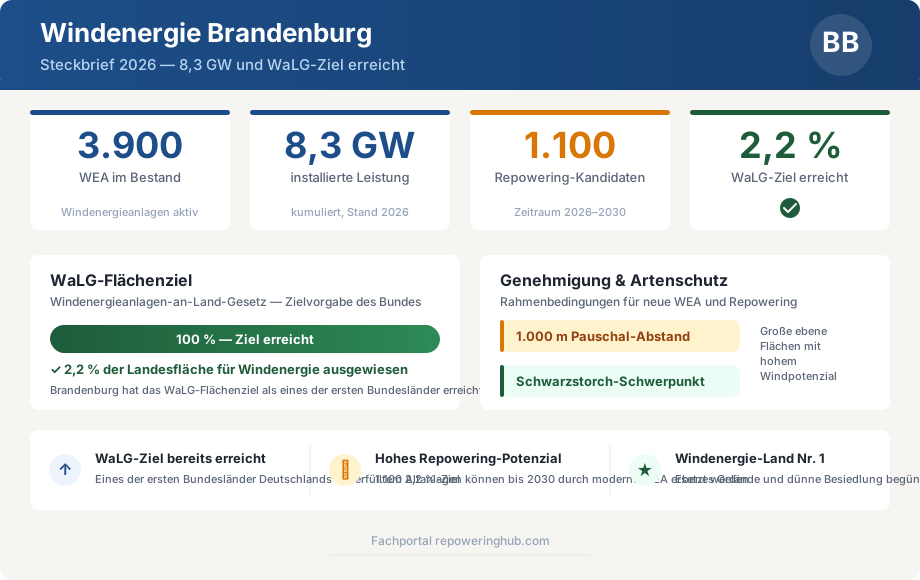
Wind energy in Brandenburg – market data, WaLG status and permitting framework
An old turbine in Brandenburg — assess repowering?
Brandenburg stands at the start of a major repowering wave, and black stork questions decide the pace and the permit eligibility. We connect you specifically with planning firms experienced in BB — from black stork pre-assessment through LfU application practice to participation communication for the host municipality.
Send enquiry