EIA Screening for Wind Turbines
The EIA screening (UVP-Vorprüfung) is the regulatory decision on whether a wind turbine project requires a full Environmental Impact Assessment or whether a negative certificate suffices. It is carried out within the BImSchG procedure prior to the actual permitting decision — based on documents submitted by the applicant.
Site-specific (S) or general (A)?
| Number of WTG > 50 m | Screening type | Depth |
|---|---|---|
| 3–5 | S — site-specific | Shorter review focused on protected area proximity; negative certificate in > 90% of cases |
| 6–19 | A — general | More comprehensive review across all environmental receptors; negative certificate in approx. 70% of cases |
| 20+ | None — direct full EIA obligation | Screening not applicable, straight to EIS |
Escalation to full EIA
Even an S or A screening can result in an obligation for a full EIA. Common triggers:
- Location in or immediately adjacent to FFH/bird protection areas — almost always escalated
- Location in nature reserves or landscape protection areas — usually escalated
- Significant impact on forest, habitat type or geotope
- Litigation history of the region — where environmental groups have already filed suits, escalation is used as a precaution
- Cumulation with existing turbines — combined impact of other WTG in the vicinity
What does the screening document contain?
- Project description: number of turbines, heights, site coordinates, access roads
- Site description: topography, vegetation, protected areas in the surroundings
- Screening of environmental receptors: for each receptor (human health, fauna, flora, soil, water, climate, landscape, cultural heritage, interactions) a brief impact assessment
- Existing protected areas + conservation value: FFH, bird protection, nature reserves, landscape protection, protected biotopes
- Pre-existing impacts: other existing turbines, traffic noise, commercial activity
- Recommendation for negative certificate / escalation as the applicant's proposal
What does it cost?
Guideline cost €5,000–15,000. For very straightforward cases (3-turbine park, no protected areas) from €3,500. Complex general screenings near protected areas can reach €25,000.
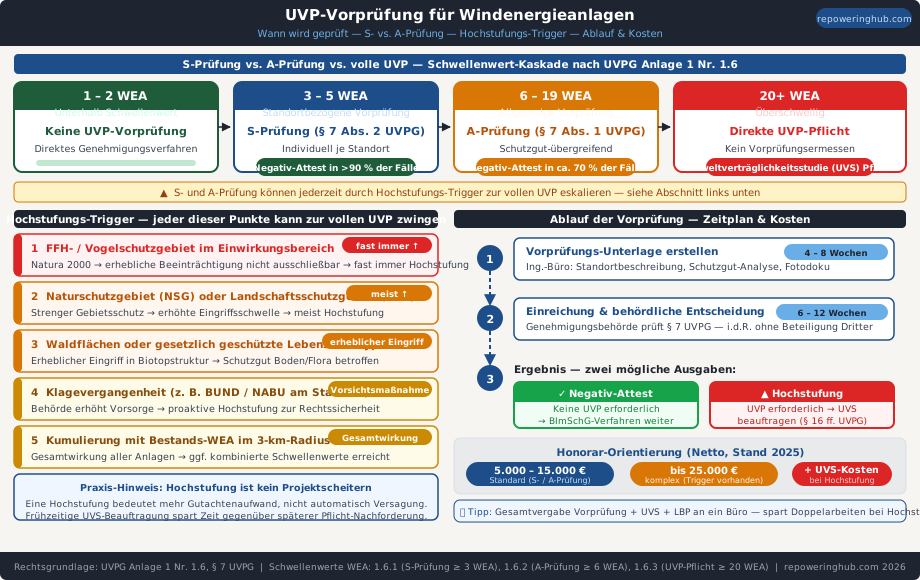
EIA screening — thresholds, escalation triggers and process with costs
Who prepares it?
Environmental planning consultancies, often the same firms that later carry out the full EIS and the landscape impact plan (LBP). Advantageous: awarding the screening + full EIS + LBP to a single provider as a package.
Preliminary assessment — the legal standard
The legislature deliberately designed the screening as a preliminary assessment (Sec. 7 (1) UVPG): the authority is not expected to reach the same depth of review as in a full EIS, but rather to judge, on the basis of the submitted documents and any information already available, whether significant adverse environmental effects are to be expected at all. This reduced standard of review is at the same time a frequent point of attack in litigation: if the screening is carried out too superficially, or if recognisable indications of significant effects are overlooked, a negative certificate can be classified by a court as flawed — with the consequence that the entire permitting procedure has to be supplemented retroactively with a full EIA.
Documentation duty of the authority
The permitting authority must give a comprehensible justification for its screening decision and document the essential considerations — a mere tick-box decision without reasoning does not withstand judicial review. For the applicant, this means in practice: the more detailed and robust the submitted screening document addresses each individual environmental receptor, the more solid and legally secure the authority's decision tends to be. A document kept deliberately brief saves cost in the short term, but increases the risk of a later successful legal challenge against the negative certificate.
Commission an EIA screening
We connect you with an experienced environmental planning consultancy — ideally with the option to extend to a full EIS if the screening escalates.
Get in touchFrequently asked questions
How long does the screening take?
Preparation of the document by the consultancy: 4–8 weeks. The regulatory decision after submission: typically 6–12 weeks, as other public interest authorities are consulted (nature conservation, landscape management, water management).
Can I challenge the negative certificate?
As the applicant, generally not — if the certificate is negative, you proceed without a full EIA. In the case of escalation, you can file an objection, though this is rarely successful.
What is different for repowering?
For repowering, the screening runs the same as for new construction — the number of new turbines determines the procedure. However, for 1:1 repowering, existing data can be used, which considerably shortens the screening document.
Do turbines from an earlier, discontinued procedure still count?
No — what matters is the actual number of turbines applied for in the current permit. If an earlier project was never realised or the permit has lapsed, the classification for a new procedure starts again from zero. What does remain relevant is the cumulation check against turbines that actually exist or are applied for in parallel nearby, regardless of the fate of older, unrealised projects.
Does a screening result carry over to later procedures at the same site?
Not automatically. Every new permit — whether an additional project, a material change, or a later repowering — in principle triggers its own EIA screening. Earlier screening documents and the site data collected in them can serve as a starting point and shorten the preparation effort, but they do not replace the current review, because both the turbine configuration and the environmental situation at the site may have changed in the meantime — and it is exactly this currency that the authority requires in every new procedure. For project planning this means: even a site with a long, unremarkable permitting history goes through the screening again from scratch for the next project — earlier negative certificates are a useful technical indication, but not a legal guarantee for the future.