Species Protection Report for Wind Turbines
The species protection report (Artenschutzgutachten) assesses whether construction and operation of wind turbines would significantly disturb specially or strictly protected species (birds and bats) — in particular whether the killing prohibition (sec. 44 para. 1 no. 1 BNatSchG) and the disturbance prohibition are violated. It is a mandatory component of every BImSchG permitting procedure.
What does it cover?
- Breeding bird survey following methodology standards (Suedbeck et al.), including nest/territory mapping
- Resting and migratory bird survey where the site is located in migration corridors
- Bat survey using detectors at nacelle height plus ground-level recording, seasons March–October
- Significance testing: Does the turbine significantly increase the general mortality risk?
- Habitats Directive assessment where the site is in or near FFH or bird protection areas
- Avoidance and CEF measures (Continuous Ecological Functionality) — curtailment schedules, tower modifications, compensatory habitats
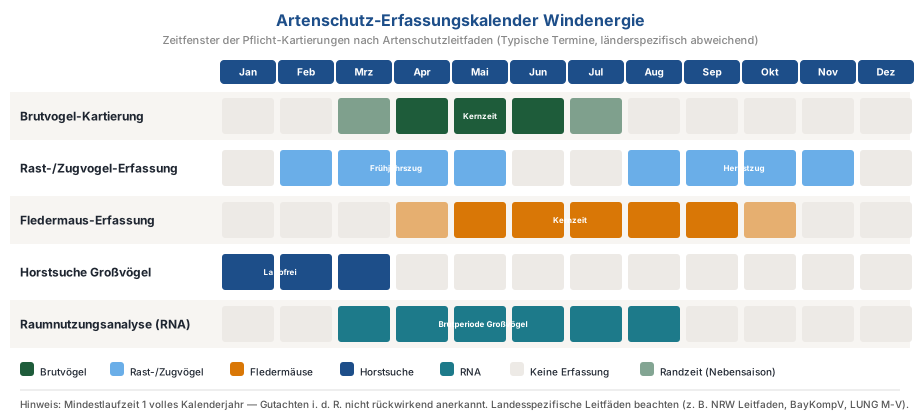
Survey periods in species protection — minimum duration one full calendar year
Key conflict species
| Species | Status | Typical avoidance measure |
|---|---|---|
| Red kite | Collision-prone, nationwide priority | 1.5 km exclusion zone around nest, possibly anti-collision system (ABS) |
| White-tailed eagle | Collision-prone | 3 km exclusion zone around nest |
| Black stork | Disturbance-sensitive | 3 km exclusion zone around nest, 10 km deflection corridor |
| Montagu's harrier | Breeding habitat sensitive | 1 km exclusion zone around breeding site |
| Bats (Common noctule, Nathusius' pipistrelle, Common pipistrelle) | Collision-prone | Seasonal curtailment at low wind/warm conditions — typically < 6 m/s + > 10 °C |
What does it cost?
Guideline cost €15,000–60,000 for a full survey (birds + bats), starting from €10,000 at straightforward sites. The range is wide because it depends heavily on survey seasons — a full breeding-bird season (March to August) and a bat season (April to October) require 6–10 field visits per season.
Sec. 45b BNatSchG — the new regulation
Since the Wind Energy Acceleration Act (WaLG, 2022), simplified rules apply for the species protection derogation assessment at wind turbines: for 15 collision-prone species, exclusion zones are now defined uniformly at federal level (Annex 1 to sec. 45b BNatSchG), and derogations are facilitated where there is an “overriding public interest” (sec. 2 EEG). This has streamlined many permitting procedures.
Legal basis: the three prohibition types
The core of the report is sec. 44 para. 1 BNatSchG with three prohibitions. The killing and injury prohibition (no. 1) covers the collision risk at the rotors. The disturbance prohibition (no. 2) applies when disturbance worsens the conservation status of the local population. The damage prohibition (no. 3) protects breeding and resting sites. Decisive is the significance framework under sec. 44 para. 5 BNatSchG: not every theoretically possible collision event is prohibited, only a significant increase in the general life risk. In practice, this significance threshold is the most frequent point of dispute between project developer and nature conservation authority.
Procedure of a survey
- Desk research: evaluation of existing nest and roost data from state authorities and specialist associations before the site's own field survey begins.
- Field survey: breeding birds over a full season, bats using detectors and nacelle monitoring across the activity season March–October.
- Assessment: assignment of the confirmed species to close-range and assessment zones under Annex 1 to sec. 45b BNatSchG, prognosis of collision risk.
- Mitigation concept: avoidance (curtailment schedules, anti-collision systems), pre-emptive CEF measures, and where applicable an application for a derogation under sec. 45b para. 8.
Who prepares it?
Ecological engineering consultancies specialising in avifauna and chiropterology (bats). Key criterion: regional experience with the breeding-bird inventory of the relevant federal state and accreditation for the respective state guideline (e.g. Helgoland Paper, LANUV guideline NRW, Hesse guideline).
Request a species protection report
We connect you with a specialist consultancy experienced in regional field surveys. At very early project stages (before site selection), a preliminary assessment often saves significant costs later in the formal report.
Get in touchFrequently asked questions
What happens if a red kite nest is found within 1 km?
Under the LAG-VSW Helgoland Paper, this falls within an exclusion area. Sec. 45b BNatSchG has partially redefined the radii — within the “close range” zone (1,500 m), the turbine is generally not permittable; in the “central assessment zone” (1,500–4,000 m), permitting with an anti-collision system (ABS) or curtailment during the breeding season may be possible.
What is a CEF measure?
“Continuous Ecological Functionality” = a pre-emptive compensatory measure that must be effective before the impact occurs, in order to avoid triggering the killing and disturbance prohibitions. Examples: creation of new breeding territories away from the turbines, habitat enhancement, installation of nesting aids.
Bat curtailment — how costly is it?
Typical curtailment during critical summer nights (May–October, < 6 m/s wind, > 10 °C, sunset to midnight) costs 1–3% of annual energy yield. For repowering projects this is usually acceptable; it becomes relevant where economic viability is tight.
What about repowering — are there advantages?
Yes — for repowering projects, a lesser impact is often argued because the sites already have an anthropogenic pre-load. Furthermore, modern turbines often have higher hub heights, which somewhat reduces conflicts with low-flying species (red kite).