Do Solar Parks Harm Nature?
In short: It depends decisively on the prior condition of the site and on the park's design. On intensively farmed arable land, a solar park designed to species-protection standards with extensive maintenance can significantly increase biodiversity — on nutrient-poor grassland, in protected areas, or with poor maintenance, it goes the other way. It is neither a conservationist fairy tale nor a lobby promise across the board — it depends on the individual case.
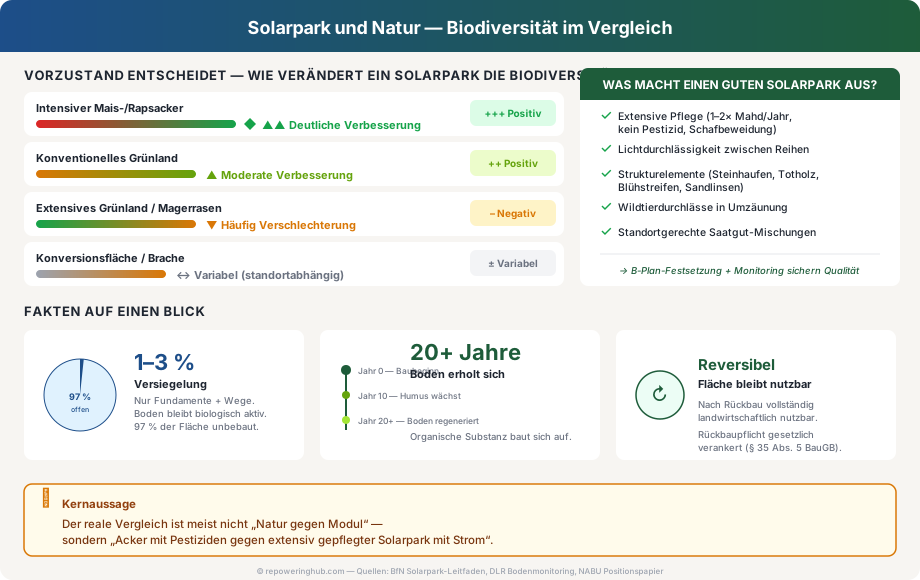
The key distinction: prior condition
| Starting surface | Conservation balance after solar deployment |
|---|---|
| Intensive maize/rapeseed field | usually a clear improvement (pesticides discontinued, extensive maintenance) |
| Grassland under conventional management | often a moderate improvement |
| Extensive grassland / nutrient-poor grassland / protected area | frequently a deterioration — such sites are usually off-limits |
| Conversion site / fallow land | variable; depends on the prior succession |
Site acquisition determines which areas are eligible for a permit at all — exclusion layers such as NSG (nature reserves), FFH (Natura 2000 sites) and high-value soils are standard.
What makes a "good" solar park
- Extensive maintenance: one or two cuts per year, no pesticide use, often sheep grazing.
- Light transmission between the rows: plant growth possible.
- Structural elements: stone/deadwood piles, flowering strips, sand lenses for wild bees.
- Wildlife passages in the fencing.
- Site-appropriate seed mixtures instead of standard turf.
Details in our cluster article Species protection at the solar park.
What the studies show
Scientific monitoring studies at German solar parks document that biodiversity-friendly installations can increase the diversity of wild bees, butterflies and ground-nesting birds compared with the intensive prior condition. The effect is not automatic — it requires the right maintenance concept. Policy and industry are working on standards (e.g. "biodiversity PV") for this approach.
Common points of conflict
- Visual change to the landscape: solar modules are visible, especially from close range. Site selection and, where needed, screen planting are the most important tools.
- Soil sealing: in reality solar parks are largely unsealed — the module foundations occupy only 1–3 % of the area. The land legally remains arable land or grassland.
- Conflict with food production: addressable with agrivoltaics (see Agri-PV).
Frequently asked questions
What happens to the soil beneath the modules?
It rests for 20+ years — no intensive cultivation, no crop protection. Studies show a build-up of organic matter and a recovery of the soil structure. After decommissioning, the land is once again available for agricultural use.
How does the shade affect the vegetation?
Between the rows there is full sun; beneath the modules direct radiation is reduced — the amount of light is sufficient for many meadow mixtures. Special shade-tolerant seed mixtures are used.
Is it true that solar parks create heat islands?
Solar modules heat up but release that heat again quickly. A local microclimate effect is measurable, but small-scale — no relevant regional climate effects.
How the conditions in the permit come about
Whether and to what extent nature conservation measures become binding is not decided by the operator's voluntary commitment, but in the permitting procedure itself. The basis is the special species-protection assessment, which clarifies whether prohibitions under the Federal Nature Conservation Act (BNatSchG) are triggered — for example through impairment of breeding or resting sites of protected species. If the assessment finds potential for conflict, avoidance, mitigation or CEF measures (advance compensation measures) become mandatory conditions. Only this legal bindingness turns a theoretically possible biodiversity gain into an actually verifiable obligation — including monitoring duties that are often continued for several years after commissioning.
In practice, the scope varies considerably by federal state and responsible nature conservation authority. Some permits require a detailed maintenance plan with an annual report; others are satisfied with more general requirements. Anyone planning a site with high nature-conservation value should not wait for the authority to demand a maintenance plan, but coordinate it with a specialist assessor from the outset — this eases both the length of the procedure and later operations.
Monitoring over the operating period
A solar park typically stands for 20 to 30 years. Over this period, vegetation development changes considerably — the first years after construction look very different from an established stand after ten years of extensive maintenance. Responsible operators, and increasingly permitting authorities too, therefore require recurring ecological monitoring that documents maintenance success and species occurrence. If this monitoring is missing, or if the maintenance plan is not followed (for example, mowing too rarely or too often), the balance quickly tips back towards a species-poor, overgrown or matted stand — the positive effect is therefore not a given, but requires ongoing upkeep.
Who checks whether the maintenance requirements are met?
Responsibility generally lies with the lower nature conservation authority that set the conditions in the permit. Depending on the federal state and the scope of the requirements, evidence such as mowing logs or monitoring reports is requested periodically or checked on a spot basis.
Can sheep replace mowing?
Yes, extensive sheep grazing is a common and often nature-conservation-preferred alternative to mechanical mowing — it creates a smaller-scale, more structurally diverse vegetation mosaic that is more favourable for many insect and bird species than uniform mowing at a single point in time.
What happens to the land after decommissioning
A central argument for accepting solar parks on arable land is reversibility: once the operating period ends — typically 20 to 30 years — modules, mounting structures, cabling and the transformer station are fully dismantled. Unlike a concrete foundation, driven-pile or screw foundations leave no permanent sealing; after decommissioning the land is generally available again for agricultural use. How the soil has developed over the operating period depends heavily on the maintenance concept: land with consistently extensive management and no use of plant protection products can be in a markedly better, humus- and structure-richer condition after decommissioning than before the park was built. This aspect is generally already factored into the decommissioning and restoration planning set as a condition in the permitting procedure.
The difference between a compensation area and a productive solar site
A common misunderstanding in the public debate is equating solar park land with an ecological compensation area in the classic sense. In fact, the solar park area itself is primarily land used for energy generation with accompanying nature-conservation conditions — not compensation in the sense of the impact mitigation regulation for a different project. Where the solar project itself still requires additional compensation measures elsewhere because the impact mitigation regulation demands it, this is set separately in the permitting procedure. This distinction matters for setting realistic expectations: the biodiversity gain within the park is an added benefit of good design, not a substitute for standalone compensation obligations.
Does every solar park need a maintenance plan?
In practice, yes — at the latest through the nature-conservation ancillary provisions in the permit, a minimum level of regulated maintenance becomes binding, because uncontrolled overgrowth harms both the technical equipment and the conservation goal. The exact level of detail varies by federal state and individual case.
Are there certifications for "good" solar parks?
Quality-mark and certification approaches exist from industry and conservation associations that assess biodiversity-friendly criteria such as maintenance frequency, structural diversity and wildlife permeability. The exact scope and uptake of such labels is still developing; none are mandatory so far.
Solar parks and nature – biodiversity by prior condition and the features of a good solar park