Do Wind Turbines Kill Many Birds?
In short: Yes, birds do get killed at wind turbines — on average about 10–15 per turbine and year, predominantly common species. Measured against other causes of death, that is a small number. The real problem is not the overall total but the risk to individual rare, collision-prone species such as the red kite. That is precisely what surveys, setback rules and shutdown systems address.
The Numbers in Context
The nationwide PROGRESS study recorded collisions systematically. Extrapolated, the order of magnitude is around a dozen collision victims per turbine and year. That sounds like a lot, but it is put into perspective when compared with other human-caused bird losses:
| Cause of death (Germany, rough order of magnitude) | Birds/year |
|---|---|
| Window glass / window collisions | ~100–115 million |
| Domestic cats | tens of millions |
| Road traffic | ~70 million |
| Power lines | ~2.8 million |
| Wind turbines | ~100,000–200,000 |
Wind energy's share of total losses is therefore small. From a nature-conservation standpoint, however, what counts is not just the absolute number but the effect on the population of a species.
Why Individual Species Are Nonetheless a Problem
For common species, the loss of individual animals barely registers. For rare, long-lived species with a low reproductive rate, the death of even a few breeding pairs can endanger the local population. Raptors and large birds are particularly affected, as they look downwards on their search flights and perceive the rotor blades poorly:
- Red kite — Germany bears a special responsibility for this species (more than half of the world population breeds here)
- White-tailed eagle, Montagu's harrier, marsh harrier
- Common buzzard — common, but the most frequent collision victim among raptors
- White stork as well as migrating large birds
How Species Protection Is Handled in the Permitting Process
In the permitting process, an avifaunistic survey (breeding-bird and resting-bird mapping) is mandatory. It clarifies which collision-prone species breed in the surrounding area. Since the 2022 amendment, § 45b BNatSchG (Federal Nature Conservation Act) sets nationwide near-zones (Nahbereiche) and assessment zones (Prüfbereiche) for each species — replacing the previously inconsistent rules of the individual federal states.
If the distance to the nest is insufficient, avoidance measures are deployed before a site is rejected.
In practice, the process follows a fixed pattern: first, an expert firm maps all relevant nests, eyries and flight routes around the planned turbine sites over at least one breeding season. This mapping determines whether a site falls within the near-zone (where a rebuttable presumption of elevated killing risk applies) or only within the broader assessment zone. In the assessment zone, it is often enough to demonstrate that the area is not regularly used as a foraging habitat to make the turbine permittable. In the near-zone, by contrast, an in-depth case-by-case review is required, in which the authority and the expert firm jointly weigh up whether avoidance measures reduce the risk sufficiently.
Important for developers: the standardisation introduced by § 45b BNatSchG has not only harmonised procedures on the substance but also sped them up, because authorities no longer have to assess every case without a reference framework. Courts had previously and repeatedly criticised the inconsistent state-by-state practice, because identical facts led to different permitting decisions depending on the federal state.
What Post-Commissioning Monitoring Achieves
Many permits impose post-construction monitoring: over one to two years after commissioning, it is checked whether the usage of the area by collision-prone species predicted in the expert report actually occurs, or whether the animals' behaviour has changed because of the new turbine. If the monitoring does not confirm the prediction, the authority can subsequently order additional shutdown periods. This after-the-fact correction is a key building block ensuring that forecast uncertainty in the expert report does not come at the population's expense but can be corrected during ongoing operation.
Anti-Collision Systems: Shutting Down Instead of Preventing
Modern technology detects approaching large birds and briefly shuts the turbine down:
- Camera systems (e.g. IdentiFlight, BirdVision): detect raptors at several hundred metres and trigger a demand-controlled shutdown
- Phenological shutdown: fixed standstill periods during harvest/mowing, when raptors hunt over the area
- Habitat steering: making diversion areas away from the turbine more attractive
The yield loss from such shutdowns is usually small (often in the low single-digit percentage range) and makes otherwise non-permittable sites possible.
Frequently Asked Questions
Do modern wind turbines rotate more slowly and are therefore safer?
The rotational speed of modern large turbines is lower than that of old small turbines — but the blade tips move faster. What is decisive for the risk is less the rotational speed than the site selection (distance to breeding sites) and the shutdown technology.
Do bats also die at wind turbines?
Yes, bats are in fact more strongly affected than birds. They are protected via a separate bat survey and wind-speed-dependent shutdowns.
Can a site be rejected outright because of a red kite?
Yes, if the killing risk remains "significantly elevated" despite avoidance measures. However, § 45b BNatSchG has standardised the assessment and introduced reasonableness limits for shutdowns, so that more sites become permittable.
Who pays for the anti-collision systems?
The turbine operator bears the costs, both for procurement and for ongoing operation of the camera technology. They are calculated as part of the permit conditions and factored into the project's economic viability calculation — usually considerably lower than the yield loss that a blanket shutdown period without detection technology would cause.
Does the collision risk change with repowering?
It tends to fall per kilowatt-hour generated, because fewer but larger turbines have a smaller rotor "footprint" per megawatt of capacity. At the same time, the avifaunistic survey is carried out again as a matter of course during repowering, because populations and the site's use may have changed since the original permit.
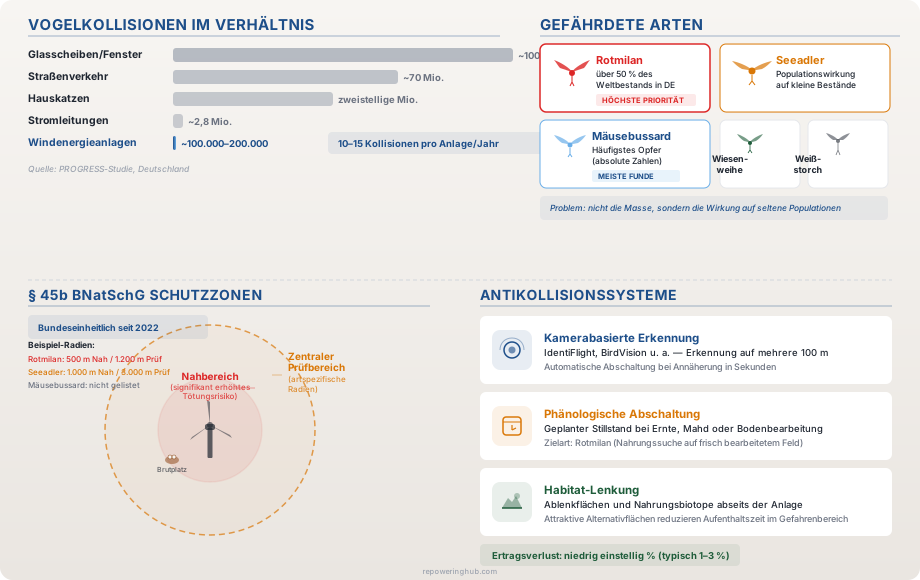
Bird collisions at wind turbines – the numbers in context, endangered species and protection systems