How are wind turbines recycled?
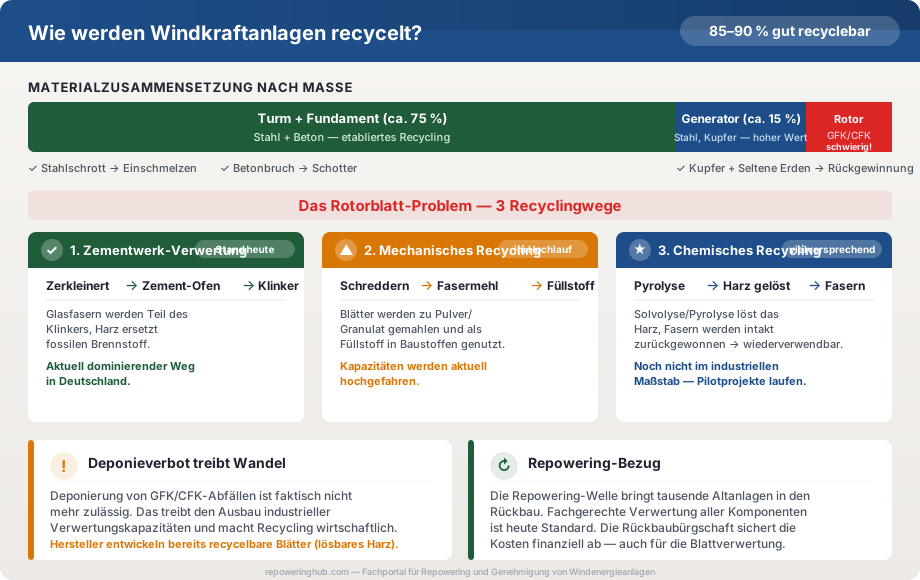
In short: A wind turbine is around 85–90% readily recyclable — the tower, foundation, generator and cables are made of steel, concrete and copper. The actual sticking point is the rotor blades made of fibre composite. For them, recovery is technically solved, but not yet high-value within the material loop.
What's inside a turbine?
| Component | Material | Recovery |
|---|---|---|
| Tower | Steel / concrete | established recycling (steel scrap, concrete rubble) |
| Foundation | Reinforced concrete | removal + concrete rubble as aggregate |
| Generator, gearbox | Steel, copper, rare earths (in part) | high material value, recovery |
| Nacelle cladding, rotor blades | Glass/carbon fibre (GFRP/CFRP) | difficult — see below |
The rotor blade problem
Rotor blades consist of glass or carbon fibres soaked in resin — a material made precisely so that it does not break down into its constituents. That makes genuine recycling laborious. Three routes currently dominate:
- Cement plant recovery (today's standard): The blades are shredded and used in the cement kiln. The fibres become part of the clinker, the resin replaces fuel. Material-thermal, but no landfill and no material lost into nothing.
- Mechanical recycling: Shredding into fibre flour/granulate as a filler for new plastics — ramping up.
- Chemical recycling (pyrolysis, solvolysis): The resin is dissolved out, the fibres remain intact and reusable — promising, but not yet at large scale.
Manufacturers have meanwhile announced recyclable blades, or have first models on the market in which the resin can later be dissolved again.
Why genuine circular recycling only pays off now
Until a few years ago, there were simply too few end-of-life rotor blades to run a dedicated recycling infrastructure economically — most German wind turbines were still within their first 20 years of operation. This is changing fundamentally with the repowering wave now getting under way: thousands of turbines from the 2000s and early 2010s are reaching the end of their EEG support or their technical lifespan and are being decommissioned. Only this plannable volume of material, growing continuously over years, makes investment in specialised mechanical and chemical recycling plants commercially attractive — before this, the market simply lacked the critical mass of recoverable rotor-blade material for a standalone industry.
Rare earths in the generator — a special case
Some turbine types, especially gearless direct-drive designs, use permanent magnets containing rare earths such as neodymium or dysprosium in the generator. These raw materials are geopolitically highly concentrated and costly to extract, which is why targeted recovery from end-of-life generators is becoming increasingly economically attractive and strategically significant. Specialised recycling companies therefore deliberately remove the magnet components separately before the rest of the generator goes into classic metal recycling for steel and copper. For turbines with a conventional gearbox and an asynchronous generator, by contrast, this aspect barely matters, since these mainly contain standard materials such as steel and copper that have gone through established recycling routes for decades.
Landfill ban drives the change
In Germany, landfilling rotor blades is effectively no longer permitted — they must be recovered. This has accelerated the build-up of the cement plant route and of new recycling capacity. With the upcoming repowering wave, thousands of legacy turbines will come up for decommissioning over the next few years, which makes the market for blade recycling economically viable.
Frequently asked questions
Does the foundation stay in the ground?
In principle, complete removal is mandatory. In practice, removal is usually carried out down to a certain depth; a complete excavation may be stipulated in the permit or land-lease contract. With repowering, the foundation is often newly built anyway.
Who pays for the decommissioning?
The turbine operator. For this, a decommissioning bond (Rückbaubürgschaft) must be lodged at the permitting stage, the amount of which is based on the estimated decommissioning costs. Details under Decommissioning & reserves.
How much of the turbine really ends up in the loop?
Over 90% by mass, because the tower and foundation account for the bulk of the weight. The remaining fibre-composite fractions are the small but technically demanding remainder.
Will rotor blades eventually be fully material-recycled instead of recovered in cement plants?
That is the industry's declared direction, but not yet reality across the board. Chemical processes such as pyrolysis or solvolysis can in principle dissolve the fibres out of the resin and make them reusable — the challenge is doing this reliably at industrial scale and high yield, with consistent fibre quality and at competitive cost. Until these chemical processes fully and comprehensively replace the cement-plant route, thermal-material recovery in the cement kiln remains the pragmatic interim solution that at least reliably rules out landfilling the rotor blades.
Are there already rotor blades designed for recycling from the outset?
Yes, individual manufacturers have blade concepts on the market or in trials in which a specially formulated resin system can be deliberately dissolved at end of life, so the glass or carbon fibres can be recovered as a pure fraction. These newer approaches are not yet standard across the entire installed fleet, but are likely to gain importance as large-volume repowering cycles ramp up, because manufacturers increasingly use recyclability as a selling point to operators and permitting authorities, and tenders and permit conditions are increasingly incorporating corresponding recycling criteria.
What happens to the turbine's cables and electronics?
Copper cables are among the most valuable material fractions of the entire turbine and are separated almost completely into pure fractions and fed into established metal recycling. Electronic components such as control boards and converters go through the established e-waste processes, in which precious metals and other recoverable materials are properly recovered — a sub-area of decommissioning recovery that, compared with the rotor-blade problem, is largely solved technically and economically uncritical.
Wind turbine recycling – material shares, the rotor blade problem and three recovery routes