Wind Energy Guides
The most common questions about wind turbines — fact-based, with concrete figures and sources. For residents, project planners, municipalities and anyone who wants to understand how wind turbines really work.
This guide series is deliberately not built as a linear reference work, but as a collection of standalone answers to concrete questions that keep coming up in practice — from residents on the ground, from municipalities in land-use planning, and from landowners with a lease or participation request on the table. Each article can be read on its own, but links to the relevant expert-report, permitting and tool pages wherever a question needs concrete calculations or legal detail beyond the plain explanation.
Which section is worth reading for whom
Not every question is equally relevant to every audience. The guides can roughly be grouped into four user groups, even though many articles are equally interesting for several groups at once:
- Residents and neighbours of a planned or existing wind farm: setback distance, noise, shadow flicker, ice throw and property value are usually front and centre here — the technical and legal limit values that actually apply.
- Municipalities and planning authorities: permitting duration, community participation, decommissioning conditions and how a wind farm contributes to local value creation are the central topics here.
- Landowners and lessors: lease models, contract clauses on repowering, and the financial side of a wind farm on your own land.
- Developers, investors and the technically curious: questions on storm behaviour, recycling, lifespan, CO2 balance and the economics of continued operation versus repowering.
Thematic grouping of the articles
If you prefer to orient yourself by topic rather than audience, the articles below are roughly sorted into four content blocks, even though some topics overlap:
- Technology & practice: storm behaviour, noise, ice throw, bird strike, height, power yield, standstill causes.
- Law & permitting: setback distance to homes, permitting duration, BImSchG costs, shadow-flicker compensation.
- Economics & lease: lease income, lease contracts during repowering, wind farm financing, community participation.
- Environment & decommissioning: recycling, decommissioning costs, CO2 savings, property value, solar park biodiversity.
Each article deliberately stays short and answers exactly one question — for deeper technical calculations we specifically point to the relevant expert tools and expert-report pages.
How the articles are produced and kept current
Each guide article is maintained individually, not generated as a text block from a template — figures such as noise levels, lease ranges or permitting durations come from named sources (TA Lärm, EEG 2024, WaLG, UBA, BNetzA) and are updated when relevant laws change, indicated by the "as of" date under each heading. Where a figure genuinely varies across the industry (for example lease amounts or decommissioning costs), we state it as a range rather than pretending a single, seemingly precise value.
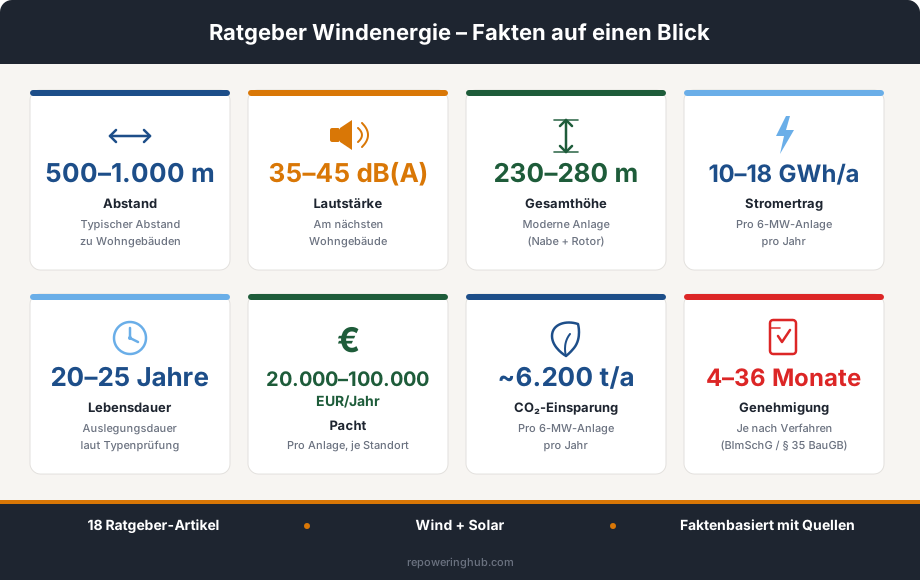
Wind Energy Guides – The key facts at a glance
Planning a concrete wind turbine project?
Beyond the guides, we connect you with qualified engineering firms for expert reports, permitting and planning — free initial referral.
Submit an enquiry