How close can a wind turbine be to homes?
In short: There is no nationwide uniform rule. The governing figure is the higher of two values — the flat-rate setback set by state law (where one exists) and the TA Lärm (Technical Instructions on Noise Abatement) noise distance derived from the acoustic calculation. In practice, permitted setbacks usually lie between 600 and 1,500 m.
The two benchmarks
- Flat-rate rule under state law: Some federal states prescribe a fixed minimum setback (e.g. 1,000 m). Bavaria uses the 10H rule.
- TA Lärm noise distance: The acoustic emission prognosis determines the distance from which the night-time noise limits at the home are met — typically 600–1,000 m depending on turbine type and area.
The higher value always applies. Where housing is dense, the noise requirement is usually stricter than the flat-rate rule.
Minimum setback by federal state
| Federal state | Rule (as of 2026) |
|---|---|
| Bavaria | 10H (10 × total height, at 200 m = 2,000 m) |
| NRW (North Rhine-Westphalia) | 1,000 m (opt-out possible for municipalities) |
| Brandenburg | 1,000 m |
| Saxony | 1,000 m |
| Schleswig-Holstein | 400 m + TA Lärm |
| Lower Saxony, Baden-Württemberg, Hesse, Rhineland-Palatinate and others | no flat-rate rule — TA Lärm decides (typ. 600–1,000 m) |
The specific value for your site is provided by the setback checker.
Why does the setback often apply only to residential areas?
The flat-rate rules under state law usually refer to "residential development within the meaning of planning law" — that is, designated residential areas. Individual houses in the outlying area (Außenbereich, undeveloped land outside settlements, e.g. resettler farms) are less protected; there, TA Lärm applies directly.
How is the TA Lärm distance calculated?
The TA Lärm figure is not a flat measure but the result of a propagation calculation. The basis is the turbine's sound power level on the nameplate (manufacturer data, usually 104–107 dB(A) for modern multi-MW turbines). From this, sound propagation over distance, ground and meteorological attenuation, and a safety margin for series variation are deducted. At the point of immission — the nearest home — the calculated assessment level must not exceed the applicable limit value:
- General residential area, at night: 40 dB(A) as the standard limit.
- Pure residential area, at night: 35 dB(A) — stricter, because a higher level of protection applies.
- Village and mixed-use area, at night: 45 dB(A) — here a shorter distance is often enough.
With several turbines in a wind farm, it is not the individual turbine that is considered, but the total immission of all turbines added together at the same point of immission. In practice, this means larger wind farms tend to need greater setbacks to the nearest housing than a single turbine of the same capacity.
Repowering: does the setback change?
With repowering, the setback is not automatically carried over — the new, usually significantly larger turbine goes through a complete new BImSchG permitting procedure, including a new noise prognosis. Because modern turbines, while taller, are often quieter per kilowatt-hour generated and equipped with a noise-reduced night mode, the newly calculated setback is not necessarily greater than for the old turbine. What matters is the specific acoustic emission prognosis for the particular turbine type, not the turbine height alone.
What rules of thumb often miss in practice
Many residents rely on simple rules of thumb like "500 metres should be enough" or "10H applies everywhere". Both fall short. The 10H rule applies only in Bavaria, and even there not without exception — municipalities can permit shorter setbacks via their own local development plan if TA Lärm is still met. Conversely, the TA Lärm distance can also exceed 1,000 metres in particularly quiet, sparsely populated areas with pure-residential status, if several turbines in a wind farm overlap their immissions at the same housing.
Another point often missing from the discussion: distance alone says nothing about the actual impact. Two turbines at an identical distance can sound different depending on whether they sit in the prevailing wind direction relative to the home, what ground attenuation lies in between, and how the topography carries the sound. That is why no flat-rate rule replaces the specific acoustic emission prognosis for the individual case — it is a mandatory part of every BImSchG permitting procedure anyway.
Setback to other uses
Besides homes, other uses are subject to their own, usually shorter setback requirements, which likewise derive primarily from safety and noise-protection considerations:
- Roads and rail lines: the setback is based on the turbine's tip-over height (hub height plus rotor radius), to avoid endangering traffic routes in a theoretical toppling scenario.
- Neighbouring undeveloped land: no flat-rate residential setbacks apply here, but neighbour-law setback zones under the respective state building code.
- Protected areas (FFH, bird protection): their own, species-specific setback recommendations — see the FFH impact assessment and the LAI guidelines on bird protection.
Frequently asked questions
Is there a nationwide minimum setback?
No. The federal government gave the states an opt-in option for flat-rate setbacks, but did not prescribe a uniform value. TA Lärm remains the governing standard.
What if my house is closer than the minimum setback?
Existing homes enjoy grandfathering (Bestandsschutz, protection of existing rights) — a new turbine must maintain the setback to your house. New construction within the impact zone after the turbine has been permitted has no retroactive claim to protection.
How is the setback measured?
From the base of the turbine mast to the nearest residential development. In the acoustic calculation, the noise source is the hub height.
Does every building count as a "home" for the setback rule?
No. What matters is the planning-law classification: residential buildings in a designated residential area enjoy full protection, while a single resettler farm in the outlying area gets less. Purely commercial, storage, or unoccupied buildings generally do not trigger a residential setback, even if people are present there at times.
Can a municipality change the setback via a local development plan?
Yes, within their planning authority, municipalities can define their own priority areas with adjusted setbacks via land-use and local development plans — as long as the TA Lärm minimums and state-law requirements are still met. This is one of the levers municipalities use to actively steer wind energy rather than just react to it.
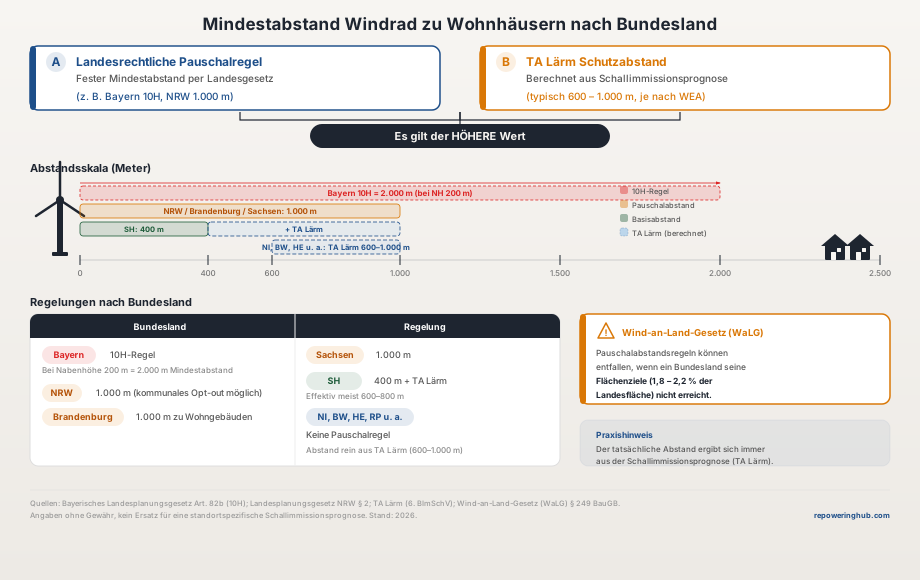
Minimum wind turbine setback – state rules, TA Lärm and the Wind-an-Land-Gesetz