How Loud Is a Wind Turbine?
In short: At the nacelle, a modern turbine produces 104–109 dB(A). But sound falls off sharply with distance — at a home 500–1,000 m away, only 35–45 dB(A) arrives. That is roughly comparable to a quiet living room or the hum of a refrigerator.
Sound levels compared
| Sound | Level |
|---|---|
| Rustling leaves, soft whisper | 20–30 dB(A) |
| Wind turbine at a house (500–1,000 m) | 35–45 dB(A) |
| Quiet living room, refrigerator | 40 dB(A) |
| Normal conversation | 60 dB(A) |
| Main traffic road | 70–80 dB(A) |
| Wind turbine directly at the nacelle | 104–109 dB(A) |
Why does the sound fall off so sharply?
Sound spreads spherically — the energy is distributed over an ever-larger area. With each doubling of distance, the level drops by about 6 dB. In addition, the ground, vegetation and air all attenuate it. The exact calculation is carried out according to DIN ISO 9613-2 in the acoustic emission prognosis (sound immission forecast).
What are the limit values?
The TA Lärm (Technical Instructions on Noise Abatement) sets the permissible levels at the house — at night (the critical case with wind):
- Purely residential area: 35 dB(A)
- General residential area: 40 dB(A)
- Village/mixed-use area: 45 dB(A)
If a value is exceeded, the turbine runs in noise-reduced night mode. Whether an area is classified as purely residential, general residential, or village/mixed-use follows from the local land-use plan (Bebauungsplan) or, if none exists, from the actual character of the surroundings.
Where the sound comes from — not just the wind itself
The audible sound of a wind turbine is predominantly aerodynamic in origin: air flows past the rotor blades and generates broadband noise, mainly at the trailing edge of the blade, similar to wind through treetops, but with a periodic element from the rotor's rotation. Mechanical noise from the gearbox and generator plays hardly any role in modern turbines, since many manufacturers now use gearless or acoustically damped drivetrains. This periodic "swish" sound — a slight rise and fall in time with the rotor's rotation — is the reason wind-turbine noise is sometimes perceived as more noticeable than equally loud but steadier traffic noise, even though the measured decibel values are lower.
How the acoustic emission prognosis calculates the result
The acoustic emission prognosis determines the expected assessment level for each relevant reception point (usually the nearest house). The basis is the sound power level of the specific turbine as measured by the manufacturer, from which propagation attenuation is subtracted according to DIN ISO 9613-2 — depending on distance, ground conditions, air absorption and meteorological conditions. Where several turbines stand in one wind farm, the individual contributions are added energetically, because sound sources don't combine linearly but logarithmically: two equally loud sources together produce only about 3 dB(A) more, not double. The report additionally accounts for pre-existing noise from turbines already in operation or other noise sources at the same reception point.
What residents actually hear in practice
Whether a wind turbine is perceived as disturbing depends, beyond the pure level, heavily on ambient background noise: on a very quiet rural night with no traffic noise, a steady swishing sound at 35 dB(A) stands out more than it would during the day with a window open and background noise from the road or from farming. That's precisely why the TA Lärm sets stricter limits at night than during the day. Weather conditions with tailwind toward the reception point, or a stable nocturnal temperature inversion, can additionally raise the perceived level slightly — effects that the prognosis accounts for through conservative propagation assumptions.
What a site visit can show that a report cannot
Anyone who wants to form their own impression before filing an objection should visit an existing wind farm on a windy day and in calm weather — the impression often differs noticeably from pure figures, because the subjective auditory impression depends not only on the level but also on the tonality and regularity of the sound. A report models the assessment level according to a recognised methodology, but it does not replace a personal experience on site — the two complement each other for an informed judgment.
Frequently asked questions
Can you hear a wind turbine at night?
With unfavourable wind and very quiet surroundings, a faint, steady swishing sound is possible. That is why night mode exists, pushing the levels below the guideline values. Whether and how clearly the sound is perceived depends heavily on wind direction, topography, and the individual resident's sensitivity — blanket statements are hardly possible here, which is why the prognosis is always calculated for the specific reception point.
Do modern turbines get louder because they are bigger?
Not necessarily. Larger turbines have higher hubs — the sound source is farther from the ground. Modern rotor blades are also aerodynamically quieter (serrated trailing edges). The sound power level is only moderately higher than for older turbines. In repowering, a quieter modern large turbine often replaces several older, louder turbines at different sites — overall, the noise exposure for residents can even decrease as a result, even though the individual turbine is taller and larger.
How is the noise assessed before construction?
Via the acoustic emission prognosis (sound immission forecast) in the BImSchG procedure (federal immission control permitting). A rough preliminary estimate is provided by our sound level calculator.
Is the noise measured again after commissioning?
Yes, many permits require an acoustic emission measurement after commissioning, to check whether the actual turbine really complies with the sound power levels predicted in the report. If the measurement comes in higher, the authority can subsequently order an operating restriction or an adjusted night mode. This after-the-fact check is an important element for reconciling the planning-stage prognosis with operational reality.
Does the noise differ between turbines from different manufacturers?
Yes, sometimes significantly. Manufacturer figures for sound power level differ depending on rotor blade design, blade-tip speed, and the noise-reducing measures used, such as serrated trailing edges or special profiles. For this reason, the choice of turbine type at noise-sensitive sites — for example with residential buildings at close distance — is an active planning parameter, not a mere formality in the report.
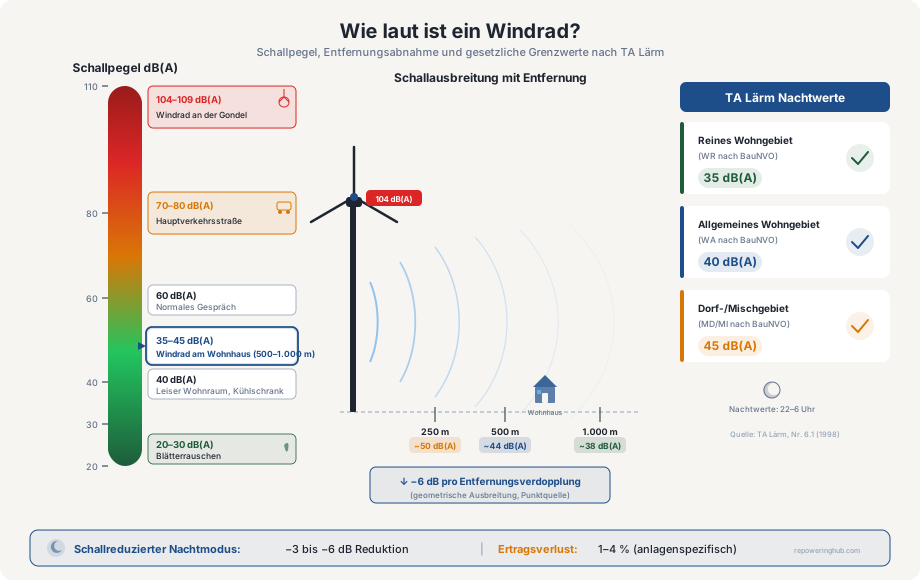
Sound levels of a wind turbine – decay with distance, comparison and TA Lärm limit values