EEG Auctions for Onshore Wind
Since 2017, all wind turbines > 750 kW must obtain support through BNetzA auctions. Four rounds per year, pay-as-bid pricing, ceiling of 7.35 ct/kWh. Understanding the mechanism is key to optimising your bidding strategy.
Auction Dates 2026
| Bid Date | Volume | Ceiling Price |
|---|---|---|
| 1 February 2026 | 4,094 MW | 7.35 ct/kWh |
| 1 May 2026 | 3,250 MW | 7.35 ct/kWh |
| 1 August 2026 | 3,962 MW | 7.35 ct/kWh |
| 1 November 2026 | 3,094 MW | 7.35 ct/kWh |
| Annual Volume 2026 | 14,400 MW | — |
BNetzA adjusts volumes annually. Expansion target: 115 GW onshore by 2030.
Auction Process
- Pre-qualification: BImSchG permit must be in place before the bid date
- Bid submission: electronically via the BNetzA platform, anonymous
- Pay-as-bid: each successful bidder receives their own bid price (not the market-clearing price)
- Award notification: approx. 2 weeks after the bid date
- 30-month deadline: commissioning must occur by then, otherwise penalty payment
Bidding Strategy
The central decision: bid as close to the ceiling as possible (maximum return, but risk of rejection in tight competition) or below (secure award, but lower margin).
| Strategy | Advantage | Risk |
|---|---|---|
| Ceiling strategy | Maximum return | Rejection if competition is stronger |
| Safety strategy (5–10 % below ceiling) | Near-certain award | Lower margin |
| Min-LCOE strategy | Margin maximised | Rejection if competition > LCOE |
Pre-Qualification in Detail
The BImSchG permit is the hard entry ticket for every auction round — without it, no bid is admitted. In practice this means: anyone wanting to bid at the February round realistically needs to have filed the permit application the previous year, since a full BImSchG procedure takes 7 to 18 months depending on the state and complexity of the project. Beyond the permit itself, BNetzA requires a set of formal documents: site coordinates, turbine type including technical data, a grid connection commitment from the distribution grid operator, and a security deposit currently set at €30,000/MW, which is forfeited in whole or in part if the project is not realised. If even one document is missing at the bid date, the bid is formally excluded — late submission is not possible. Developers bidding for the first time often underestimate the lead time needed for the grid connection commitment, which is frequently the critical path in the entire process.
Exceptions for Community Wind Companies
Community wind companies (Bürgerenergiegesellschaften) long benefited from a relaxed participation rule: they could bid without a complete BImSchG permit, provided they submitted it within 24 months of the award. This relief was subject to state-aid scrutiny by the European Commission, since it gave community projects an advantage over conventional developers. As of 2026, the rule is no longer applied in its previous form — anyone planning to bid as a community wind company should check with BNetzA in advance for the current pre-qualification conditions, as the legal position can change at short notice.
Repowering in the Auction
Repowering projects participate in the same auction rounds as new-build projects — there is no separate quota. The practical advantage lies in permitting speed: when existing site data (wind measurements, noise studies, species-protection screening) can be reused from the existing installation, the BImSchG permit can often be obtained faster than for a greenfield project on undeveloped land. That tends to give repowering projects more buffer before the desired bid date and lowers the risk of missing a round due to a pending permit. Economically, the bid mechanism remains identical — repowering turbines compete in the same pay-as-bid process for the same ceiling price.
Relationship to Other Revenue Models
Developers who fail to win an award, or who deliberately skip the auction, can refinance their project through a PPA power purchase agreement. This is particularly relevant for turbines falling out of EEG support after 20 years (see Repowering), or for developers who want to avoid auction risk and instead take on a bilateral price risk with an industrial offtaker. The choice between auction and PPA is essentially a question of risk allocation: the auction offers a 20-year indexed, state-backed revenue mechanism (market premium), while the PPA contractually shifts price risk between offtaker and developer, but can be concluded independently of the BNetzA schedule.
Award Statistics — Recent Rounds
| Round | Volume | Awards | Median Award |
|---|---|---|---|
| Feb 2025 | 4,094 MW | 3,987 MW | 7.33 ct/kWh |
| May 2025 | 3,250 MW | 3,250 MW | 7.34 ct/kWh |
| Aug 2025 | 3,962 MW | 3,962 MW | 7.33 ct/kWh |
| Nov 2025 | 3,094 MW | 3,094 MW | 7.32 ct/kWh |
As of 2025/2026: bids virtually always at the ceiling. Competition has eased — volumes are fully awarded.
Penalties for Delays
- Failure to commission within 30 months: €10/kW + forfeiture of award
- Delay up to 30 months: penalty of €5/kW/month from the 24th month
- 6-month extension possible for unforeseeable supply-chain delays
Why Pay-as-Bid Instead of a Uniform Price?
Germany deliberately runs onshore wind auctions as a pay-as-bid procedure rather than a uniform market-clearing price for all awards. The reasoning: under a uniform-price procedure, every bidder would receive the highest still-awarded value, which in tight competition could result in overpayment to bidders who had actually calculated a lower value. Under pay-as-bid, each successful bidder receives exactly their own bid price — this tends to push down the average support level, but requires developers to calculate more precisely, since a bid set too low directly reduces their own margin without benefiting from the overall competition level.
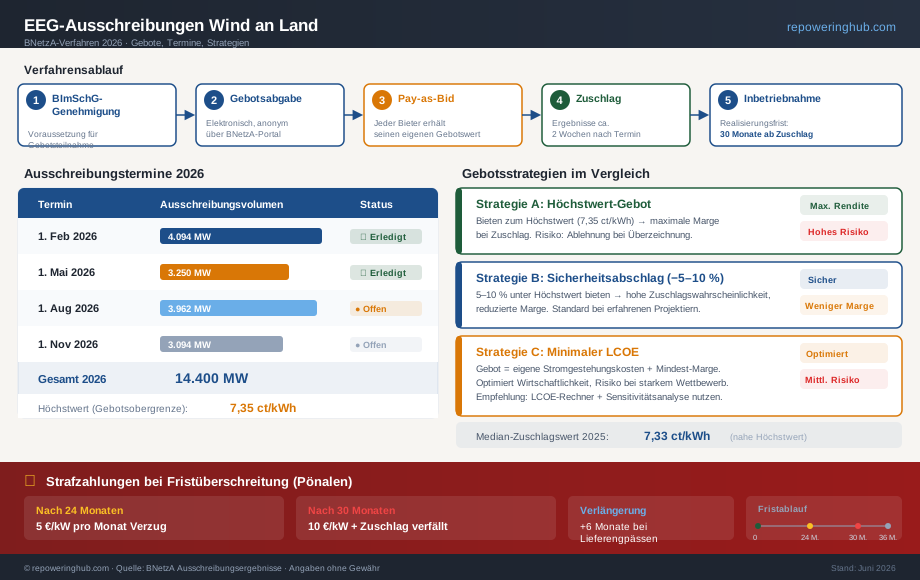
EEG Auctions for Wind — Process, 2026 dates and bidding strategies
Need bidding strategy support?
We connect you with energy-law firms and energy auditors for optimal bidding strategy including LCOE-based economic viability analysis.
Get in touchFrequently Asked Questions
What happens if a bid exceeds the ceiling?
It is invalid — exclusion from that round. Participation in the next round is still possible.
Can I submit bids for multiple turbines?
Yes, each turbine separately or bundled as a wind farm. For a farm, the same bid value applies to all turbines.
Are community wind companies privileged?
Historically yes, currently under review due to EU state-aid rules. As of 2026: no special conditions, but simplified pre-qualification is under discussion.
What happens if the grid connection is delayed?
The 30-month commissioning deadline runs from the award date regardless of the grid connection status. Delays on the part of the distribution grid operator are considered part of the bidder's business risk, unless a formally recognised, unforeseeable supply-chain shortage applies.
Can an award be sold or transferred?
Yes, under narrow conditions: the award is tied to the specific project. A transfer to a different operator at the same site is possible but must be reported to BNetzA. Reselling the award independently of the project is not permitted.