Legal and Economics of Wind Energy
Wind energy projects in Germany rest on four legal pillars: the EEG (remuneration), BNatSchG (nature conservation), the Wind-on-Land Act (land allocation), and BImSchG (permitting). This section covers the first three — permitting is addressed in the Permitting section.
How these topics connect
The legal and economic sides of a wind energy project cannot really be assessed in isolation — every legal decision has a direct economic consequence, and vice versa. Whether a site falls inside a priority area under regional planning determines the permitting risk and, with it, the timeline until the project can enter an auction. Whether a site sits within the central review radius of a Section 45b exclusion zone determines whether an anti-collision system is required, which in turn drives the investment sum and the financing structure built around it. And whether a given state meets its Wind-on-Land Act area target helps decide how many sites can even reach the auction stage in the first place. Anyone planning a project should therefore think through these four areas together from the outset, rather than working through them one at a time.
Which topic matters for whom
Depending on the project phase and your role in it, different pages in this section take priority. Anyone currently searching for or assessing a site should start with Regional Planning and the Wind-on-Land Act — both clarify whether a site is, or can become, permissible under planning law at all. Anyone examining permitting feasibility in detail, particularly where sensitive bird species are present on site, will find the relevant exclusion zones and avoidance measures under Section 45b BNatSchG. Once permitting looks achievable, the economic side becomes decisive: Auctions covers the path to public support, Market Premium the ongoing remuneration once a bid has been awarded, and Financing the capital structure used to build the project. For investors and community energy groups mainly weighing return and risk, financing and market premium are usually the most direct entry point; for developers still at the early site-search stage, regional planning, the Wind-on-Land Act and Section 45b tend to matter first.
A typical project sequence through these four areas
In practice, a wind project works through these topics in a fairly fixed order, even though individual steps can overlap. First, regional planning clarifies whether a site lies in a priority or suitability zone, and the Wind-on-Land Act clarifies whether the relevant state meets its area target or whether the concentration-zone effect has been suspended. In parallel, the species-protection review under Section 45b BNatSchG runs its course, with the result feeding into the BImSchG application. Only once the permit has been granted can the project take part in an EEG auction; after a successful bid, the market premium mechanism applies for the operating phase. The financing structure is usually negotiated in parallel with the permitting phase, so that construction start and loan disbursement can align in time. Knowing this sequence makes it easier to judge, realistically, which question comes up at which point in a project — and when to bring in which partner (law firm, technical expert, bank).
Remuneration and Market Law
EEG 2024 / 2025
Section 2 EEG — wind energy as an “overriding public interest,” auction mechanism, reference value.
EEG Auctions
BNetzA auctions for onshore wind — dates, ceiling prices, bidding strategy.
Market Premium
How the EEG market premium is calculated: reference value minus monthly market value.
PPA — Power Purchase Agreements
Bilateral direct contracts, frequently used for re-financing after the EEG funding period ends.
Land and Nature Conservation Law
Wind-on-Land Act (WaLG)
2 % of federal territory for wind — area targets per state, penalty consequence: privileged siting in outer areas.
Section 45b BNatSchG
Standardised exclusion zones for 15 collision-prone species, simplified exemption procedure.
Section 35 BauGB — Privileged Siting
Privileged in outer areas, provided in a concentration zone or under WaLG provisions.
Regional Planning
Priority, suitability and concentration zones — how regional planning prepares or excludes sites.
Participation and Contracts
Community Wind & Participation
Participation models and state laws (e.g. Mecklenburg-Vorpommern, Brandenburg, NRW from 2025).
Lease and Land-Use Agreements
With landowners, rights of way, cable corridors, voltage easements.
Financing
KfW programmes, project finance, equity structures, community bonds.
Decommissioning Reserves
Mandatory performance bond for later turbine dismantling — how much, when to set aside.
Repowering versus new-build: a different starting point
For repowering projects, the legal and economic picture looks different from a greenfield project: the site is usually already secured under planning law, species-protection and yield data already exist, and permitting can generally proceed faster. That changes the economic assessment too, for instance in the financing structure or the bidding strategy for an auction. Anyone planning a repowering project will find the deeper coverage in the Repowering section — the pages linked here cover the legal and economic mechanisms that apply equally to new and existing projects, but each one flags repowering-specific simplifications where they exist.
Telling legal and economic questions apart
A common mistake when categorising these topics: not every question that comes up in a wind project is purely legal or purely economic — most have both dimensions. Whether a site falls within the Section 45b review radius of a red kite nest is, at first, a purely legal question of fact. Whether an anti-collision system pays off economically at that site, on the other hand, is a pure investment decision that depends on wind yield and the expected reference output. The Wind-on-Land Act works the same way: whether a state meets its area target is a legal fact with a direct effect on municipal land-use planning — what that means for your own site strategy is, again, a business judgement. Looking at both levels separately from the start, but always in relation to each other, leads to more solid investment decisions than checking only one side.
Where our figures come from
The content in this section draws on the relevant statutes — EEG 2024, BNatSchG, WindBG/Wind-on-Land Act, BauGB — as well as published Bundesnetzagentur statistics on auction results and the monthly market value publications from the transmission system operators. Where specific figures are given (interest rates, cost ranges, marketing fees), these are, unless stated otherwise, market observations and benchmark values from project practice — not individual financial or legal advice. For a binding assessment of a specific project, we always recommend involving a specialised law firm or auditor; we can put you in touch on request. Details on our editorial approach are available under Methodology and Editorial.
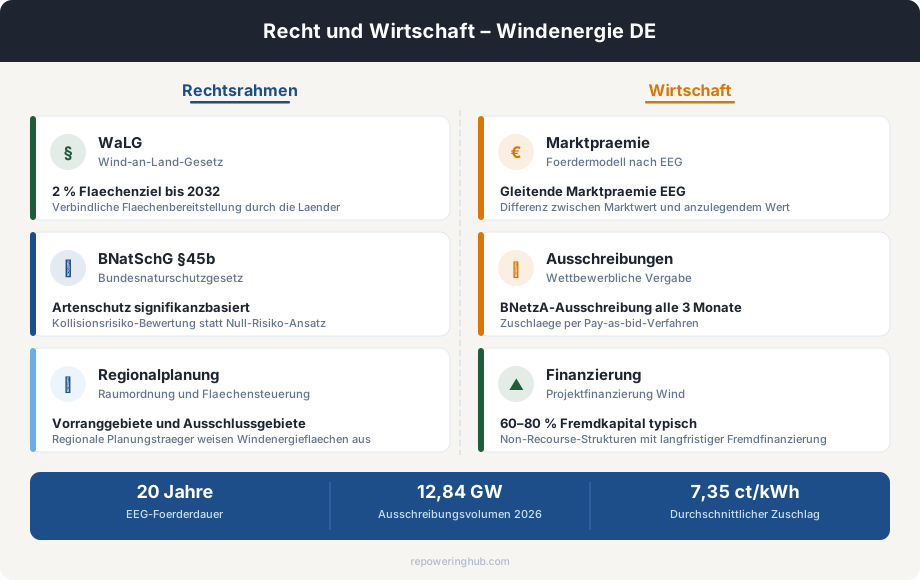
Legal and economics of wind energy — regulatory framework and support at a glance
Need a legal or economic review for your project?
We connect you with specialised law firms (energy law, nature conservation) and financial advisors for commercial project due diligence.
Get in touch