Financing of Wind Energy Projects
Wind projects are predominantly structured as project finance: senior debt from specialised energy banks covers 70–80 % of the investment, with equity from sponsors and community wind providing the remainder. Collateral, contracts and terms follow an established standard.
Typical Financing Structure
| Component | Share | Terms 2026 |
|---|---|---|
| Senior Debt (Bank) | 70–75 % | 4.0–5.0 % p.a. fixed, 15 years amortising |
| Subordinated Debt (Mezzanine) | 0–10 % | 7–10 % p.a., 10–12 years, sometimes with equity kicker |
| Sponsor Equity | 15–25 % | Return expectation 8–12 % p.a. |
| Community Wind Share (where mandatory) | 5–20 % | 4–6 % guaranteed return |
Specialised Wind Financiers in Germany
- NORD/LB — market leader for wind finance in Northern Germany
- KfW IPEX-Bank — large-scale project finance, repowering, international projects
- Bayern LB — Southern Germany focus, frequently community wind
- UmweltBank — specialist energy bank, mid-sized projects
- Triodos Bank — sustainable energy finance
- Helaba, DZ Bank, Sparkassen — regionally active partners
- European Investment Bank (EIB) — for large portfolios
Roles in the Financing Process
Beyond the sponsor and the lending bank, a wind project financing typically involves several further parties whose interaction determines the timeline. The technical advisor (independent engineer) reviews turbine technology, the wind assessment and maintenance contracts on behalf of the bank. The bank's legal counsel reviews all project contracts for bankability — that is, whether termination rights or liability caps in supply contracts match the usual market standard. The insurance broker puts together the insurance package for the construction and operating phases, which the bank takes as collateral by assignment. This structure, with several independent advisors alongside the actual lending, explains a substantial part of the ancillary financing costs mentioned above and should realistically be factored into any project timeline.
Repayment Structure
- Amortising: constant annuity over 15 years, standard case
- Sculpted repayment: repayment adapted to cash flow, lower in early years
- Bullet maturity with refinancing risk: rare, for very strong sponsors
- Bullet payment: at maturity, combined with annual interest — closer to equity character
Collateral
- Security assignment of the turbines: bank can realise the asset in worst case
- Cash-flow assignment: all EEG market-premium payments and PPA revenues flow through the project account
- Parent guarantees: standard when a sponsor holding is involved
- Construction-phase guarantee: turbine manufacturer provides performance bond
- Maintenance guarantee: manufacturer contract or ISP contract is assigned
Key Contract Elements
| Element | Typical Terms |
|---|---|
| Debt Service Coverage Ratio (DSCR) Min. | 1.25× P50, 1.10× P90 |
| Debt-Service Reserve | 6–12 months interest + principal |
| Maintenance Reserve | Built up over the term |
| Insurance Reserve | Built up over the term |
| Cash-Flow Sweep | 50–100 % of free cash flow for prepayment when DSCR is low |
| Construction Insurance | From turbine manufacturer + construction contractor |
Green Bonds and Schuldschein Loans as an Alternative
Alongside classic bank financing, larger portfolio operators increasingly use capital-market instruments. A Green Bond or Green Schuldschein (German promissory note loan) targets institutional investors — insurers, pension funds — and is structured through a placement bank rather than a classic bank consortium. This route usually requires a minimum volume of €50–100 million, which is why it mainly suits bundled financings of several wind farms or established operators with a larger existing portfolio. The advantage lies in somewhat more favourable terms for very strong credit quality and in diversifying the capital base beyond the house bank. The downside: higher structuring costs and a more elaborate rating or green-bond certification (e.g. under the ICMA Green Bond Principles), which only pays off from a certain project size upward.
Tax Framework
Particularly relevant for the financing structure are the German interest-barrier rules (§ 4h EStG / § 8a KStG), which limit the tax deductibility of debt interest above a certain threshold, and the trade-tax add-back of interest expenses under § 8 No. 1 GewStG. Both rules directly affect the after-tax return of equity investors and are therefore routinely modelled as part of the tax due diligence before financial close. For community wind participations, the individual income-tax treatment of distributions at investor level comes on top — each investor should clarify their individual situation with a tax advisor, since Repowering Hub cannot and may not provide individual tax advice on this.
Repowering-Specific Financing Questions
For repowering projects, the financing structure differs from a new-build project in one important respect: part of the investment goes toward the decommissioning of the old turbine, which banks factor in separately when assessing collateral. At the same time, robust historical yield data from operating the old turbine is usually available for the site, which a bank can use to sanity-check the wind assessment — this tends to reduce due-diligence effort compared with a site that has no operating history. Existing grid connection points and access roads can also often be reused, which noticeably reduces the investment sum compared with a comparable greenfield project.
KfW Programmes
- KfW 270 “Renewable Energy Standard”: up to €50 million, rates from 3.5 %, term up to 30 years
- KfW 277 “RE Premium”: repayment grants for particularly innovative projects
- KfW IPEX Direct Loan: for large projects from €25 million
- KfW Community Energy Programme: special terms for community wind cooperatives
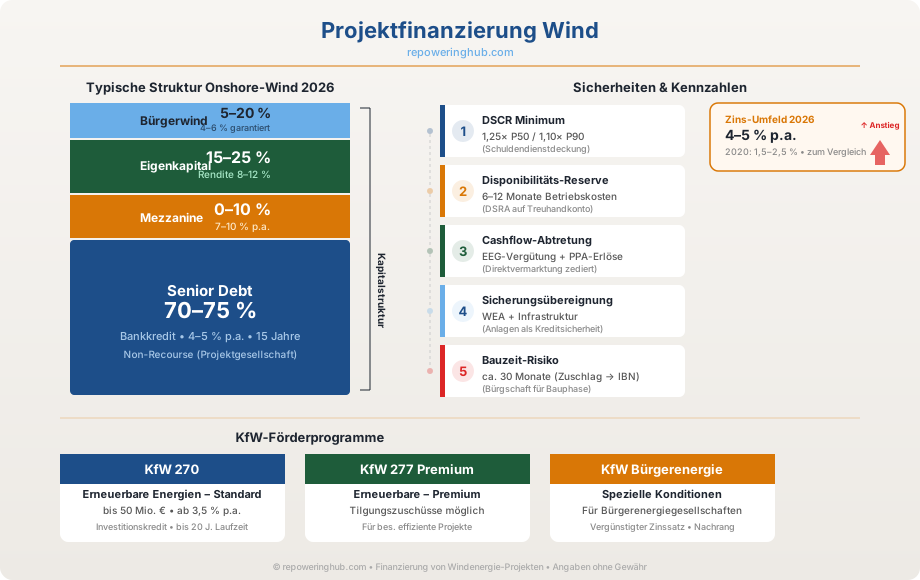
Wind project finance — capital structure, collateral and KfW programmes
Need financing structuring for your project?
We connect you with a specialised wind-finance advisor and bank selection (term-sheet comparison) — optimal terms from 5–7 enquiries.
Get in touchFrequently Asked Questions
How long does financing structuring take?
From term sheet to signed loan agreement typically 4–6 months. For complex structures (multiple tranches, international banks) up to 9 months.
What are the ancillary financing costs?
Structuring fee 0.5–1.5 % of loan amount + legal fees €50,000–150,000 + due-diligence costs (technical & legal) €30,000–80,000.
When are banks ready to finance?
After BImSchG permit + EEG award + manufacturer contract. Bridge financing during the application phase via sponsor equity or bridge loan.
How does a PPA instead of the market premium affect bankability?
Banks generally assess PPA revenues more cautiously than the EEG market premium, because the offtaker's counterparty risk and the contract term (often 10–15 years rather than 20) are additional review points. In practice, lending banks usually require a credit check on the PPA offtaker and sometimes additional security before PPA revenues are fully factored into the debt-capacity calculation.
What role does the wind assessment play for financing?
The independent wind assessment (P50/P90 yield forecast) is the central basis for the bank's debt-capacity calculation. The DSCR is typically calculated on the P90 value, to ensure debt service capability even in a below-average wind year.