Section 45b BNatSchG — Species-Protection Simplification for Wind Turbines
With the Wind-on-Land Act (WaLG, 2022), Section 45b was inserted into the Federal Nature Conservation Act (BNatSchG). It standardises exclusion radii for 15 collision-prone bird species and introduces a simplified exemption procedure. This means the biggest permitting hurdle — species protection — is now regulated uniformly at the federal level.
The 15 Listed Species
| Species | Inner Exclusion Zone | Central Assessment Zone |
|---|---|---|
| Rotmilan (Red Kite) | 1,500 m | 1,500–4,000 m |
| Schwarzmilan (Black Kite) | 1,000 m | 1,000–3,500 m |
| Seeadler (White-tailed Eagle) | 3,000 m | 3,000–6,000 m |
| Fischadler (Osprey) | 1,000 m | 1,000–4,000 m |
| Schreiadler (Lesser Spotted Eagle) | 4,000 m | 4,000–6,000 m |
| Wiesenweihe (Montagu’s Harrier) | 1,000 m | 1,000–4,000 m |
| Kornweihe (Hen Harrier) | 1,000 m | 1,000–4,000 m |
| Sumpfohreule (Short-eared Owl) | 1,000 m | 1,000–4,000 m |
| Schwarzstorch (Black Stork) | 3,000 m | 3,000–10,000 m (deflection corridor) |
| Weißstorch (White Stork) | 1,000 m | 1,000–2,000 m |
| Baumfalke (Eurasian Hobby) | 1,000 m | 1,000–4,000 m |
| Wanderfalke (Peregrine Falcon) | 1,000 m | 1,000–4,000 m |
| Wespenbussard (European Honey Buzzard) | 1,000 m | 1,000–4,000 m |
| Wachtelkönig (Corncrake) | 500 m | 500–2,000 m |
| Uhu (Eurasian Eagle-Owl) | 1,000 m | 1,000–3,000 m |
Three Zones, Three Consequences
| Zone | Permit Status | Required Measures |
|---|---|---|
| Inner Exclusion Zone | Generally not permittable | Layout adjustment or site abandonment |
| Central Assessment Zone | Killing prohibition applies; permit possible with protective measures | Anti-collision system (ABS), curtailment periods, habitat measures |
| Extended Assessment Zone | Case-by-case assessment possible | Typically no special measures required |
Cost-Benefit Trade-Off: ABS versus Site Abandonment
In the central assessment zone, developers regularly face a basic economic question: is investing in an anti-collision system worthwhile, or is an alternative turbine location outside the critical zone the more economical solution? The answer depends heavily on site quality. At a wind-rich location with a high reference yield, an ABS almost always pays off despite the ongoing yield losses from curtailment, because that loss — typically a low single-digit percentage — is clearly smaller than the yield loss from a weaker alternative site. At a location with marginal wind conditions, on the other hand, a layout with larger setbacks from the exclusion radii can be more economical than ABS-supported operation inside the inner zone. This trade-off should be made as early as possible in the planning process, since it materially affects both layout planning and the later economic feasibility calculation (see Financing).
Anti-Collision System (ABS) as Standard Solution
Within the central assessment zone, the killing prohibition can be addressed through an anti-collision system (German: Antikollisionssystem, ABS). How it works:
- Camera or radar system monitors the airspace around the turbine
- Detects approaching birds of the listed species
- Sends a signal to the turbine control system upon critical approach
- Turbine shuts down briefly (typically 1–3 minutes)
- Restarts after the bird has left the area
Providers: BioConsult SH, Bird Vision, Sound Office, IFAO. Cost: €100,000–250,000 per turbine, typical yield loss 0.5–2 % p.a.
Background: from Significance Case Law to Section 45b
Before Section 45b was introduced, species-protection assessment for wind energy projects was shaped by the Federal Administrative Court’s so-called significance case law: a permitting authority had to assess, case by case, whether the killing risk for a collision-prone species was “significantly” increased compared with the general background risk. Because there were no uniform federal standards for this, the German federal states developed their own setback recommendations — the well-known Helgoland Papers issued by the national working group of bird protection authorities were professionally recognised but not legally binding, and courts weighted them inconsistently. This legal uncertainty was one of the most frequently cited reasons for failed or delayed permitting procedures. With the WaLG package, the legislature transferred much of the technical standard set out in the Helgoland Papers into the new Section 45b, creating for the first time a federal statutory basis for setback systematics in species-protection law.
How a Section 45b Species-Protection Assessment Works in Practice
The process generally follows a fixed pattern. First, an avifaunal consultancy determines, through space-use analyses and nest mapping, which of the 15 listed species occur around the planned site and where breeding sites or regularly used flight corridors are located. It then assesses which of the three zones the planned turbine locations fall into. If a location falls within the central assessment zone, an avoidance and mitigation concept is developed — typically a combination of an anti-collision system, curtailment during peak foraging periods, and supplementary habitat measures. The resulting report then feeds into the BImSchG application and is reviewed by the competent nature conservation authority as part of statutory agency consultation. For repowering projects, a substantial share of this data basis can be carried over from the existing turbine’s monitoring records, which noticeably shortens processing time.
Relationship to Regional Planning
Section 45b applies independently of regional planning: even a site within a designated priority area must still go through the species-protection assessment — designation as a priority area does not replace the case-by-case review, though in practice it often speeds it up, because a preliminary species-protection screening has typically already taken place during the regional plan’s drafting. Developers should therefore always think of site selection as two separate steps: first, planning-law permissibility under the regional plan; second, species-protection feasibility under Section 45b — the two assessments can reach different conclusions.
Simplified Exemption Procedure
Section 45b enables a faster exemption procedure than the previous process under Section 45 (7) BNatSchG:
- Standardised exclusion radii instead of regional guidelines
- “Overriding public interest” of wind energy (Section 2 EEG) recognised as a valid argument
- Habitat measures and ABS accepted as avoidance measures
- Faster authority decisions possible
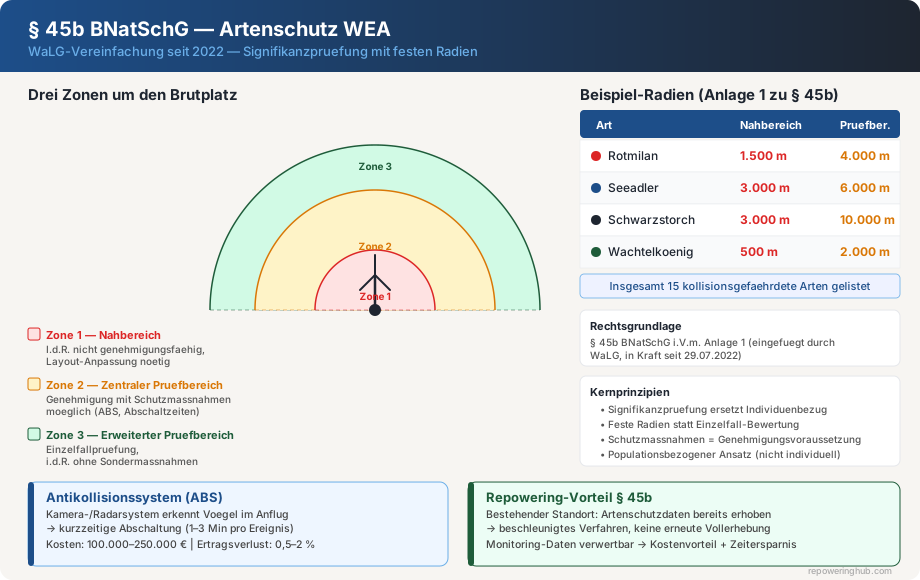
Section 45b BNatSchG — Three zones, exclusion radii, anti-collision system and repowering advantage
Need a species-protection strategy for your site?
We connect you with an avifaunal consultancy experienced with Section 45b — early site assessment against the exclusion radii.
Get in touchFrequently Asked Questions
What about species outside the 15-species list?
For other species, Section 44 BNatSchG with regional guidelines still applies. The permitting authority decides on a case-by-case basis.
Who certifies the ABS system?
BfN-certified providers with their own validation process. The authority approves the system for the specific site.
How much does habitat enhancement as avoidance cost?
€20,000–80,000 per site, one-off. Examples: creating skylark plots, establishing fallow land for Short-eared Owl, providing alternative habitat for Red Kite territories.
How long does a complete avifaunal survey take?
For new turbines, typically one full calendar year, since breeding-bird and migratory-bird surveys are tied to the seasons. For repowering projects with existing monitoring data, follow-up surveys can often be limited to targeted checks during specific periods.
Does Section 45b also apply to existing turbines without repowering?
No — Section 45b applies to new permitting decisions, which also covers a 1:1 repowering, since that legally counts as a new build. For the continued operation of an existing turbine without a permit change, the original conditions of the existing permit continue to apply.