Bird Survey for Wind Turbines
The avifaunal survey (avifaunistisches Gutachten) records the breeding and resting birds within the impact zone of the planned turbines and assesses the killing and disturbance risk under sec. 44 BNatSchG. It is the ornithological component of the comprehensive species protection report and usually the critical path in the entire permitting procedure.
What is surveyed?
- Breeding bird mapping following the “Methodology Standards for Recording Breeding Birds in Germany” (Suedbeck et al., DDA 2005)
- Territory mapping for non-colonial breeders: 6–10 field visits from March to July
- Nest inspections for particularly relevant raptors (red kite, black kite, white-tailed eagle) within an extended radius
- Resting bird survey where the site is in migration corridors — autumn/spring field visits
- Functional habitat analysis: Where do the birds breed, hunt, and fly over the project area?
- Assessment according to the Helgoland Paper (LAG VSW) and sec. 45b BNatSchG
Key conflict species and exclusion zones
| Species | Close range | Assessment zone | Notes |
|---|---|---|---|
| Red kite | 1,500 m | 1,500–4,000 m | Generally not permittable in close range; in assessment zone often feasible with anti-collision system (ABS) |
| White-tailed eagle | 3,000 m | 3,000–6,000 m | Strict exclusion, compatibility rarely demonstrable |
| Black stork | 3,000 m | 3,000–10,000 m | Disturbance-sensitive, wide deflection corridors |
| Montagu's harrier | 1,000 m | 1,000–4,000 m | Breeding site changes annually — ongoing monitoring required |
| Honey buzzard | 1,000 m | 1,000–4,000 m | Standardised since sec. 45b BNatSchG |
| Hen harrier, Short-eared owl, Corncrake | 1,000 m | — | Local significance, varies regionally |
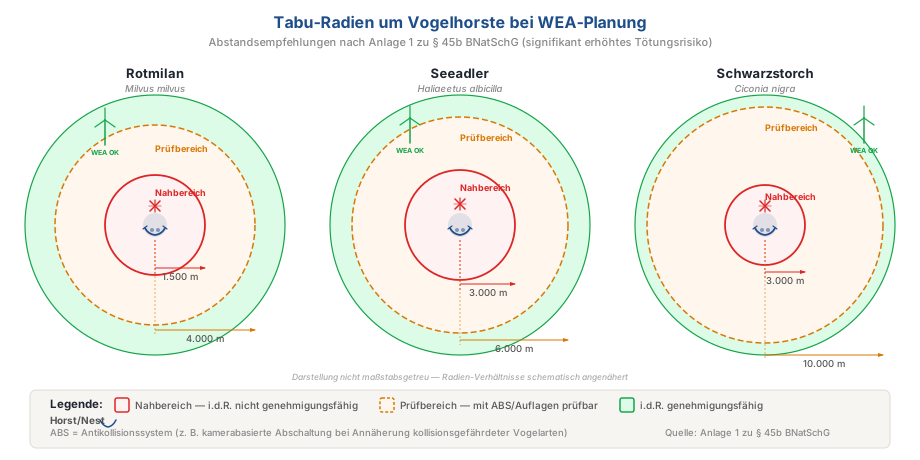
Exclusion zones around bird nests per sec. 45b BNatSchG — close range (red) vs. assessment zone (orange)
Survey effort and timeline
- One full breeding-bird season: 6–10 field visits March–August
- Two seasons at complex sites or when required by the authority
- Nest inspections typically via two additional spring field visits
- Resting/migratory bird survey if relevant: 8–12 visits between September and April
Methodology: the Suedbeck standard
Every reliable breeding-bird survey rests on the “Methodology Standards for Recording Breeding Birds in Germany” (Suedbeck et al., Dachverband Deutscher Avifaunisten, 2005). They specify how territories are delineated, how many field visits per species group are required, and how breeding-season codes are assigned. For the wind-energy-relevant assessment, the Helgoland Paper of the German federal states' bird protection working group (LAG VSW) is added, setting out recommended distances to the breeding sites of collision-prone species. Since the WaLG, these recommendations for 15 species have been codified nationwide in Annex 1 to sec. 45b BNatSchG — the older state-level guidelines continue to apply only to species not listed there.
Significance and CEF measures
Even where a collision-prone species is confirmed, the project is not automatically inadmissible. What matters is the significance framework under sec. 44(5) BNatSchG: only a significantly increased mortality risk triggers the prohibition. To bring the risk below that significance threshold, advance compensation measures (CEF — Continuous Ecological Functionality) are used, such as upgrading deflection areas away from the turbines or anti-collision systems that shut down the rotor when a raptor approaches. Whether such measures are accepted lies within the authority's discretion and is the most frequent point of dispute in the procedure.
What does it cost?
Guideline cost €15,000–45,000 for a full survey over one season; with two seasons or proximity to bird protection areas, up to €80,000. Key factors:
- Number of turbines + size of the project area
- Required seasons (1 vs. 2)
- Resting bird component where migration corridors are involved
- Habitats Directive assessment for sites near protected areas
Who prepares it?
Ecological engineering consultancies specialising in avifauna with long-standing survey experience in the relevant region. Key criterion: calibrated methodology aligned with state-level requirements (e.g. LANUV guideline NRW, Hesse guideline, Helgoland Paper).
Request a bird survey
We connect you with a specialist consultancy experienced in regional field surveys — ideally well before the breeding-bird season starts.
Get in touchFrequently asked questions
What happens if a red kite nest is found in the project area?
Within the close-range zone (1,500 m), the turbine is generally not permittable. In the assessment zone (1,500–4,000 m), the turbine may be permitted with an anti-collision system or seasonal curtailment during the breeding season.
Can the survey be carried over from the existing installation during repowering?
Partially — the WaLG (2022) introduced simplifications. For 1:1 repowering without site relocation, existing survey data can be used, though an updated survey is usually still required.
What about raptors not listed in sec. 45b BNatSchG?
For species outside Annex 1 to sec. 45b, the previous regional guidelines continue to apply. The permitting authority decides on a case-by-case basis — which makes the consultancy's regional expertise particularly important.
How reliable is a survey?
With properly applied Suedbeck methodology, very reliable. Authorities accept the procedure without fundamental objections — disputes tend to arise around the assessment (significance testing, CEF measures) rather than the field data.
How long do survey results remain valid?
There is no nationwide fixed validity period; in practice, authorities often still accept data from the last two to three years, while older surveys are usually considered outdated. If the permitting procedure is significantly delayed, the authority can demand an update, because breeding sites and population densities can shift noticeably within a few years — particularly for collision-prone large birds with changing nest locations.