Bat Survey for Wind Turbines
The bat survey (Fledermausgutachten) records the activity of collision-prone bat species in the rotor zone and assesses the mortality risk. It is a mandatory component of every BImSchG permitting procedure and typically results in the condition of a bat-friendly curtailment algorithm during critical summer nights.
What is surveyed?
- Nacelle monitoring: Ultrasound detector at nacelle height (80–160 m), recording calls of passing bats throughout the entire season
- Ground-level survey: Detector plus field visits, recording the species community at the site
- Roost search in the project area (cavity trees, buildings) — particularly relevant at forest sites
- Derivation of the curtailment algorithm: At which wind speed / temperature / time of year must the turbine be shut down at night?
Key collision-prone species
| Species | Significance | Notes |
|---|---|---|
| Common noctule | High-flying | Most frequent collision find at wind turbines nationwide |
| Leisler's bat | High-flying, long-distance migrant | Annex IV Habitats Directive |
| Nathusius' pipistrelle | Migratory species | Collision peak in late summer/autumn |
| Common pipistrelle | Most abundant species in DE | Collision risk especially near roosts |
| Soprano pipistrelle | Cryptic sister species | Not always acoustically distinguishable from common pipistrelle |
Standard curtailment algorithm
Based on the recorded activity, a smart curtailment algorithm is derived (Brinkmann/Niermann/Behr). The turbine is preventively shut down during critical phases:
- Season: typically 1 April to 31 October
- Time of day: sunset to sunrise
- Wind: curtailment at < 5.5–6.5 m/s at nacelle height
- Temperature: curtailment at > 10 °C
- Precipitation: restart permitted during rain
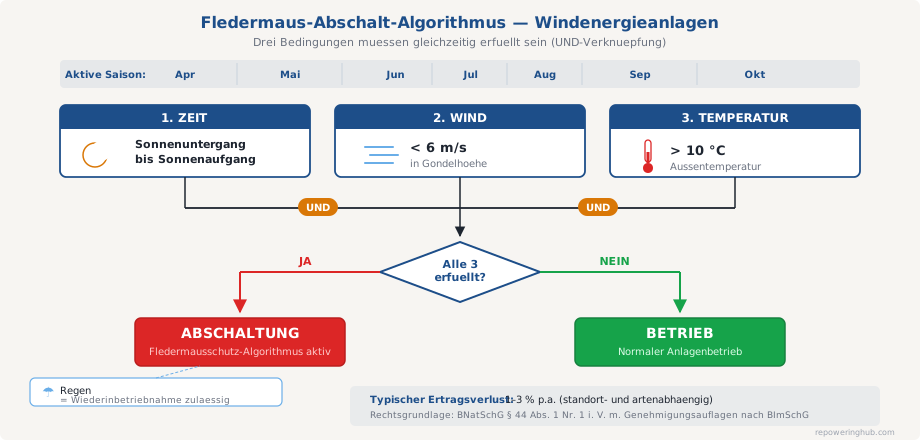
Curtailment algorithm for bat protection — three conditions must be met simultaneously (AND logic)
Legal basis: the killing prohibition under BNatSchG sec. 44
Bats are strictly protected under EU law (Annex IV of the Habitats Directive). Section 44(1) of the Federal Nature Conservation Act (BNatSchG) prohibits killing or significantly disturbing protected animals. A wind turbine increases this mortality risk through collision and barotrauma. The permit can only be granted if the significantly increased mortality risk is pushed below the significance threshold through avoidance measures — in practice, almost always via a curtailment algorithm. The survey provides the technical justification for the conditions under which the turbine must be shut down so that the prohibition does not apply.
Survey methodology: why nacelle height matters
What matters is the acoustic activity where the rotor blades turn. A ground-level detector records the species community but says little about the collision risk at 100–150 m height. That is why nacelle monitoring is the core of the survey:
- Survey period: at least one full season, typically from spring into late autumn, to cover both maternity-roost and migration periods.
- Continuous recording: the detector runs every night, while wind speed and temperature from the turbine nacelle are logged in parallel.
- Call analysis: the recorded ultrasound calls are assigned to species or species groups using software support and manual review — acoustically similar species such as common and soprano pipistrelle cannot always be separated.
- Activity model: linking activity, wind, and temperature shows under which conditions activity is negligible — the turbine may run during those conditions.
Two-year monitoring and algorithm refinement
Because the pre-construction survey covers only one season, the initially conservative algorithm is usually confirmed or adjusted through two years of post-commissioning nacelle monitoring. If the real site shows low activity, the curtailment thresholds can be relaxed — reducing the yield loss. Conversely, the authority can tighten the condition if activity is high. This monitoring condition is recorded as an ancillary provision in the permit.
What does it cost?
Guideline cost €10,000–30,000 for nacelle monitoring over one season. Key factors:
- Number of turbines (nacelle monitoring per turbine or by sample)
- Additional ground-level survey (forest sites, building-adjacent sites)
- 2-year post-commissioning monitoring — often a permit condition, additional €15,000–25,000
Who prepares it?
Specialist chiropterologists — usually the same consultancies that also carry out the bird surveys, but with a dedicated bat expert. Key criterion: calibrated detector technology (Avisoft, Petersson, Batlogger) and experience with the local species community.
Request a bat survey
We connect you with a chiropterology-experienced consultancy — including nacelle monitoring and a curtailment concept for the permit condition.
Get in touchFrequently asked questions
What is the difference from a ground-level survey?
Nacelle monitoring records activity at rotor-blade height — exactly where the mortality risk arises. The ground-level survey describes the species community at the site but is only indirectly indicative of risk in the rotor zone. Authorities typically require both.
Can the curtailment algorithm be adopted from a similar site?
No. Every site has its own activity profile, which can only be determined through site-specific measurement. Only after 2 years of operational monitoring can the algorithm potentially be relaxed.
What about anti-bat acoustic devices (ultrasound deterrents)?
Anti-bat devices are an alternative technology (acoustic deterrence) but are not yet certified in Germany. Currently, the smart curtailment algorithm is the standard solution.
How much yield does curtailment cost during repowering?
For repowering, typically 1–4% per year — modern turbines have optimised algorithms with precise thresholds. Where economic viability is tight, factor the yield loss into the LCOE calculation.
Are all bat species protected to the same degree?
Legally, yes — all native bat species fall under Annex IV of the Habitats Directive and are therefore subject to the strict killing prohibition. Technically, however, species differ markedly in their collision risk: high-flying, migratory species such as the common and Leisler's noctule, along with Nathusius' pipistrelle, account for the largest share of documented collision finds, while species that forage close to the ground are affected less often. This species-specific risk feeds into the assessment but does not change the underlying legal protection status.