Community Wind (Bürgerwind)
Community wind models enable residents and municipalities to participate financially in wind projects — improving acceptance and securing local value creation. In MV, BB and NRW this is a legal requirement. Models, structures and practice in 2026.
Mandatory Participation by Federal State
| Federal State | Mandatory since | Share / Model |
|---|---|---|
| Mecklenburg-Vorpommern (MV) | 2016 | 20 % participation offer to residents (5 km) + host municipality |
| Brandenburg (BB) | 2024 | Special levy 10,000 €/MW/a to host municipality |
| North Rhine-Westphalia (NRW) | 2025 | 0.2 ct/kWh levy to host municipality |
| Schleswig-Holstein (SH) | voluntary | Community wind definition with tax advantages |
| Lower Saxony (NDS) | voluntary | Currently under discussion |
Participation Models
| Model | Advantages | Disadvantages |
|---|---|---|
| Registered cooperative (eG — eingetragene Genossenschaft) | Democratic, easy membership, tax privileges | Formation effort, board liability |
| GmbH & Co. KG (limited partnership with a limited liability company as general partner) | Limited liability, tax-flexible | Higher administrative costs |
| GbR (civil-law partnership) | Quick to form | Full personal liability — rarely used |
| Direct investment via subordinated bond | No shareholder status required | Interest only, no voting rights |
| Savings certificate model (municipal bank) | Simple, local | Limited return |
Practical Example: 18 MW Park, 20 % Community Participation
- Total equity: 7.5 million € (30 % of 25 million € investment)
- Community wind share: 1.5 million € (20 % of equity)
- Minimum investment per citizen: 500 €
- Expected return on community equity: 4–6 % p.a. (fixed coupon, annual payout)
- Priority entry for residents in a special tranche
- Local marketing: info events + local bank as trustee
Tax Privileges
- Cooperative: lower corporate income tax, possible exemptions for smaller profits
- Community wind GmbH & Co. KG: typical energy tax optimisation
- Minimum requirements for community wind status (BNetzA — Federal Network Agency — definition):
- ≥ 50 % of voting rights held by natural persons from the district
- Each person max. 10 % of voting rights
- Minimum number of members (often 10+ persons)
EEG Community Wind Simplifications
Genuine community wind companies have simplified participation in EEG auctions — in the past sometimes even exemption from the auction mechanism. Currently under debate; the procedure is being revised for EU state-aid compliance.
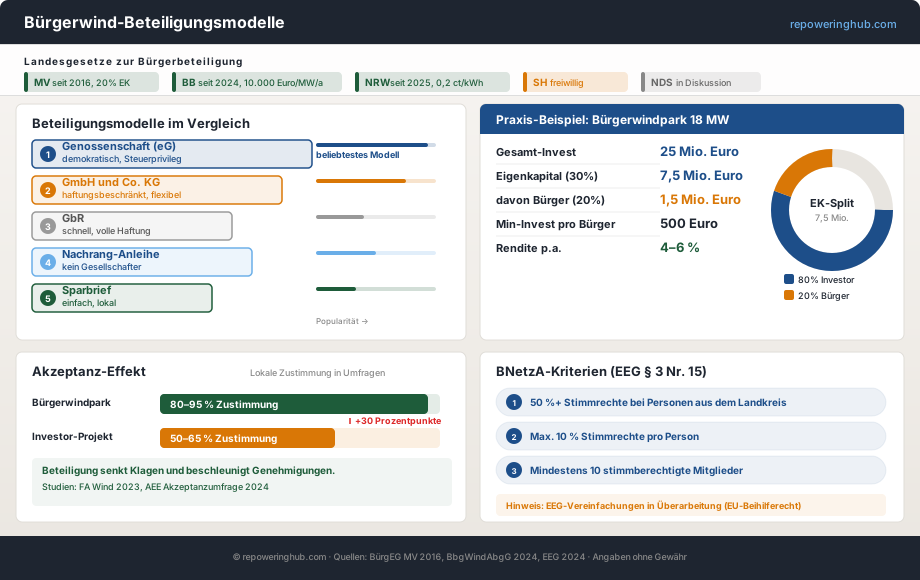
Community wind — participation models, mandatory states and acceptance effect
Community Wind Concept for Your Park?
We connect you with a specialist community wind law firm and a local bank for cooperative formation or GmbH & Co. KG structuring.
Get in TouchSetting Up a Cooperative Step by Step
Founding an energy cooperative for a specific wind project follows a fixed sequence in practice that needs several months of lead time and should therefore be scheduled early into the project timeline. A founding initiative — usually consisting of the project developer, interested residents and often a local savings bank (Sparkasse) or cooperative bank (Volksbank) as a partner — first drafts articles of association that set out in particular the minimum contribution, the distribution of voting rights, and the profit allocation formula. The articles and the founding report must then be reviewed by a cooperative auditing association (genossenschaftlicher Prüfungsverband, e.g. the regional cooperative association) — this audit is a legal requirement and usually takes several weeks. Only after a positive audit report can the cooperative be entered in the cooperative register at the competent local court. In parallel, the membership drive is organised, typically through information events in the host municipality, direct mailings, and the participating local bank acting as the subscription point.
Risks for Citizen Investors
Unlike a conventional savings product, a community wind participation is an entrepreneurial investment with corresponding risk — a disclosure that belongs in every serious participation offer. In most models, citizen capital is equity or equity-like subordinated capital and therefore ranks behind lenders (banks) in the repayment order in the event of insolvency. Revenue shortfalls from low-wind years, exceptional repairs, or a later decline in the market value achieved in the EEG auction first affect payouts to citizen shareholders before they threaten the bank financing. Important for prospective investors: a sales prospectus or key investor information sheet (Vermögensanlagen-Informationsblatt, VIB) is a legal requirement above certain thresholds for publicly advertised participations (Vermögensanlagengesetz) and should be read carefully before any subscription, as it must formally set out the opportunities and risks involved.
Distinguishing Community Wind from Simple Citizen Participation
In practice, a clear line is often not drawn between “genuine” community wind and a mere financial participation option, even though the two are treated differently under the law. Under the BNetzA definition, community wind in the narrower sense only exists where the majority of voting rights actually rest with natural persons from the region and no single individual holds more than 10 % — projects where an investor merely sells a small share to residents while retaining majority control themselves count as an investor project with citizen participation, not as community wind in the narrower sense. This distinction matters because certain EEG provisions and state programmes are tied to the narrower community wind definition, while plain citizen participation does not automatically trigger these privileges.
Communication and Building Local Acceptance
The observed acceptance effect of community wind models does not arise automatically merely from offering a participation stake — it depends heavily on how early and how transparently the host municipality is involved. Projects that communicate the participation offer only shortly before construction begins achieve, in developers' experience, markedly lower approval ratings than projects that work from the start of planning with information events, a local point of contact on the ground, and an open presentation of noise, shadow flicker and landscape impacts. Early involvement of the municipal council and local advisory boards is regarded in practice as one of the most effective levers for avoiding later legal challenges against the permit — alongside the technical expert reports from the permitting process.
Frequently Asked Questions
What are typical returns for community equity?
4–7 % p.a. fixed coupon — somewhat lower than investor equity (8–12 %), but more stable and with local connection.
What happens if not enough citizens invest?
The remaining shares are taken up by the project developer. Under MV mandatory participation, the offer must have been made — the quota counts, not whether all shares were subscribed.
How do community wind models affect the IRR?
Community equity typically receives 4–6 % fixed coupon. Remaining equity can carry higher return expectations. Overall approx. 0.5–1 percentage point IRR reduction for the sponsor.
Can a community wind participation be sold?
Usually only to a limited extent: cooperative shares are typically terminated by notice rather than sold (with notice periods often running several years), while subordinated bonds may in some cases be transferable during their term depending on contract conditions. A liquid secondary market practically does not exist for most community wind participations.