Land Lease for Wind Turbines
The land lease agreement with the site landowner is a central contractual element. It governs land use over the entire turbine lifetime (typically 25–30 years) plus options for repowering. Below are the standard market models, rates and key clauses.
Lease Models
| Model | Mechanism | Risk Allocation |
|---|---|---|
| Fixed lease | Fixed annual sum per turbine | Landowner security, operator risk |
| Variable lease | Percentage of electricity revenue | Landowner risk, operator security |
| Combined lease (standard) | Minimum fixed amount + variable component above revenue threshold | Shared risk — most commonly negotiated |
| Equity participation | Landowner becomes a shareholder | Full risk sharing — rare |
Market-Standard Lease Rates 2026
| Site Type | Fixed Lease/yr | Variable Lease | Minimum Lease Guarantee |
|---|---|---|---|
| Top site (3,000+ FLH) | 40,000–80,000 €/MW | 7–10% of revenue | 50,000–80,000 €/turbine |
| Standard site (2,500 FLH) | 30,000–50,000 €/MW | 5–8% | 40,000–60,000 €/turbine |
| Low-wind site | 20,000–40,000 €/MW | 4–6% | 30,000–50,000 €/turbine |
For a 6 MW turbine this often translates to 80,000–200,000 €/a in lease payments — distributed across the local municipality, landowner and rights-of-way holders.
Lease Allocation (Multiple Stakeholders)
- Site landowner: receives the largest share (60–80%)
- Rights-of-way holders: receive access fees (typically 5,000–15,000 €/a per access road)
- Local municipality: with voluntary participation 5–15% (in North Rhine-Westphalia mandatory since 2025 at 0.2 ct/kWh)
- Neighbouring landowners: in some models, compensation lease for noise/shadow impact
Contract Duration + Repowering Clause
- Primary term: 25–30 years (extends beyond the EEG subsidy period)
- Extension option: unilateral by the operator, often 2 × 10 years
- Repowering clause: allows lease adjustment when turbines are replaced
- Decommissioning guarantee: secured by a bond from the operator
- Price escalation clause: inflation adjustment (often CPI-indexed)
Rights of Way — Separate Contractual Matter
Access roads often require multiple agreements with different landowners. Typical access fees are 5,000–15,000 €/a per kilometre plus a road maintenance clause (asphalt protection). Cable routes are negotiated separately — usually as an easement registered in the land registry (Grundbuch) with a one-off payment of 10,000–50,000 € per route.
Tax Treatment
- Lease income for the landowner: income from renting and leasing (Vermietung und Verpachtung)
- For agricultural/forestry land: potential reclassification to commercial income
- With multiple turbines on one property: commercial classification often applies — involve a tax adviser
- Special case cooperative lease: partial tax privileges
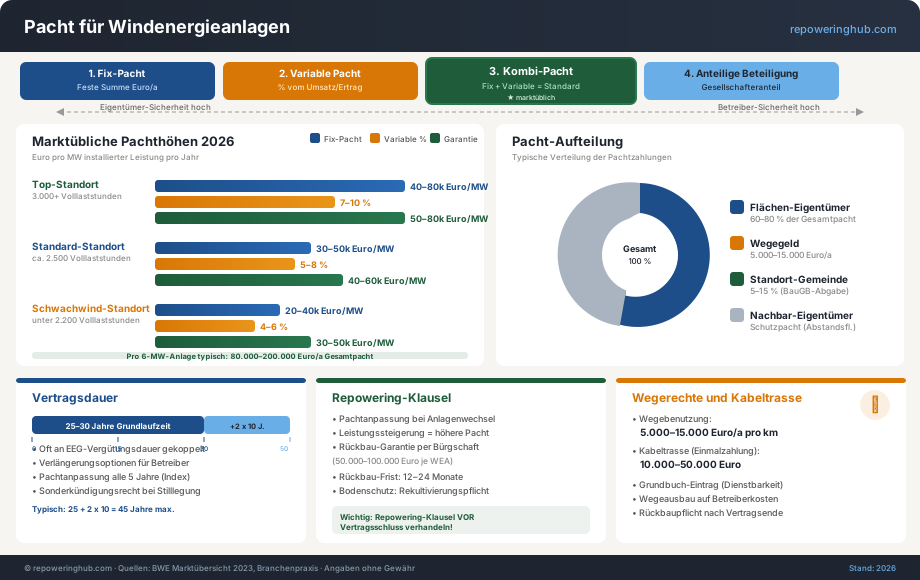
Wind turbine land lease — models, market rates 2026 and allocation
Lease Negotiation for Your Site?
We connect you with a specialist energy/real-estate law firm for the negotiation — market-standard terms and repowering protection.
Request a QuoteNegotiation Process — From First Contact to Signature
The path to a signature-ready lease agreement typically runs through several stages. It begins with the first approach to the landowner, often via a local land broker or directly through the project developer. An information phase follows, in which the landowner is briefed on turbine count, construction period, decommissioning obligations and the general contract structure — transparency at this stage considerably speeds up later negotiations. Only after that is a preliminary agreement or a usage option signed, giving the project developer the right to use the land for geotechnical surveys, foundation studies and the permitting process without yet concluding the final lease. The actual lease agreement is usually finalised only shortly before or after the BImSchG permit is granted, once turbine count, type and exact land requirements are fixed. Landowners are well advised to obtain independent legal counsel throughout this phase — template contracts from project developers are naturally drafted in the developer's favour.
Land Requirements per Turbine
The actual land footprint of a modern wind turbine can be roughly divided into three categories: the permanently sealed foundation area (several hundred square metres depending on turbine type and foundation design), the crane pad needed for erection and later maintenance work (often several times the foundation area, though usually returned to extensive agricultural use during operation), and access roads plus cable routes. In practice, what is leased is regularly not just the pure turbine footprint but a larger land corridor around the turbine that accounts for clearance and safety requirements as well as some site flexibility for the final construction layout. Because modern turbines have significantly larger rotor diameters than the legacy turbines of the 2000s, this land corridor is regularly larger for a repowering project than for the original one — a point often underestimated in lease negotiations over existing land.
Contractual Protection for the Landowner
Beyond lease rate and term, a number of further clauses are economically relevant for landowners. This includes the decommissioning bond: the operator must deposit financial security for the complete dismantling of the turbine including the foundation at the end of the contract, usually in the form of a bank guarantee equal to the estimated decommissioning cost. A provision for construction-phase compensation is also advisable, since agricultural land is temporarily unusable during erection and cable laying. Operator liability insurance in favour of the landowner for damage caused by turbine operation (such as ice throw or blade failure) also belongs in a robust contract. Finally, the question of the easement should be clearly regulated: without registration in the land registry, the lease may lose its effect against a new owner in the event of an ownership change — a significant project risk for the operator.
Regional Differences in Participation Models
The obligation for financial participation of host municipalities and residents is regulated inconsistently across Germany and is set at the state level. Mecklenburg-Vorpommern was among the first federal states with a mandatory participation requirement, offering residents within a radius around the wind farm an equity stake. North Rhine-Westphalia introduced a comparable obligation via its Wind Energy Participation Act, based on a cent amount per kilowatt-hour generated. Other federal states, by contrast, continue to rely on voluntary models, where the level of municipal participation is negotiated freely between the project developer and the host municipality — actual practice here varies considerably depending on negotiating position and competition for the site. Project developers with projects spanning multiple federal states should therefore review the applicable state-level requirements before contract negotiations, since a blanket nationwide contract template regularly falls short.
Common Negotiation Mistakes in Practice
A recurring mistake on the landowner side is underestimating the contract term: an agreement spanning 25 to 30 years plus extension options ties up the land across generations — succession planning for inheritance cases should therefore be considered from the outset. On the operator side, rework often arises when the repowering clause was drafted too narrowly and a later turbine with a larger rotor diameter or higher hub height is no longer covered by the original land release. Equally underestimated is often the routing of cable trenches across third-party land: if this is not secured in parallel with the main lease agreement through separate easement arrangements, a single uncooperative neighbouring landowner can delay the entire grid connection. Early, complete mapping of all affected parcels — including access roads and cable routes — significantly reduces this risk and should be completed before the actual lease negotiations begin.
Frequently Asked Questions
Does the landowner receive lease payments even without electricity production?
With a minimum lease guarantee: yes. With a purely variable lease: no — the landowner bears the full production risk. In practice, combined models are therefore almost always used.
How long should the repowering option run?
Standard: 30-year primary contract + option for an additional 20 years for repowering. This contractually secures a second turbine generation at the same site.
What happens when the landowner changes?
The lease agreement is registered as an easement in the land registry (Grundbuch) — it is binding on every successor owner. Registration in the Grundbuch is therefore mandatory in the contract.
Must all neighbouring residents receive lease compensation?
Not legally required, but common in community wind models. In Mecklenburg-Vorpommern it is mandatory — 20% equity participation must be offered to residents within a 5 km radius.