Site Selection for Wind Turbines
Site selection determines 70% of project success. Thorough preliminary screening avoids permitting failure, economic shortfalls and construction delays. The 8 criteria for a structured site assessment.
Criterion 1 — Wind Resource
The single most important parameter. Mean wind speed at hub height determines yield and economic viability. Thresholds:
- ≥ 8 m/s — top site (coast, ridgelines)
- 7.0–8.0 m/s — good site (northern Germany inland)
- 6.0–7.0 m/s — standard, low-wind turbine required
- < 6.0 m/s — economically critical
Data sources: on-site measurement, DWD Federal Wind Atlas, MERRA-2, ERA5.
Criterion 2 — Minimum Setback Distance to Residential Areas
State regulation + TA Lärm (Technical Instructions on Noise) protection distance. At many sites the limiting factor — the Setback Checker (DE) provides an indication. Typically 600–1,500 m depending on federal state and area type.
Criterion 3 — Protected Areas in the Vicinity
- FFH/SPA (Natura 2000) sites: 0 m tolerance, often 3+ km distance to conservation objectives required
- Nature reserves: generally an exclusion zone
- Landscape protection areas: exemption possible but risky
- Priority zones in regional planning: positive signal
Criterion 4 — Species Protection Conflicts
Raptor nest search within a 6 km radius (red kite 1.5 km close range, black stork 3 km). First through existing data from state nature conservation authorities, then dedicated surveys (DE).
Criterion 5 — Site Access
- Access roads: load-bearing capacity for 50-t trucks + 60-m heavy transport vehicles, minimum width 4 m
- Crane pad: 1,500–2,500 m² levelled per turbine
- Cable route: to the grid connection point, 50,000–100,000 EUR per kilometre
Criterion 6 — Grid Connection
- Existing transformer substation within 5 km desirable
- Grid operator preliminary enquiry ("grid connection request") to be obtained — 4–8 weeks
- Connection voltage 20 kV (medium voltage) or 110 kV (high voltage)
- Medium-voltage connection costs: typically 500,000–1,500,000 EUR per wind farm
Criterion 7 — Building Planning Law
The site must comply with § 35 BauGB (Federal Building Code, section on outer areas):
- Outer area (not in inner/contiguous development area)
- Concentration zone per land-use plan or WaLG relaxation in effect
- No conflicting public interests
Criterion 8 — Ownership / Lease
- Ownership or renewable lease agreements with all landowners
- Access rights for road and cable routes
- Lease payments at market rate: 6–10% of revenue (often combined with a fixed component)
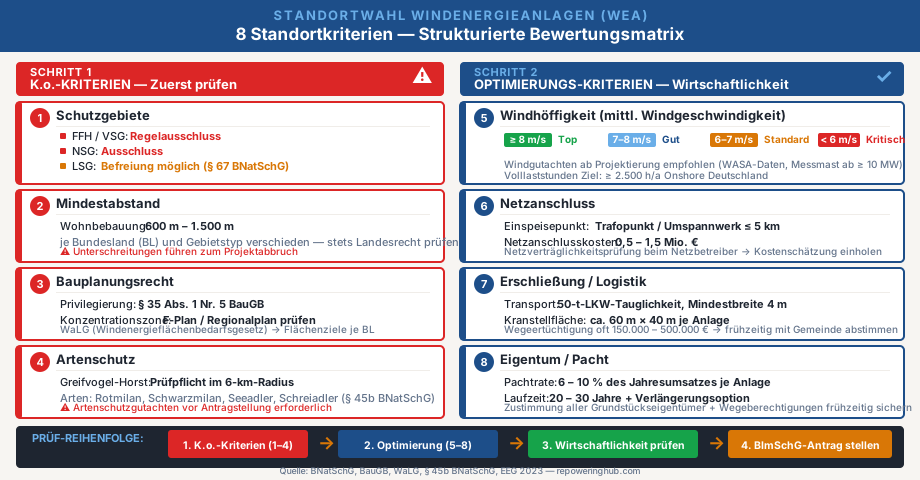
8 site criteria — check knock-out criteria first, then optimisation
Site check for your new-build or repowering project?
We connect you with a planning firm experienced in site pre-screening — rapid analysis of all 8 criteria in 2–4 weeks.
Get in touchPrioritising the Criteria in Practice
Not all eight criteria carry equal weight, and the order in which they are checked determines how project resources are deployed. A two-stage approach has proven effective: first, the four knock-out criteria (protected areas, minimum setback, building planning law, species protection) are cleared through a pure desktop review based on publicly available geodata — this costs little and filters out unsuitable sites early. Only once no hard stop is apparent here does the more resource-intensive second stage follow, with a rough wind resource estimate, a grid connection preliminary enquiry, and owner/lease outreach. Projects that reverse this order and invest in expensive wind measurements first risk sinking money into sites that ultimately fail on an easily checked knock-out criterion.
Map Sources and Geodata
For desktop pre-screening, most German federal states provide digital specialist maps: the states' geoportals with protected area boundaries (FFH, bird protection, nature conservation, landscape protection), the regional planning priority zones for wind energy, and the land registry cadastre for identifying owners. In addition, the wind area demand calculator under the WaLG (Wind Energy Area Act) provides, per federal state, the area target for 2027 and 2032 — an indicator of how far a given state currently still falls short of its own area contribution value, and therefore how much permitting pressure it is likely to exert in favour of new sites.
Common Mistakes in Site Pre-Selection
- Overestimating wind resource: relying on coarse wind atlas data without accounting for local terrain roughness or forest-edge effects leads to yield forecasts that are 10–20% too optimistic.
- Setback distance checked too late: if preliminary planning and the investment decision are already underway before the minimum setback to residential buildings has been properly surveyed, costly planning adjustments or a complete site failure can result.
- Underestimating landowner fragmentation: with more than 3–4 landowners per turbine site, the risk increases that individual negotiations delay the entire schedule.
- Development costs calculated generically rather than site-specifically: soft ground, long access routes or watercourse crossings can push development costs well above the rule-of-thumb estimate.
Site Selection in Repowering — Special Considerations
In repowering existing wind farms, the weighting of criteria shifts: the wind resource is already reliably known from years of operating the existing turbine, and much of the development infrastructure (access roads, cable route, grid connection point) partly remains in place. The focus then shifts more to whether the planning-law framework has changed since the original permit (for example through new protected-area designations or a revised concentration zone plan), whether the existing grid connection point is sufficient for the higher capacity of the new turbine generation, and whether the required minimum setback to residential buildings changes due to larger rotor diameters and higher hub heights. Details in the repowering section.
Role of the Municipality and Public Participation
Even where regional planning and the land-use plan formally release a site for wind energy, local political acceptance often determines the project timeline. Early, transparent communication with the municipal council, together with a participation offer under section 6 of the EEG 2024 (financial participation for the host municipality), typically reduces the number of objections during the permitting procedure and thereby shortens the process. Sites with noticeably high local opposition — for example due to prior conflicts in the community — should be flagged as an additional risk during pre-screening, even if all eight hard criteria are met.
Documenting the Site Assessment for the Permitting Authority
A structured, traceable documentation of the site pre-screening pays off later in the BImSchG procedure: the permitting authority will in any case require evidence on setback distances, protected-area impact and site development. Anyone who compiles this information during the pre-screening phase into a site file with map extracts, source references and query dates saves time during the application process and avoids the authority's follow-up questions about outdated or contradictory data.
Frequently Asked Questions
How long does a site pre-screening take?
2–4 weeks for the desktop analysis of all knock-out criteria. Reliable wind data take considerably longer (3–12 months of measurement or long-term correlation).
What does it cost?
Desktop pre-screening 5,000–15,000 EUR. With long-term wind correlation + desktop noise assessment + species protection preliminary review 25,000–50,000 EUR.
Who decides when criteria conflict?
The applicant — typically in consultation with the responsible permitting authority and, in the case of repowering, the municipality. Where economics are marginal, trying a second site often makes more sense than forcing the issue.