Operating Costs of a Wind Turbine
OPEX (Operating Expenditures) are the ongoing costs during the turbine's lifetime. For modern onshore turbines: typically 20–30 €/MWh during the first 10 years, rising moderately thereafter due to wear. Seven cost blocks shape the OPEX profile.
OPEX Breakdown
| Item | Value | Notes |
|---|---|---|
| Maintenance & service (manufacturer contract) | 8–14 €/MWh | Full-service contract with 95–98% availability guarantee |
| Insurance (machinery breakdown + liability) | 1.5–3 €/MWh | Rises significantly after warranty expiry |
| Land lease (site + rights of way) | 4–8 €/MWh | Often a combination of fixed + variable |
| Direct marketer fee | 1–3 €/MWh | Commission for EEG/PPA marketing |
| Administration / asset management | 1–2 €/MWh | Commercial operations management |
| Turbine self-consumption | 0.3–0.8 €/MWh | Controls, cooling, aviation lighting |
| Decommissioning reserve | 0.5–1.5 €/MWh | Accrued over lifetime |
| Miscellaneous (taxes, fees) | 1–3 €/MWh | Property tax, trade tax share |
| Total | 17–35 €/MWh | Median approx. 24 €/MWh |
Maintenance Models in Detail
- Full-service contract with manufacturer (standard): lump sum per MWh produced; the manufacturer bears the repair risk and guarantees availability. Duration 10–15 years. Advantage: predictable costs.
- Basic service + self-managed major repairs: cheaper under normal operation, but risk exposure in case of major damage. Suited to very robust turbine types with experienced operators.
- Independent Service Provider (ISP): third-party providers (e.g. Deutsche Windtechnik, Availon, BayWa r.e. Service). After warranty expiry, often 20–30% cheaper than OEM contracts.
Lease Models
- Fixed lease: fixed annual sum per turbine (typically 30,000–80,000 €/a)
- Variable lease: percentage of electricity revenue (typically 6–10%)
- Combined lease: minimum fixed amount + top-up when revenue exceeds threshold (most common model)
- Rights of way for access: one-off contract, usually not an ongoing charge
OPEX Trajectory over Lifetime
| Year | OPEX Level | Explanation |
|---|---|---|
| 1–5 | 20–25 €/MWh | Low maintenance, warranty period |
| 6–10 | 22–28 €/MWh | Standard maintenance, occasional repairs |
| 11–15 | 25–32 €/MWh | Generator replacement, gearbox overhaul possible |
| 16–20 | 30–40 €/MWh | OEM support ends, repairs become more costly |
| 20+ (post-EEG) | 30–50 €/MWh | Repowering decision pending |
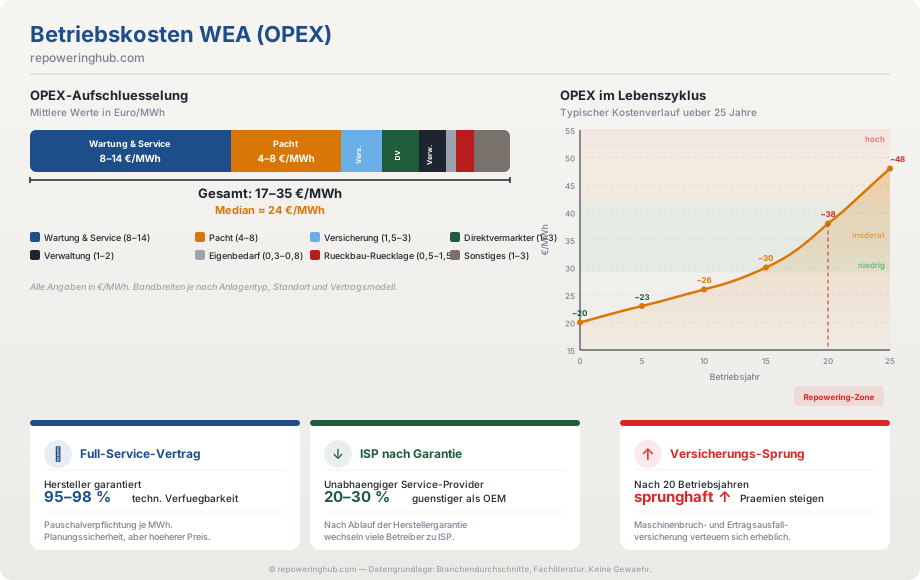
OPEX breakdown and cost trajectory over the turbine lifetime
How to Reduce OPEX
- Fleet bundling for service: per-turbine service costs fall with group contracts
- Predictive maintenance with turbine sensors: detect major faults early
- Extended warranty contract: often cheaper than switching to an ISP
- ISP competition after warranty expiry: regular provider comparisons
- Optimised asset management platform: digital tools (e.g. Greenbyte, Bazefield) reduce administrative costs
OPEX Optimisation for Your Turbines?
We connect you with a wind asset manager or ISP for a maintenance contract comparison + predictive maintenance concept.
Request a QuoteContracting Models: Full-Service vs. In-House Operations
Beyond the pure maintenance question, larger operators also decide whether commercial and technical operations management is outsourced or handled in-house. Operators with one to three turbines almost always do better with an external asset manager, because the fixed costs of an in-house department (staff, software licences, 24/7 standby) only pay off from a certain fleet size upwards — as a rough rule of thumb, own staff typically becomes economically viable from around 50–80 MW of installed capacity. Larger portfolio operators with several wind farms, by contrast, frequently bundle technical operations management and commercial operations management into their own corporate unit, because economies of scale amortise faster across many turbines than through external contracting. Switching between the two models is legally straightforward but practically bound to the notice periods of existing contracts (usually 6–12 months).
Tax Treatment of Operating Costs
For tax purposes, the basic rule is: ongoing maintenance, insurance and lease expenses are immediately deductible operating expenses that reduce taxable profit in the relevant financial year. Larger repairs such as a gearbox or generator replacement can, depending on scope and character, qualify as capitalisable subsequent production costs and must then be depreciated over the remaining useful life rather than deducted immediately — this distinction should be clarified with a tax advisor specialising in renewables where in doubt, since valuation judgement calls arise regularly here. The decommissioning reserve itself is not deductible as an operating expense as long as it is only accrued on the balance sheet but not actually spent; only the later decommissioning itself triggers the tax-relevant expense. For trade tax purposes, part of the lease payments also counts as an add-back item under section 8 no. 1 of the German Trade Tax Act (GewStG), which slightly increases the effective tax burden.
OPEX Differences by Turbine Type and Site
The 17–35 €/MWh OPEX range conceals substantial differences depending on turbine type and site. Low-wind turbines with a large rotor and moderate rated power tend to achieve more full-load hours, but because of the higher rotor blade loading they typically require more extensive blade inspections and sit towards the upper end of the maintenance cost range per MWh. Turbines near the coast or in exposed elevated locations show, on average, higher insurance premiums than inland sites in sheltered locations, due to greater mechanical stress and harsher weather (salt air, icing, more frequent lightning strikes). Accessibility also plays a role: turbines in difficult terrain — for example in forests or on steep slopes — incur noticeably higher call-out and crane-positioning costs for unplanned repairs, because larger equipment cannot easily be brought up to the turbine.
Setting OPEX Correctly in the Economic Model
When building a financing model, OPEX is often set too optimistically, because early manufacturer quotes frequently only reflect the first contract years, when the turbine still runs under full warranty. For a robust LCOE calculation over the full lifetime, it is advisable to explicitly model the staggering shown in the OPEX trajectory section above (rising costs from year 11 onward) rather than assuming a constant average value over 20 years — otherwise economics look too favourable in the early operating years and too poor in later years. Banks and lenders generally require a conservative OPEX assumption with a safety margin anyway when reviewing financing, often in the form of a debt service reserve account that holds additional liquidity for unforeseen repairs.
Frequently Asked Questions
What happens if the turbine stands idle for an extended period?
Fixed costs (lease fixed component, insurance base premium, direct marketer base fee) continue to accrue. Downtime only reduces the variable OPEX. In the worst case, 30–40% of OPEX remain as standby costs.
How do electricity price fluctuations affect OPEX?
Indirectly — through the variable lease (higher lease when electricity prices are high) and the direct marketer fee (often percentage-based). Cost pressure increases when electricity prices are low.
What are standard availability guarantees?
Manufacturer guarantees typically cover 95–98% technical availability. If availability falls below the threshold, the manufacturer pays compensation (typically 30–50 €/MWh penalty).
Is an in-house operations department worthwhile?
As a rule of thumb, only for larger portfolios (several wind farms or well above 50 MW total capacity), because the fixed costs for staff and systems only amortise from that point onward. Smaller operators are usually better off with external asset management.