Wind Repowering in Berlin
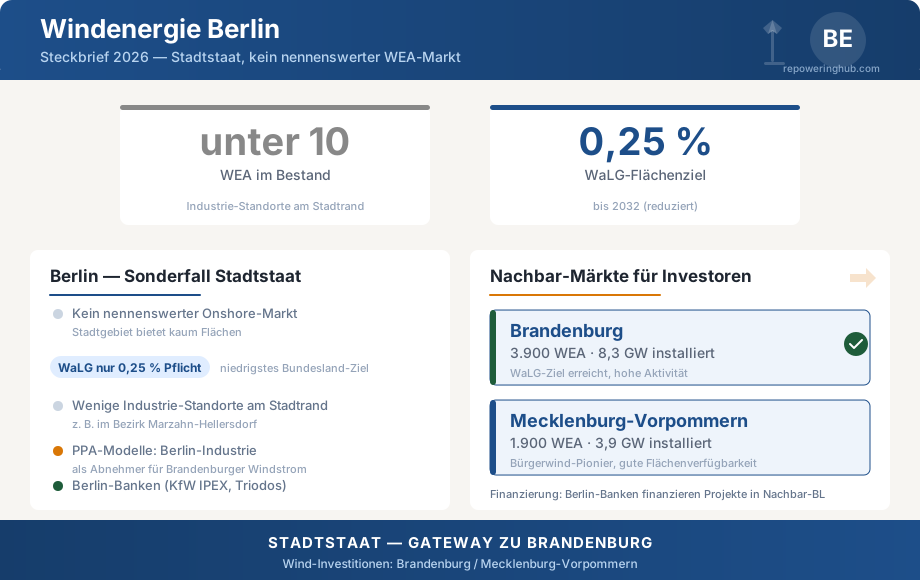
Berlin is a city-state — not a meaningful market for wind turbines of relevant size. The WaLG (Wind Energy Areas Requirement Act) obligation is reduced to 0.25%; the few wind sites lie on the city's outskirts, often in conflict with neighbouring development. That does not make Berlin irrelevant for the wind industry, though — as the federal capital, a capital market and the largest single offtaker in the region, the city is a central demand and financing hub for wind projects that are overwhelmingly built in the surrounding states.
Berlin as a Federal Policy and Regulatory Hub
One factor no other federal state shares in this form: Berlin is home to the Bundesnetzagentur (Federal Network Agency), the Federal Ministry for Economic Affairs, and the wind industry's trade associations (the BWE federal office), which set the nationwide framework for tenders, EEG subsidy rates and permitting law. For developers with a nationwide portfolio, proximity to regulation and association work is a concrete reason to base head offices in Berlin, even though the actual wind farms stand in Brandenburg, Mecklenburg-Western Pomerania or Saxony-Anhalt. Anyone who needs to track federal-level developments around EEG 2024 and tender design has short distances to the ministry, the Bundesnetzagentur and industry associations in Berlin.
Market Data
| Installed turbines | < 10 turbines (industrial sites) |
| WaLG target | 0.25% by 2032 |
Recommendation for Investors
For wind investments out of Berlin, look to neighbouring Brandenburg (3,900 turbines, high repowering activity, WaLG target already met) or Mecklenburg-Vorpommern (community-wind pioneer). Both states offer what Berlin structurally cannot: a substantial fleet of legacy turbines, established wind regions and the developed sites that make repowering worthwhile in the first place. For a Berlin-based investor, the practical path therefore runs through projects in the surrounding region rather than within the city boundary.
Related Topics
- PPA models: Berlin industry as a potential offtaker for Brandenburg wind power
- Financing: Berlin banks (KfW IPEX, Triodos) finance wind projects in the neighbouring federal states
Participation Models: Berlin Capital, Brandenburg Turbines
For Berlin-based private and institutional investors who want to participate in wind energy without owning sites themselves, two routes have become established. First, community-wind and cooperative models, in which Berlin capital flows into Brandenburg or Mecklenburg project companies, often with a regional pre-emption right for residents at the actual site. Second, closed or open infrastructure funds based or distributed out of Berlin that hold diversified wind portfolios across several federal states. Both models presuppose that the underlying projects — including expert reports and the BImSchG permit — are cleanly processed in the respective host state; the capital side in Berlin typically scrutinises exactly these documents as part of due diligence.
Permitting in Berlin
The responsible authority is the Senate Department for Mobility, Transport, Climate Protection and the Environment (SenMVKU). The BImSchG (Federal Immission Control Act) permit is processed through the State Office for Occupational Safety, Health Protection and Technical Safety (LAGetSi). Owing to the dense built-up area, stricter immission limits effectively apply (mixed/residential area instead of the unzoned outer area), which severely restricts the permitting feasibility of onshore wind turbines.
Ground-Mounted PV on the City Outskirts
More relevant than wind is solar energy: Berlin promotes rooftop PV (Masterplan Solarcity), while ground-mounted PV emerges occasionally on former railway land and along motorway verges. For large-scale solar parks, the same applies as for wind — the available land lies practically in Brandenburg. The Senate Department is targeting an installed PV capacity of 4.4 GWp within the city by 2035 — primarily through rooftop and façade systems.
Berlin as a Financing and Fund Location for Wind
Beyond federal policy, Berlin is a growing location for infrastructure and renewables funds, family offices and investment companies that channel capital into the wind and solar parks of neighbouring states. The structure resembles other European capitals: capital is managed centrally, while investment happens decentrally, wherever the land and wind resources are. For a repowering project in Brandenburg or Mecklenburg-Western Pomerania, this can mean that both the financing fund and the accompanying law firm or audit firm are based in Berlin, while the site, permitting and operation take place entirely in the host state. This separation of capital location and asset location is not a special case in the wind industry but the rule in metropolitan areas — comparable to the role Hamburg plays for the wind industry as a whole.
Berlin Industry as a PPA Buyer
As Germany's largest city, Berlin has a correspondingly high commercial and industrial power demand — from data centres to rail infrastructure to manufacturing businesses in the surrounding commuter belt. For operators of Brandenburg wind farms, Berlin is therefore an obvious sales market for long-term power purchase agreements: short transmission distances, high baseload and a politically desired share of green electricity in public procurement. This demand side is a structural advantage for repowering projects in Berlin's surrounding region, because it opens an additional marketing option alongside the EEG market premium and diversifies a project's revenue base.
What repowering practically means for Berlin
Repowering — replacing legacy turbines with a few larger, higher-yield ones — presupposes a stock of legacy turbines. That is exactly what Berlin lacks: the fewer than ten turbines in the city stand on industrial and commercial sites and are not classic repowering candidates. Anyone who, as a Berlin actor, wants to invest in wind repowering effectively does so via sites in the surrounding region. Three routes are common in practice:
- Direct investment in the surrounding region: participation in repowering projects in Brandenburg. Whether a specific legacy site pays off can be roughly gauged in advance with our free calculators — the reliable calculation is produced by an engineering firm with site data.
- Power offtake instead of turbine ownership: Berlin commercial and industrial operations secure long-term green electricity from Brandenburg wind and solar parks via a PPA, without operating turbines themselves.
- The capital side: through financiers based in Berlin, capital flows into projects in the neighbouring states; the structure does not differ from an on-site project finance (see Financing).
In short: for wind energy, Berlin is not a site market but a demand and capital market. The actual project development — including the BImSchG procedure and expert surveys — takes place in the surrounding region.
Why This Division of Roles Is Unlikely to Change
Even as the WaLG area target rises, Berlin remains a densely built city-state without relevant outlying land for privileged wind turbines under § 35 BauGB. The 0.25% area share the state must designate can realistically only be covered through existing sites in industrial and port areas, not through new wind farms. For investors with Berlin-based capital or headquarters, wind energy therefore remains structurally a demand and financing story — anyone seeking operator returns has to look for the site in the surrounding region, even while planning and financiers continue to work out of Berlin.
Wind energy in Berlin – city-state and gateway to Brandenburg
Planning a wind or solar project in or around Berlin? We connect you with engineering firms and developers active in Brandenburg and the surrounding region.
Get in touch