Wind Energy in Mecklenburg-Western Pomerania
Mecklenburg-Western Pomerania (MV) combines two things that rarely come together for repowering: a windy coastal region and a legally anchored model of community participation. Anyone replacing an old turbine here is planning at one of Germany's highest-yielding onshore sites — but must at the same time bring residents on board financially. This combination shapes every project in the state.
Site Quality: Coastal Proximity and Full-Load Hours
Proximity to the Baltic Sea is the economic core of MV as a wind location. Near-coastal and coast-parallel positions reach mean wind speeds noticeably above inland values — and higher wind speeds translate disproportionately into yield, because power grows with the cube of wind speed. In practice this means higher full-load hours for many MV sites than in the south of the country. For repowering the effect is doubly attractive: modern turbines with greater hub heights tap the steadier higher-altitude winds, and the higher specific utilisation lowers the levelised cost of energy. How much a specific site benefits can be gauged in advance with the repowering economics analysis.
| Turbine fleet | approx. 1,900 turbines |
| Installed capacity | 3.9 GW |
| Repowering candidates 2026–2030 | approx. 400 |
| Community-wind share | > 50% of all projects |
The Citizen Participation Act as a State Feature
In 2016 MV was the first federal state with a mandatory community participation in wind projects. The Citizen Participation Act (Bürgerbeteiligungsgesetz) requires project developers to make a 20% participation offer to residents within a 5 km radius as well as to the host municipality. The fine mechanics are decisive: the shares must be offered on defined terms — what is mandatory is the offer, not the actual subscription. In practice, cooperatives (Genossenschaften) or a GmbH & Co. KG (limited partnership) serve as the participation vehicle, often with low minimum contributions so that as many households as possible can take part. The mandate also applies to repowering, so the participation structure belongs early in the project calculation. The general framework derives from the Wind Energy Areas Act (WaLG), which is supplemented at state level.
Permitting, Area Target and Authorities
MV forgoes a blanket minimum setback; decisive for noise protection is the TA Lärm (technical noise abatement standard) on a case-by-case basis. The permitting authority is the respective district (Landkreis), technically supported by the Landesamt für Umwelt, Naturschutz und Geologie (State Office for Environment, Nature Conservation and Geology, LUNG). The state's WaLG area target of 2.1% has already been met — the designated concentration zones take effect, with exclusion applying in principle outside them. For repowering this means: within existing suitability areas the planning basis is solid, while the species-protection part of the BImSchG procedure forms the critical path.
- Minimum setback: no blanket state rule, TA Lärm is decisive
- Authority: the district (Landkreis) is the permitting authority, LUNG is the technical authority
- WaLG target: 2.1% by 2032; current status: met
- Community-wind mandate: 20% participation offer to residents (5 km) + host municipality
- Species protection: black stork, white-tailed eagle (Bodden coast), lesser spotted eagle in the east
Near-Coastal Species Protection
The favourable coastal location has a nature-conservation flip side: the Bodden and coastal landscape is habitat for collision-sensitive large birds. The white-tailed eagle characterises the Bodden coast; in the east of the state the particularly disturbance-sensitive lesser spotted eagle is added, and the black stork is also widespread. For repowering projects near the coast a robust bird survey is therefore the decisive building block — including a review of curtailment algorithms where conflicts with the ban on killing exist.
Permitting Practice: BImSchG Procedure and Authority Path
The permitting procedure under the BImSchG (German Federal Immission Control Act) runs in MV through the district as the lower immission-control authority; repowering projects subject to an environmental impact assessment additionally require a formal environmental impact assessment, whose sequence is described in the relevant section. LUNG is consulted throughout as the technical body responsible for species protection and immission control. A repowering application at the same or a larger turbine location generally benefits from the grid connection and site data already established for the old turbine — but this does not automatically shorten the procedure, because noise and shadow-flicker forecasts have to be produced afresh for the greater hub height. For the acoustic assessment the TA Lärm applies, and depending on the distance to the nearest residential development it requires its own noise immission forecast.
Grid Connection and Grid Expansion: the 50Hertz Control Area
MV lies in the control area of transmission system operator 50Hertz. The coastal location brings a particular feature: onshore wind power from MV competes in the grid partly with the landing points of the Baltic Sea offshore wind farms, which feed into the supraregional grid via the same routes. For repowering projects this means clarifying the grid connection with the responsible distribution system operator early, rather than relying solely on the capacity of the old turbine — especially on heavily loaded coastal sections, the connection commitment can become the limiting factor in the project timeline. Where repowering requires a higher connection capacity than the predecessor turbine, an early dialogue with the grid operator alongside the permitting application pays off.
Repowering Opportunities: the Wind Energy Decree and the Existing Fleet
The Mecklenburg-Western Pomerania wind energy decree specifies how repowering within existing suitability areas is to be treated, creating planning certainty for projects that do not significantly exceed the spatial footprint of the old turbine. With around 1,900 existing turbines and a designated repowering potential of roughly 400 turbines through to 2030, MV is among the states with a particularly dense stock of old turbines from the early 2000s — many of these turbines are approaching the end of EEG funding and thus the point at which replacement with more powerful turbines becomes economically attractive. The area profile of the coastal region is doubly favoured here: already developed sites and high wind speeds lower the investment risk compared with new planning on undeveloped land.
Regional Features: Tourism and Landscape Character
MV is shaped by tourism — the Baltic Sea coast, the Bodden landscape and the Mecklenburg Lake District count among the state's central economic factors. This regularly leads to conflicting goals between wind energy build-out and landscape protection, especially in coastal and lake-rich areas with a high recreational function. Repowering projects that replace an old turbine with fewer but taller and more powerful turbines can ease this conflict, because the number of turbines in the landscape often falls. The assessment of landscape character is a fixed part of the permitting documents and is in practice coordinated closely with the species-protection procedure. Anyone wanting an overview of the technical terms used will find guidance in the portal's glossary.
Regionally Active Engineering Firms
- WIND-Projekt GmbH (Börgerende) — project development + community wind
- ENERTRAG (Dauerthal, near BB) — wind + hydrogen
- NORD/LB Greifswald — financing
- LUNG (Güstrow) — nature conservation technical authority
Competition and Market Structure
Compared with Lower Saxony or Schleswig-Holstein, the number of large project developers in MV is modest. For landowners and municipalities this means, on the one hand, fewer competing offers and, on the other, a tighter circle of experienced contacts with proven community-wind practice. Since many of the existing cooperatives have been in the market for years, there is a wealth of experience here for structuring participation that smooths the way for repowering projects. The modest market structure makes a careful choice of planning partner all the more important — especially because the combination of coastal species protection and statutory community participation demands specialised know-how. A structured project planning brings these strands together from the start.
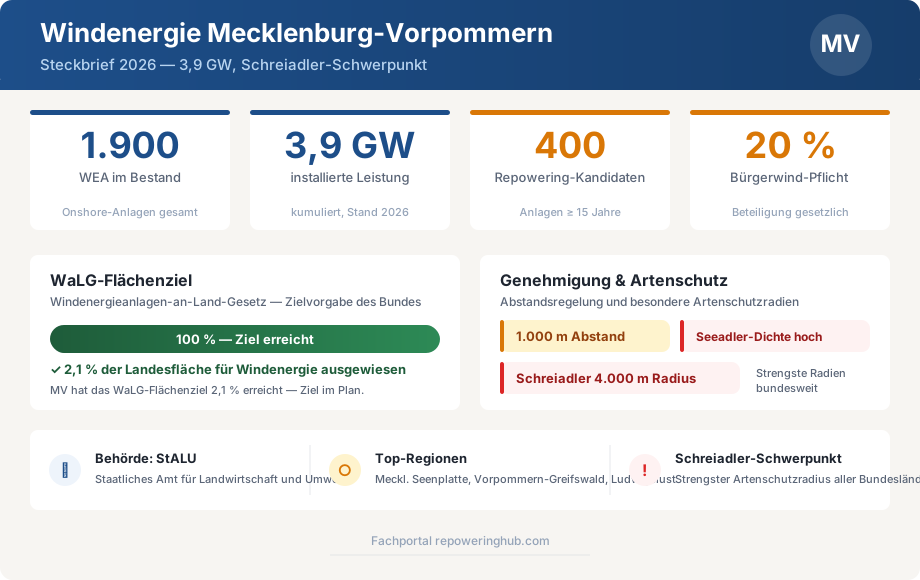
Wind energy in Mecklenburg-Western Pomerania – market data, WaLG status and permitting framework
Coastal site in MV — repowering with community participation?
In MV two things decide project success: the right community participation structure under state law and a coast-ready species-protection record. We connect you with energy lawyers for the participation structuring and with developers experienced on the MV coast.
Submit an enquiry