Wind Repowering in Saarland
Saarland is Germany's smallest territorial state (city-states aside) — and at the same time the state with the most pronounced history of industrial structural change. The exit from hard-coal mining left behind land, grid infrastructure and an energy-policy self-image that shape the renewables build-out today. This overview deliberately reads Saarland's wind energy not as a miniature of a large state but from its own logic: scarce space, targeted site selection and the chance to think the coal structural change through to its energy-economic end.
From coal country to renewables location
For more than a century Saarland was a coal and steel region. As mining wound down, conversion areas, former mining sites and industrially pre-shaped locations became free — land that is often easier to activate for the energy transition than untouched countryside, because it is already developed and has existing impact. For wind energy the structural change means above all one thing: the state does not have to organise the build-out across the board but can concentrate it on a few, specifically suitable sites. Repowering at existing wind sites fits this logic — modern turbines replace older ones without taking up additional undeveloped land.
Market data
| Turbine fleet | approx. 200 turbines |
| Installed capacity | 0.4 GW |
| Repowering candidates 2026–2030 | approx. 50 |
| Top region | Saar-Pfalz uplands |
With a fleet of around 200 turbines the Saarland market is compact — but that does not make it unimportant: with around 50 repowering candidates by 2030, every single site contributes noticeably to the state balance. In a small market, site quality counts for more than volume; our free calculators help to classify the potential of a specific legacy turbine.
Few but targeted areas under WaLG pressure
Despite its size, the same area target applies to Saarland as to large states: 1.8% of the state's land for wind energy by 2032 under the Wind Energy Areas Act. The current status of around 0.5% shows a delay. In limited space, meeting this target is demanding — it forces a particularly careful, targeted site selection rather than large-scale designation. The windiest area is the Saar-Pfalz uplands. For projects on freed-up conversion areas the building-law starting position can be more favourable than in the unburdened outer area; the privilege under § 35 BauGB is covered on the page § 35 BauGB.
Proximity to France and Lorraine
Saarland borders directly on France and lies at the tri-border point with Rhineland-Palatinate and Lorraine. For wind energy this location is relevant in two ways: first, projects with a cross-border immission-control dimension cluster here — noise and shadow-flicker forecasts sometimes also have to take French neighbouring towns into account, which makes the noise immission forecast and the shadow-flicker assessment methodologically more demanding than for a purely domestic German site. Second, the Saarland economy is closely interwoven with Lorraine and Luxembourg industry, which makes cross-border electricity supply contracts fundamentally conceivable, even though they are regulatorily more complex than domestic PPA models.
Grid connection as a location advantage
An often underestimated advantage of the structural change concerns grid infrastructure. The coal and steel past left Saarland with a comparatively dense network of substations and lines that carried high connection capacities at industrial sites. For wind and hybrid projects, proximity to existing grid infrastructure can simplify the grid connection and lower development costs — a factor that weighs all the more heavily in a small state with a limited choice of sites. Whether a specific site benefits depends on the free capacity at the respective grid connection point and must be clarified with the grid operator case by case; the basic repowering logic is set out on the page Repowering.
Permitting & law
- Minimum setback: no blanket rule
- Authority: Landesamt für Umwelt- und Arbeitsschutz (State Office for Environment and Occupational Safety, LUA)
- WaLG target: 1.8% by 2032; current level: approx. 0.5% — behind schedule
- EEG South bonus: applies — +0.30 ct/kWh
Authorisation is granted as a procedure under the BImSchG (German Federal Immission Control Act) — the sequence and deadlines are explained on the page BImSchG procedure. The EEG South bonus of +0.30 ct/kWh under the EEG 2024 economically offsets the only moderate wind conditions and is the decisive calculation factor for many Saarland sites.
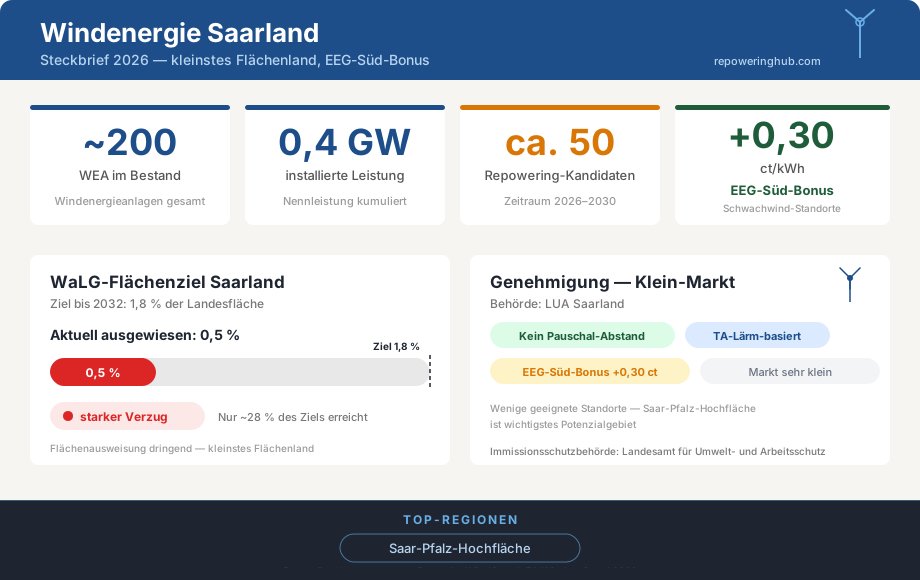
Wind energy in Saarland – market data, WaLG status and permitting framework
Repowering Instead of New Designation: the Realistic Growth Track
With a WaLG shortfall and a scarce area supply, designating entirely new wind priority areas is politically and in planning terms demanding — every additional area has to be pushed through against competing uses in densely settled Saarland. Repowering at the roughly 200 existing sites is by contrast the planning-wise simpler path: the areas are already secured as wind priority areas, grid connection and site development exist, and local acceptance is generally higher than for newly designated areas. For the roughly 50 Saarland repowering candidates through to 2030 this means: anyone replacing old turbines with 1980s or early-2000s technology with modern, significantly taller turbines can multiply the installed capacity at the same site without additional land being newly taken up. In Saarland this is not a side effect but the main lever for bringing the WaLG target into reach at all.
Wind and ground-mounted PV on conversion areas
Alongside wind, the structural change also opens opportunities for ground-mounted PV: global irradiation in Saarland, at 1,050–1,100 kWh/m², is at the upper end for Germany. Conversion areas of former mining sites offer privileged locations for solar parks. The combination of the EEG South bonus for wind and good irradiation for PV makes Saarland attractive for hybrid projects — especially where existing grid connections from the mining era can be reused.
Regionally active players
- Energis (Saarbrücken) — regional energy provider
- juwi AG (Wörrstadt, active in Saarland) — project development
- LUA Saarland — environmental authority
Repowering on Saarland conversion and wind sites?
In the smallest territorial state, the quality of the individual site is decisive — from South-bonus economics to the reuse of developed mining areas. We connect you with planning offices that have concrete Saarland experience.
Send enquiry